


Will Hot CPI Force the Fed to Hike in September After Strong Jobs Data?
 Blockbeats
Editor's note: CPI could be the most important economic data before the Fed's September meeting. Previously, the Fed could still treat tariffs and energy shocks as temporary factors and remain patient on the grounds of downside risks to the labor market; but the stronger-than-expected August jobs report weakened that argument, shifting the policy discussion back to inflation.
Mott Capital Management believes the Fed now faces not "how high must CPI be to justify a hike," but "how low must CPI be to prevent a hike." The market expects August headline CPI month-over-month growth to widen from 0.1% to 0.4%, with services costs and energy prices posing further upside risks. If the data meets or exceeds expectations, the probability of a September rate hike could rise significantly.
Meanwhile, the 2-year Treasury yield near 4.4% is also signaling tightening. However, bond yields reflect policy rate expectations as well as term premiums, inflation expectations, and supply-demand shifts, so they cannot be simply read as a direct forecast of the number of future Fed rate hikes. They better indicate that the market remains wary of continued monetary tightening.
Below is the translated original:
CPI is becoming the key variable for the September decision
Fed Governor Christopher Waller's recent remarks, whether intentional or not, have further heightened market attention on the August CPI report.
Waller said his monetary policy decisions will depend heavily on economic data. If inflation continues to make progress toward the Fed's 2% target, he would support keeping policy unchanged and is willing to be patient.
This means the August CPI could send a relatively clear signal to the market: whether investors need to fully price in the possibility of a Fed rate hike before the September 16 meeting.
At the same time, the stronger-than-expected August jobs report shows the U.S. labor market remains resilient. This makes it harder for the Fed to keep delaying its response to inflation risks on the grounds of a clear weakening in employment.
Combined with Fed Chair Warsh's speech at the Jackson Hole symposium on August 28, unless the August CPI delivers a significant downside surprise, the difficulty of the Fed staying on hold in September may be rising.
The "burden of proof" for policy decisions may have shifted. The Fed may no longer need exceptionally strong data to justify a rate hike; instead, it may need CPI to come in clearly below expectations to provide sufficient grounds for keeping rates unchanged.
Market expects headline CPI to rebound sharply
That is why this CPI report is far more important than in recent months. It could be the missing piece for a September rate hike. The market already expects August inflation to be relatively hot, so even if the final data merely meets expectations, it may not reduce the probability of a rate hike.
Analysts expect August headline CPI to rise 0.4% month-over-month, significantly higher than July's 0.1%; the year-over-year rate is expected to hold at 3.4%. Core CPI is expected to rise 0.2% month-over-month, unchanged from July; the year-over-year rate may edge down from 2.5% to 2.4%. Prediction markets like Kalshi reflect similar expectations.
This set of forecasts shows a divergence: the core inflation year-over-year reading may improve slightly, but driven by energy prices, headline inflation will accelerate notably on a monthly basis. For the Fed, this means inflation may still be cooling slowly, but short-term price pressures are far from gone.
More concerning is that the final data still carries upside risk.
The August ISM services survey showed a clear rise in business cost pressures. The Prices Paid Index rose from 70.3 in July to 72.6, also higher than June's 67.7. Historically, changes in this indicator have some synchronicity with CPI trends. While not a strict one-to-one relationship, the current reading suggests services inflation may remain sticky.
Energy prices could also push up August inflation. Higher gasoline prices feed directly into headline CPI; higher diesel prices increase logistics and transportation costs, which may gradually pass through to a broader range of goods and services.
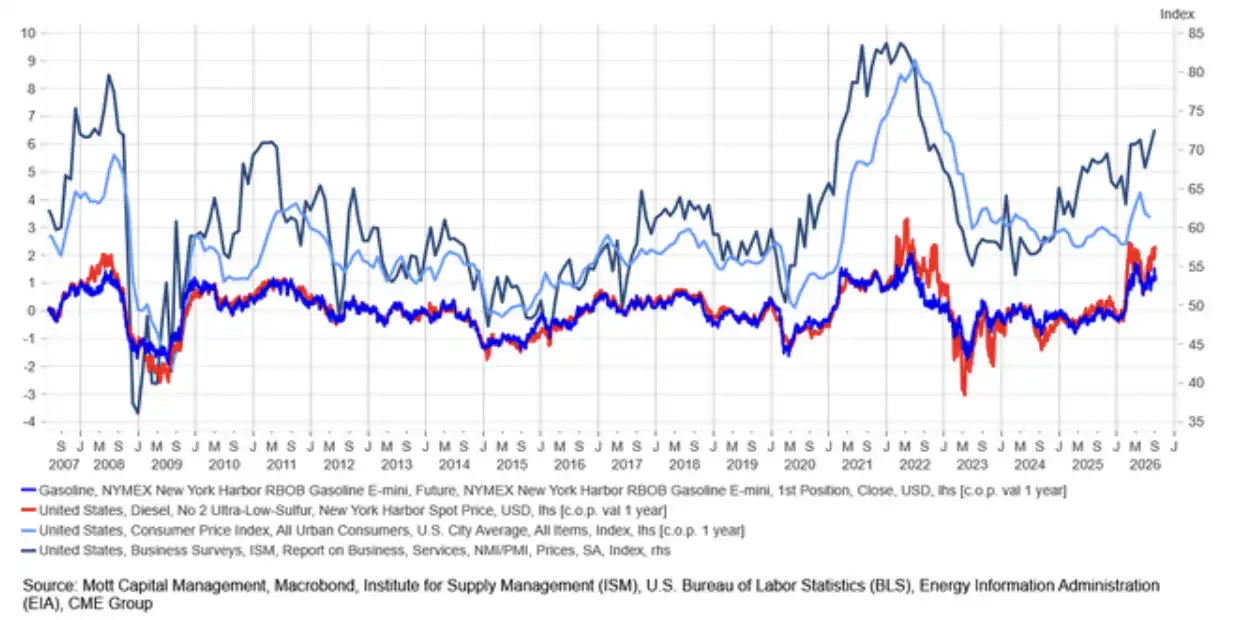
CPI and ISM Services Prices Paid Index
If headline CPI comes in at the expected 0.4% and core inflation does not weaken significantly, the Fed will find it harder to argue that waiting longer is the more appropriate choice.
2-year Treasury yield signals tightening
Besides CPI, the 2-year U.S. Treasury yield may also reflect market judgment on the policy outlook.
Currently, the 2-year Treasury yield is near 4.4%, clearly above the Effective Federal Funds Rate. The author believes this spread means the bond market is pricing in further monetary tightening ahead.
Looking back at multiple monetary policy cycles since the 1990s, the 2-year Treasury yield tends to reflect inflation changes and market expectations for the policy path more quickly, while the Effective Federal Funds Rate adjusts with a lag. In some hiking cycles, the policy rate eventually rises to near the 2-year Treasury yield, or even briefly exceeds it.
If this historical relationship holds again, the current 2-year Treasury yield near 4.4% could imply the Fed still has room to hike further.
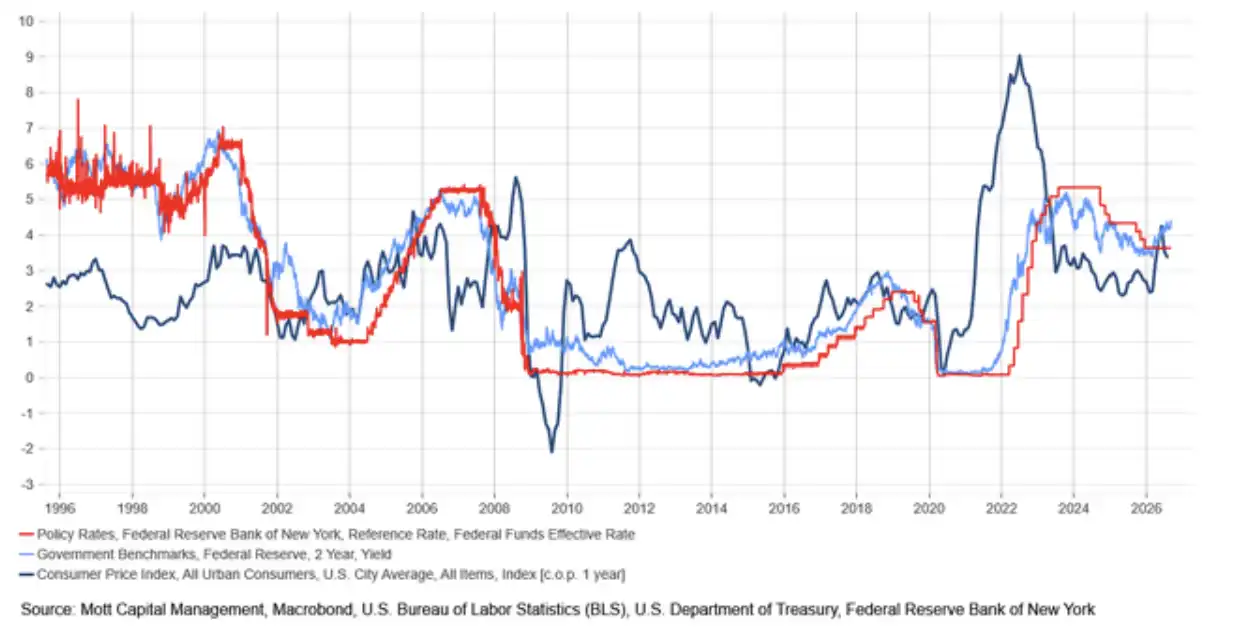
CPI, 2-Year Treasury Yield, and Effective Federal Funds Rate
However, this indicator should not be interpreted mechanically. The 2-year Treasury yield reflects not only market expectations for the policy rate but also inflation expectations, term premiums, Treasury supply and demand, and risk appetite. Therefore, it is more like a composite pricing of policy tightening risk and does not directly prove that the Fed will definitely hike multiple times.
If CPI runs hot, can the Fed keep waiting?
Waller has only one vote on the FOMC, and Warsh has made clear the Fed wants to reduce reliance on traditional forward guidance. This means a single official's remarks cannot fully determine the outcome of the September meeting.
But this raises a trickier question.
If Fed officials repeatedly tell the market that policy decisions will depend on incoming data, and the August CPI ultimately meets or even exceeds expectations, yet the Fed still chooses to hold rates steady, how should investors interpret the earlier communication?
At that point, the market would face not just a single rate decision, but also whether the Fed's policy reaction function has changed: what kind of data is enough to trigger a rate hike, and what kind of "inflation" performance allows policymakers to remain patient?
Therefore, the importance of the August CPI goes beyond the numbers themselves. It will also test whether the Fed is willing to act on the signals it has sent, and whether the market can continue to rely on economic data to gauge the policy path.
If "inflation" comes in clearly below expectations, there are still ample reasons to hold rates steady; but if both headline and core CPI run hot, and the strong labor market offers no grounds for pausing, pressure on the Fed to hike in September will increase significantly.
Market volatility may also re-intensify.
This content is for informational and educational purposes only and does not constitute investment advice related to BTCC. BTCC makes every effort but cannot guarantee the truthfulness, accuracy, or originality of the content above.