This Cryptocurrency Could Skyrocket 542% by 2028 - Wall Street’s Geoff Kendrick Reveals His Top Pick

Wall Street analyst Geoff Kendrick just dropped a bombshell prediction that's sending shockwaves through crypto markets.
The 542% Growth Catalyst
One digital asset stands poised for explosive growth according to Standard Chartered's top crypto strategist. While most analysts play it safe with modest projections, Kendrick's bold call cuts through the noise of typical Wall Street conservatism.
Market Infrastructure Revolution
The identified cryptocurrency bypasses traditional financial gatekeepers while building fundamental utility that could reshape entire industries. Its underlying technology addresses real-world adoption barriers that have plagued earlier blockchain projects.
Institutional Money Floodgates
Major financial institutions are quietly accumulating positions ahead of what could become one of the most dramatic price appreciation stories in digital asset history. The timing suggests smart money knows something retail traders haven't fully priced in yet.
Remember when Wall Street called Bitcoin a fraud? Now they're making price predictions that would make even crypto maximalists blush - guess they finally figured out which side their bread gets buttered.
What is Ethereum and why does it matter?
At its core, ethereum functions as a global, decentralized computer powered by blockchain technology. It allows developers to build applications and execute digital agreements without relying on banks, lawyers, or any centralized authority -- enabling money, assets, and information to move securely and automatically.
The flexibility has made Ethereum the backbone of the modern crypto economy, powering decentralized finance (DeFi) platforms that let users lend, borrow, and earn interest without traditional intermediaries.
Ethereum's network is also becoming more efficient. Its transition to a proof-of-stake consensus mechanism has dramatically reduced energy consumption while allowing users to lock up their coins to earn staking rewards for helping secure the network. The result is a greener, more sustainable ecosystem that appeals to both environmentally conscious and income-seeking investors.
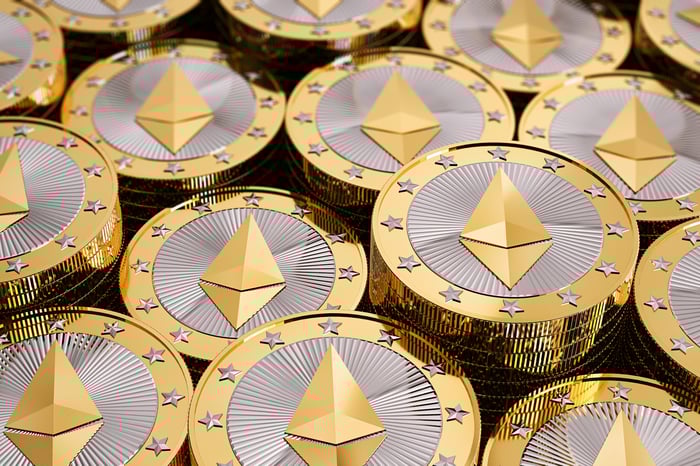
Image source: Getty Images.
Why Geoff Kendrick thinks Ethereum could reach $25,000 in 2028
According toanalyst Geoff Kendrick, Ethereum could soar to $25,000 by 2028 -- representing a potential gain of more than a 540% from levels as of Oct. 18. Kendrick's bullish outlook rests on several structural tailwinds.
First, Ethereum is rapidly becoming the default settlement LAYER for stablecoins -- cryptocurrencies pegged to assets like the U.S. dollar. As global adoption of stablecoins accelerates across banks, retailers, and payment networks, demand for Ethereum's infrastructure should rise in lockstep.
Second, the regulatory landscape is gradually turning more favorable. Following the approval of spot Bitcoin exchange-traded funds (ETFs) and plans to establish a U.S. strategic Bitcoin reserve, many analysts expect Ethereum ETFs to be next in line for mass institutional integration. The introduction of regulated investment vehicles could unlock new waves of capital and further cement Ethereum's position as a legitimate asset.
Lastly, institutional interest in Ethereum is expanding through both treasury adoption and infrastructure investment. Fundstrat top investment strategist Tom Lee has suggested that corporations may eventually allocate portions of their balance sheets to Ethereum -- much like how companies such asand(formerly MicroStrategy) embraced Bitcoin.
This shift WOULD mark a major step toward mainstream recognition, signaling that Ethereum is not just a speculative asset, but a core component of corporate financial budgeting.
The risks: Volatility and uncharted territory
Even with such compelling upside, investing in Ethereum remains inherently risky. Cryptocurrencies are notoriously volatile, with price swings that can exceed 10% or more in a single day -- often driven by sentiment, liquidity shifts, or narrative-focused headlines rather than fundamentals.
Unlike a public company, Ethereum does not have a management team, earnings reports, or corporate oversight. Investors must rely on open-source governance, where upgrades and policies are the byproduct of a community rather than enforced by a traditional boardroom or regulator.
Ethereum also faces competitive and technical risks. Rival blockchains such as,, andcontinue to push the boundaries of speed and scalability, threatening to capture developers and users if Ethereum's network upgrades lag behind.
For long-term investors, Ethereum should be viewed as a high-risk, high-reward innovation play -- one that sits at the intersection of finance, technology, and decentralization. If Kendrick's forecast proves correct, Ethereum could redefine what it means to invest in a truly open digital economy. But only those prepared to embrace volatility and uncertainty will be positioned to benefit from the journey.
