DePIN 2026-2028: The Decentralized Infrastructure Revolution You Can’t Afford to Miss

Forget the cloud—the next trillion-dollar shift is building from the ground up.
Decentralized Physical Infrastructure Networks are slicing through centralized bottlenecks. They're turning idle hardware—your router, that extra sensor, even your EV charger—into a crowdsourced utility layer. No more waiting for telecom giants to roll out 5G or energy monopolies to green the grid. The network builds itself, one node at a time.
The Math That Makes TradFi Sweat
Here's what keeps legacy investors up at night: DePIN flips the capex model. Instead of a single corporation sinking billions upfront, the cost is distributed across thousands of individual participants who are incentivized with tokens. The network's value scales with its usage, not its debt sheet. It's a flywheel that traditional finance still struggles to price—how do you value an asset that gets stronger and cheaper the more people use it?
From Niche to Necessity
The proof is moving from testnets to main streets. We're not talking hypotheticals anymore. Live networks are already delivering cheaper wireless coverage, mapping streets with dashcams, and balancing energy grids in real-time. By 2028, this won't be an alternative; it'll be the default backend for anything that requires resilient, localized infrastructure. The old guard built walls. DePIN builds webs.
Sure, the suits will call it chaotic—right up until their own cost-benefit analyses start screaming for it. The real cynicism? Watching traditional funds finally 'discover' DePIN in 2027 and claim they saw it coming all along.
The 2026 DePIN Market Map
DePIN is a diverse market of operational networks solving real problems across multiple industries. As of January 19, 2026, the DePIN market cap stood at $11.1 billion, a figure that only accounts for projects with publicly traded tokens, leaving much of the sector’s value still unpriced.
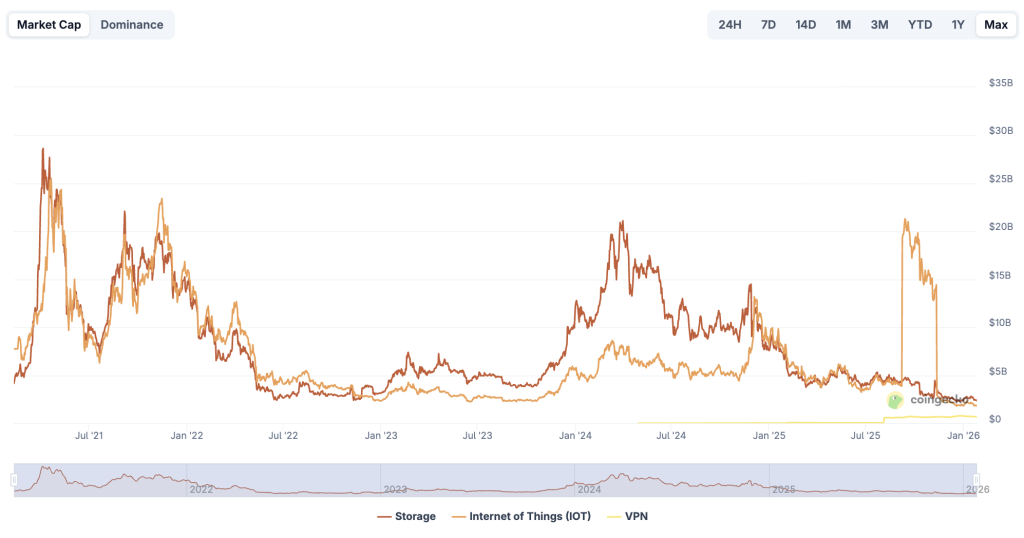
The market’s recent performance tells a story of divergence between speculation and fundamentals. While the sector lost about 80% of its token value in 2025, the year ended with a strong start for fundamentals-driven projects. RENDER, for example, surged 62% year-to-date in early 2026, with tokens like AR and AKASH also posting double-digit gains.
What I see is that DePIN grew beyond being a simple theory in 2025. These networks are up and running, and the progress is evident across different sub-sectors.
In wireless networks, we have surpassed 5 million registered routers worldwide, and it recorded a 23% increase in customers in collaboration with a Fortune 500 company, proving real enterprise demand.
In mapping, Hivemapper’s network has now covered over 700 million km of roads, or about 37% of the global road network, backed by a recent $32 million funding round. And in compute, Akash is generating over $4.3 million in annual recurring revenue, with demand maturing toward longer-lived, higher-priced deployments for serious AI workloads.
That’s the clearest proof that DePIN is now operating as real infrastructure. The question is no longer how many routers you can register. Instead, it’s how much real traffic you can serve, at measurable quality, for paying customers.
In 2026, we’ll see the winners separate by utilization, reliability, and commercial contracts, not by token noise.
7 Theses for a Maturing Market
With these shifts in mind, here’s what I’m watching for in 2026.
First,. Think of it this way: AI is the storefront; DePIN is the supply chain. Centralized providers simply cannot keep up.
Second,, with key performance indicators like revenue per active node and utilization rates becoming the new standard.
Furthermore,, such as telco offload deals and B2B data agreements, not just press releases.
, with the dismissal of the SEC’s claims against Nova Labs serving as a key precedent.
At the same time,, such as mapping networks integrating directly with autonomous vehicle data pipelines.
Finally,.
2026 is the year DePIN lays the foundation for its long-term opportunity, with the market projected to reach $3.5 trillion by 2028.
You might also like How AI and Tokenized Dollars Will Anchor the 2026 Global EconomyThe Unseen Forces Moving DePIN Forward
Beyond these observable trends, I see many powerful undercurrents that are making DePIN’s rise a NEAR certainty. AI’s relentless resource scarcity makes a decentralized supply chain an economic necessity.
Declining trust in tech giants and monopolies, highlighted by events like November’s global Cloudflare outage, creates urgent demand for resilient alternatives. The commoditization of hardware like sensors and routers means the crowd can now build infrastructure faster and more affordably than large corporations.
Simultaneously, stablecoins have become the perfect fuel for the high-volume, global microtransactions needed to instantly compensate millions of DePIN network contributors. A maturing market will also increasingly shift to a cash-flow story, ignoring projects that cannot demonstrate real revenue.
Finally, simplified on-chain accounting, which provides verifiable proof of work, makes DePIN networks transparent, auditable, and ultimately more attractive for B2B adoption and insurance.
These forces are fundamental economic and technological shifts. They signal that the MOVE toward decentralized infrastructure is not a matter of if, but when. The market is maturing, the tools are ready, and the demand is undeniable. And I believe 2026 will be the year these hidden drivers become visible to everyone.
Disclaimer: The views and opinions expressed in this article are those of the author and do not necessarily reflect the views of Cryptonews.com. This article is for informational purposes only and should not be construed as investment or financial advice.
