Arizona Eyes ’Tax-Free’ Status: New Bill Seeks to Ban Local Crypto Taxes

Arizona lawmakers are pushing to make the state a crypto tax haven—and local governments aren't happy.
The Regulatory End-Run
Forget waiting for federal clarity. The proposed legislation cuts local municipalities out of the crypto tax equation entirely. It blocks cities and counties from slapping transaction fees, licensing costs, or any new levy specifically on digital asset activities. The move effectively creates a state-level shield, forcing the crypto tax debate into a single arena.
Follow the Money (Or the Lack Thereof)
The bill's backers pitch it as an innovation magnet. The argument is simple: predictable, minimal taxation attracts builders and capital. Opponents see it as a classic state-versus-local power grab, stripping towns of potential revenue streams for services. It's a preemptive strike against a patchwork of local rules that could stifle growth before it starts—or a cynical budget bypass, depending on whom you ask.
The Bigger Game
This isn't just about Arizona's balance sheet. It's a competitive salvo in the state-versus-state battle for crypto dominance. By dangling a 'tax-free' banner, Arizona aims to pull companies and talent from coasts to desert. The strategy banks on growth generating enough broader economic activity to offset any direct tax losses. A classic 'watch the other hand' economic maneuver that usually makes accountants sigh and VCs cheer.
The bill forces a blunt question: should digital assets be taxed like property, currency, or something entirely new? Arizona's answer is to hit pause on local experiments. If it passes, expect a rush of developers—and a likely legal showdown with local governments left holding the (empty) bag. Another day, another disruptive finance scheme promising to build the future by dismantling the present's revenue model.
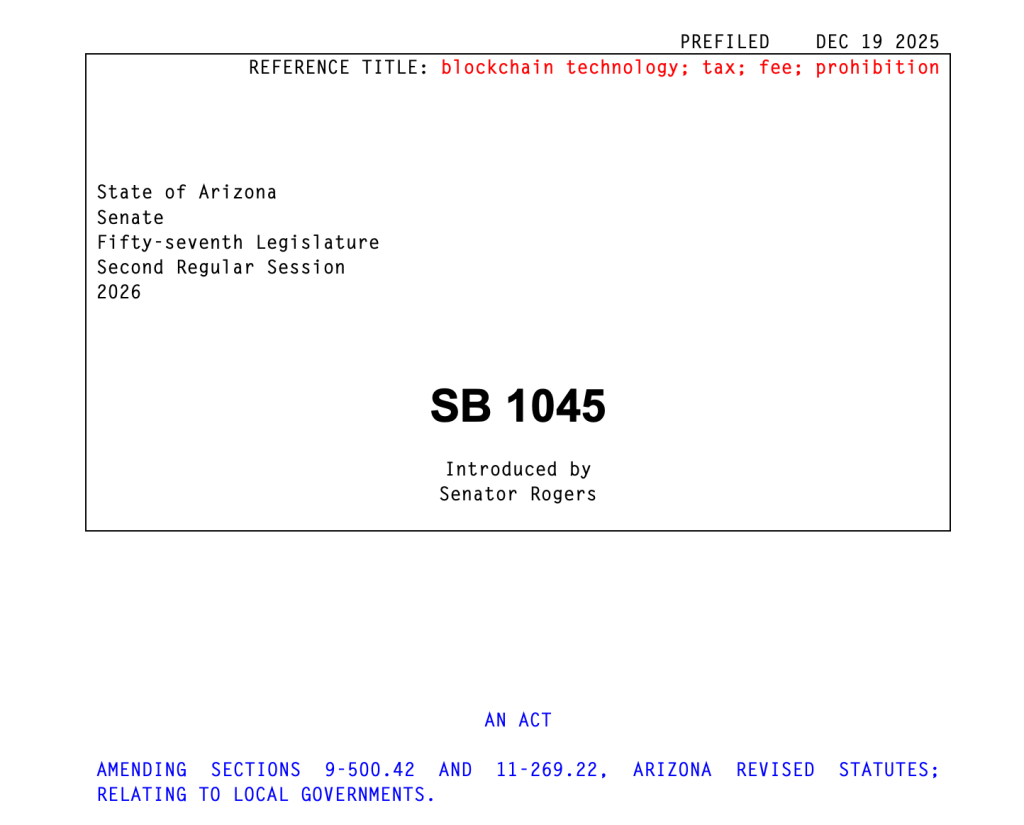 Source: Arizona legislature
One proposal, SB 1044, would amend state statutes to exempt VIRTUAL currency from taxation, while another, SB 1045, would bar counties, cities, and towns from imposing taxes or fees on people or companies that operate blockchain nodes.
A third measure, SCR 1003, WOULD amend Arizona’s constitution to explicitly exclude virtual currency from property tax. If enacted, the node-related bill could take effect through the state legislature alone.
Arizona Pushes Crypto Tax Boundaries, but Voters Hold the Final Say
The broader tax exemption proposals, however, would require voter approval during Arizona’s next general election in November 2026.
Under current law, Arizona is not a tax-free state. Residents pay a flat personal income tax rate of 2.5%, along with a state sales tax known as the Transaction Privilege Tax, which starts at 5.6% and rises above 8.5% on average once local rates are included.
Property taxes are also collected, though they are generally lower than in many other states.
Cryptocurrency is treated as property for federal tax purposes, meaning sales, trades, or payments trigger capital gains or losses.
Arizona largely follows that framework but has adopted several crypto-specific rules. Since December 2022, the state has exempted crypto airdrops from state income tax by treating them as gifts at the time they are received, even though federal taxes still apply.

Arizona also allows transaction fees, or gas fees, to be deducted when calculating gains or losses and permits state agencies to accept cryptocurrency payments through approved service providers.
Rogers’ latest proposals would go further by attempting to remove virtual currency from the state’s tax base entirely and by shielding blockchain node operators from local government levies.
Arizona already stands out as one of the few states with a law allowing the government to claim ownership of digital assets deemed abandoned after three years, a measure tied to earlier efforts to establish a state-level digital asset reserve.
The senator was also a co-sponsor of a Bitcoin reserve bill vetoed in May by Governor Katie Hobbs.
 Arizona Governor Katie Hobbs has sparked criticism from bitcoin advocates and some government officials after vetoing Bitcoin bill.#Arizona #Bitcoinhttps://t.co/WDkhfloax5
In June, the Arizona Senate later passed a revised Bitcoin reserve bill as it cleared the chamber in a narrow 16–14 vote after approving a motion to reconsider the measure.
From State Experiments to Capitol Hill, Crypto Tax Rules Are Back in Play
The Arizona push comes as debates over crypto taxation intensify nationwide. A handful of states, including Florida, Texas, Wyoming, and Nevada, do not impose personal income taxes, effectively making most crypto gains tax-free at the state level.
Others have taken more targeted approaches. Missouri, in August, eliminated state income tax on capital gains, while Ohio lawmakers have advanced a proposal to exempt small crypto transactions under $200, though that bill has stalled.
At the federal level, Congress is preparing to revisit crypto tax policy after nearly a decade of relying on Internal Revenue Service guidance issued in 2014.
In December, Representative Max Miller said a draft bill to modernize digital asset taxation could MOVE before the August 2026 recess.
 U.S. lawmakers target August 2026 for a comprehensive crypto tax bill to clarify reporting, staking, and small-transaction rules. #CryptoTax #CryptoNews #Blockchainhttps://t.co/Gr8rKi9NF6
More recently, bipartisan House lawmakers released a discussion draft that would exempt small stablecoin payments from capital gains tax and allow a five-year deferral on staking and mining rewards.
