Bank of Russia Sets 2026 Deadline for Strict Crypto Regulation and New Penalties

Russia's central bank is drawing a hard line in the digital sand. Forget the wild west—Moscow wants a tightly controlled frontier by 2026, complete with a fresh set of penalties for those who color outside the lines.
The Regulatory Countdown Begins
The clock is ticking for crypto operations in Russia. The Bank of Russia isn't just suggesting guidelines; it's building a comprehensive legal cage with a firm 2026 completion date. The framework aims to corral everything from exchanges to mining, replacing ambiguity with strict oversight.
New Rules, New Stakes
The plan introduces something the crypto space dreads more than a bear market: enforceable penalties. We're talking fines and legal repercussions designed to make non-compliance a financially painful proposition. It's a classic move from the traditional finance playbook—control through consequence.
A Global Trend or a Sovereign Stand?
While other nations grapple with crypto regulation, Russia's 2026 target shows decisive, top-down planning. It's a bid to mitigate risks like capital flight and financial instability, but also to assert state sovereignty over a decentralized technology. They're not asking for permission; they're laying down the law.
The ultimate goal? To tame crypto's disruptive potential and integrate it—on the state's terms—into the national financial system. It's a stark reminder that in the high-stakes game of digital finance, the house always wants to write the rules. After all, what's a central bank without something to centralize?
Russia Outlines Split Rules for Retail and Qualified Buyers
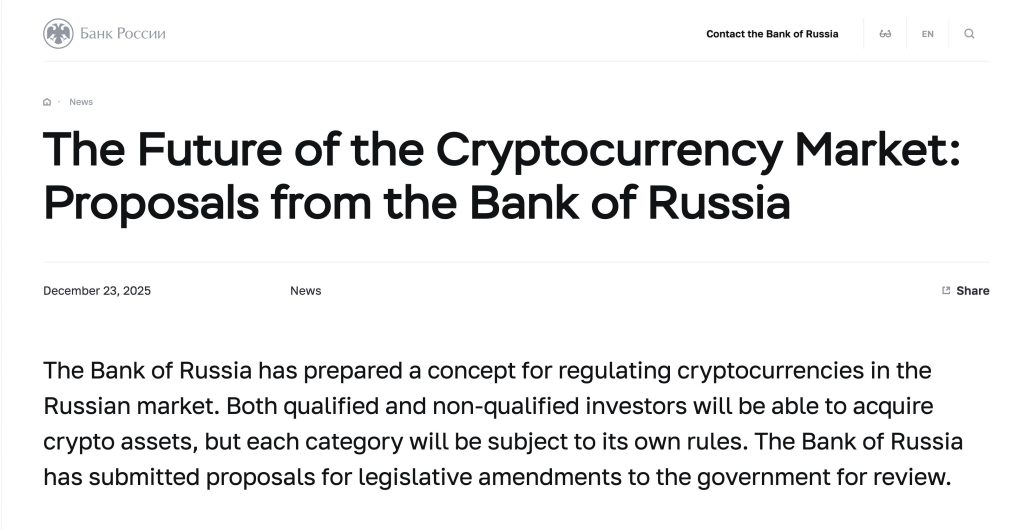
Under the concept submitted to the government, both qualified and non-qualified investors WOULD be allowed to buy cryptocurrencies, though under sharply different conditions.
Non-qualified investors would be limited to purchasing a defined list of the most liquid cryptocurrencies after passing a mandatory knowledge test.
Their annual purchases would be capped at 300,000 rubles, or about $3,800, through a single intermediary.
Qualified investors, meanwhile, would be allowed to buy any cryptocurrency except so-called anonymous tokens that conceal transaction data.
They would not face volume limits but would still be required to pass testing to demonstrate an understanding of the risks involved.
The Bank of Russia reiterated that while cryptocurrencies and stablecoins would be recognized as monetary assets that can be bought and sold, they would remain barred from domestic payments.
This position aligns with existing law passed in 2020, which restricts crypto use to investment purposes and requires all payments inside Russia to be conducted in rubles.
That stance was reinforced again on December 17, when State Duma financial markets committee chairman Anatoly Aksakov said cryptocurrencies would “never become money” in Russia and could only function as investment instruments.
 Russian lawmaker Anatoly Aksakov said that payments in Russia must only be conducted in rubles, dismissing crypto becoming legal tender.#RussiaCrypto #CryptoPayments #CryptoRegulationhttps://t.co/BLk0c4qHcQ
Russia Lays Out Phased Plan to Legalize Crypto Market Activity
If adopted, the new rules would allow crypto transactions to take place through existing licensed infrastructure.
Exchanges, brokers, and trustees could operate under their current licenses, while separate requirements would be introduced for specialized crypto depositories and exchangers.
Russian residents would also be allowed to buy cryptocurrencies on foreign platforms using overseas accounts and to transfer previously acquired assets abroad through Russian intermediaries, provided such transactions are reported to the tax service.
The concept also extends to Russia’s digital financial asset market, which would allow DFAs and other digital rights to circulate on open networks.
This would allow issuers to attract foreign investment and give buyers access to products on terms comparable to cryptocurrency investments.
The central bank has called for the legislative framework underpinning the proposal to be completed by July 1, 2026.
From July 1, 2027, liability would be introduced for illegal activities by crypto intermediaries, modeled on penalties for illegal banking operations.
This timeline suggests a gradual transition from the current gray zone toward formal enforcement.
Crypto Didn’t Disappear in Russia—It Got Too Big to Ignore
The shift reflects a longer evolution in Russia’s crypto policy. Before 2022, the Bank of Russia repeatedly pushed for a full ban on crypto trading and mining, arguing that private digital currencies threatened financial stability.
That position softened after sweeping Western sanctions cut Russia off from parts of the global financial system.
Since then, lawmakers have legalized crypto mining, approved experimental use of crypto for cross-border settlements, and begun building a regulated domestic market alongside the Finance Ministry.
Recent data underline why regulators are now focusing on structure rather than suppression.

Chainalysis has ranked Russia among the world’s top 10 countries for crypto adoption, with the country receiving more than $376 billion in crypto transactions between July 2024 and June 2025
Officials have framed the new approach as a way to bring existing participation under oversight rather than expand crypto’s role in the economy.
