Andre Cronje’s Flying Tulip Public Sale Ignites Crypto Market on Feb 16

The crypto world holds its breath as Andre Cronje—the architect behind DeFi's most enduring protocols—unveils his latest creation. Flying Tulip isn't just another token; it's a statement from one of the industry's most revered and reclusive builders. The public sale window opens today, February 16, marking a rare, direct opportunity to acquire a piece of Cronje's vision.
The Cronje Premium
Market sentiment operates on a simple calculus: Andre Cronje builds, people follow. His track record with Yearn Finance and other ecosystem-defining projects creates an almost gravitational pull of capital and attention. A public sale from his desk isn't a product launch—it's an event, bypassing the traditional VC gatekeepers and offering a slice of pure builder intent to the retail crowd.
Speculation vs. Substance
The immediate frenzy is guaranteed. Trading desks will light up, and social feeds will drown in analysis from self-proclaimed experts who've never written a line of Solidity. The real test comes after the ticker starts moving. Does Flying Tulip introduce a novel mechanism, or is it a refinement of proven concepts? The market will dissect its utility, tokenomics, and integration potential with the ruthless efficiency of a hedge fund manager reviewing a pitch deck—another fleeting distraction in the portfolio.
Timing the Tulip
Launching into today's market requires nerves of steel or supreme confidence. It cuts through the noise of memecoin mania and regulatory uncertainty, betting that genuine innovation still draws capital. Early participants aren't just buying a token; they're buying a timestamp on Cronje's development roadmap, gambling that his Midas touch hasn't faded.
The sale is live. The code is the prospectus. The only due diligence is in the GitHub commits. In a space obsessed with quick flips and faster exits, Cronje's projects demand a different kind of patience. Whether Flying Tulip soars or becomes a footnote depends on whether the community still values building over betting. Place your wagers accordingly.
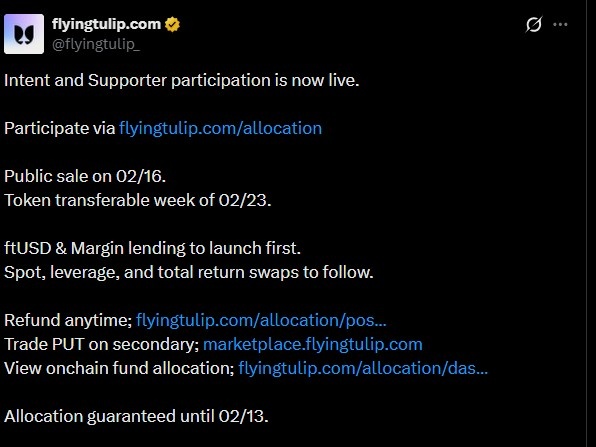
Source: X official
Early Metrics and Capital Backing
According to the official dashboard, the current invested value stands at $127.41 million, the cumulative yield has reached $87.63K, and the total FT value is $128.31 million. Notably, earnings are already being generated before the full protocol launch.
Funding history highlights strong institutional support:
Initial $200 million raise from Brevan Howard Digital, CoinFund, DWF, FalconX, Hypersphere, Lemniscap, Nascent, Republic Digital, Selini, Sigil Fund, Susquehanna Crypto, Tioga Capital, and Virtuals Protocol.
Follow-on $25 million round from Amber Group, Fasanara Digital, and Paper Ventures.
Highest raise on Impossible Finance at $55 million.
Third-largest raise on CoinList with $10 million.
The scale of backing signals confidence in Andre Cronje’s structured DeFi design and investor-protection model.
How Flying Tulip Works
Flying Tulip introduces a “deposit with refund” approach. Funds are deployed into low-risk yield, currently 100% allocated into Aave. Depositors receive FT tokens. If FT outperforms the initial value, users withdraw tokens to gain. If not, they refund their principal at $0.10 per token, forming a programmatic floor.
The 10c protection works automatically. If someone sells below that mark, refund collateral unlocks and repurchases tokens to stabilize the price. Redemptions are already visible on-chain through the official dashboard and registry contracts.
There are no refund conditions. Investors control access through a PUT option and can withdraw anytime without interacting with the team.
The product becomes fully active once transferability begins. Every fee and yield source buys FT and redistributes it. Although volatile tokens are usually unsuitable for fixed returns, the 10c mechanism ensures minimum yield while allowing upside exposure.
Sale Terms and Tokenomics
Token Price: $0.10 per FT token.
Total Supply: 10,000,000,000 FT.
Public Sale Allocation: 2,000,000,000 FT (20% of total supply).
Vesting: 100% unlocked at TGE, initially wrapped in the Perpetual Put structure.
Minimum Purchase: $100.
Accepted Assets: USDC, USDT (ERC-20)
First Products and Multi-Chain Rollout
Initial offerings include:
ftUSD, a native stablecoin settlement layer. At launch, it wraps USDC into Aave. Later, it enables delta-neutral yield strategies similar to Ethena’s model, targeting 4%–8% returns on USDC or USDT deposits. Expansion modules may include CDP features and arbitrage tools.
Margin Lending is an equity-based system rather than an LTV-based system. It functions as a cross-exchange margin account, supporting standard lending and efficient on-chain leverage. Spot trading, leveraged spot, and Total Return Swaps are part of the roadmap, though rollout will be phased and capped initially.
Deployment is live across Ethereum, Sonic, Binance Smart Chain, Avalanche, and Base, with reviews underway for Hyperliquid, MegaETH, and Monad.
Conclusion
Flying Tulip represents Andre Cronje’s latest structured DeFi experiment, combining capital protection with yield generation. With institutional backing and a transparent on-chain model, Andre Cronje aims to reshape public token launches through refund rights and sustainable revenue design.
