PayPal’s PYUSD Quietly Migrating to Solana? The Stealth Blockchain Shift That Could Reshape Payments

PayPal's stablecoin is making moves—and the destination might surprise you.
PYUSD, the payments giant's dollar-pegged digital asset, appears to be testing new infrastructure waters. While Ethereum launched it, whispers in developer circles and subtle on-chain footprints suggest a quiet exploration of Solana's rails. This isn't just a tech upgrade; it's a potential strategic pivot in the race for payment supremacy.
The Need for Speed (and Lower Costs)
Ethereum's network, for all its security and decentralization, comes with notorious friction: slower settlement times and gas fees that can eat into micro-transactions. For a company built on seamless, global payments, that's a core business problem. Solana's architecture promises a fix—transactions finalized in seconds at a fraction of the cost. For PayPal, scaling PYUSD for everyday use might mean leaving some crypto-idealism at the door in favor of raw efficiency.
A Silent Test or a Full-Scale Migration?
Evidence is circumstantial but compelling. Traces of PYUSD-related smart contract interactions have appeared on Solana devnets—sandboxed testing environments. No official announcement, no fanfare. Just code. This is how big tech operates: experiment quietly, deploy decisively. If the tests prove successful, a full or partial migration could follow, offering millions of PayPal users a dramatically improved stablecoin experience without them ever knowing the blockchain changed.
The Bigger Picture: Pragmatism Over Protocol
This potential shift underscores a maturing phase for corporate crypto. The question is no longer "which chain is most decentralized?" but "which chain works best for our customers?" PayPal's allegiance is to its bottom line and user experience, not to any single blockchain's ecosystem. It's a stark reminder that in traditional finance—and now in crypto—convenience almost always trumps creed. After all, Wall Street never picked a side because it liked the technology's vibe; it picks the side that makes the quietest, fastest buck.
If the rumors hold, PayPal isn't just routing transactions through Solana. It's routing around the entire debate, choosing the path of least resistance to mainstream adoption.
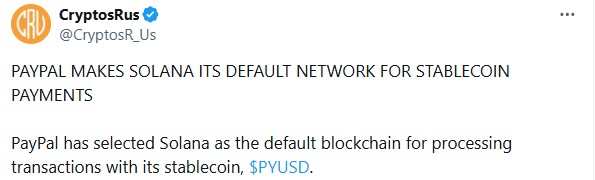
While the narrative is spreading fast across crypto communities, it is important to separate what is confirmed from what is being inferred.
What Have Been Confirmed So Far
PayPal did first launch its U.S. dollar backed stablecoin, PYUSD, in 2023 on Ethereum. Later, in May 2024, Paypal expanded the coin’s access to Solana, under which users can choose between the networks according to their suitability. Here SOL network's addition was about expanding options, not replacing Ethereum.
However, recent claims suggest Paypal has now made Sol the default blockchain, which means that when users send or receive PYUSD, transactions will automatically route through SOL network unless users switch to other networks manually.
In reality, this assumption is based on interface behaviour rather than a direct statement from the e-payment platform itself.
How the “Default Network” Narrative is Spreading
The idea gained momentum after a post from a verified account on X claimed that PayPal had "quietly" made Sol its default network. The post included a screenshot of PayPal’s blockchain selection screen, where Solana appears listed first, followed by Ethereum, Arbitrum, and Stellar.
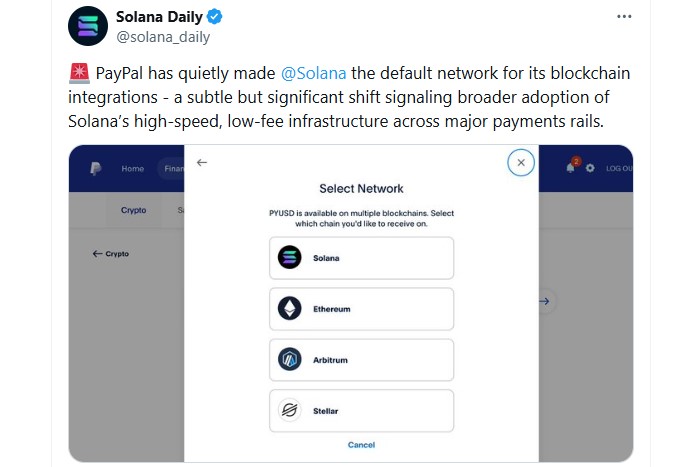
Many users interpreted this ordering as proof that Solana is now the default routing option. As the news gained attention, the claim spread rapidly across many social media platforms, framed as a subtle but meaningful infrastructure shift.
Ethereum Vs Solana: Context Behind the Assumptions
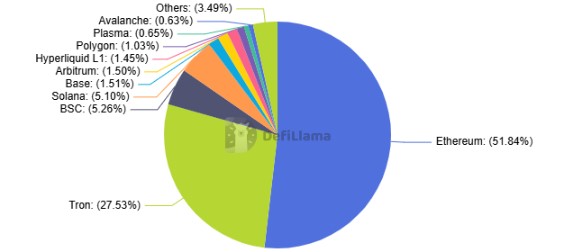
Ethereum remains the dominant platform by total stablecoin value with $158.37 billion Mcap, supported by deep liquidity, strong security assumptions, and continued institutional preference. However, congestion and higher fees can slow down payments, making it less suitable for frequent payments.
Solana, meanwhile, has emerged as the leading network for fast and low-cost stablecoin transfers. Payments on SOL network typically settle in about 400 milliseconds, and it costs near-zero fees that suit everyday payments, trading, and high-volume activity.
These advantages help explain why many assume Sol would be the preferred as main chain, but critics argue over their trading volumes and cap, saying Solana is far below ethereum and could not win over it.
Final Verdict
At this stage, the claim for SOL network integration for PYUSD is unverified, and shows how quickly crypto narratives can form based on partial evidence.
The narrative is being driven by social media signals, UI observations, and community interpretation, not by an official announcement explicitly confirming a primary change.
Until PayPal formallly confirms such a shift, the “default network” claim should be treated as speculation amplified by social media, rather than established fact.
The article is for informational purposes only. It does not constitute any legal or financial advice or claims.
