SBI CEO Declares Ripple Stake A ’Hidden Asset’ – Hints It Could Be Much Bigger Than Anyone Realizes

Forget what you think you know about the balance sheet. The CEO of Japan's financial giant SBI just called its stake in Ripple a 'hidden asset,' dropping a heavy hint that its true value might be staggering.
The Undervalued Elephant in the Room
In a world where traditional finance scrambles for blockchain relevance, SBI's deep-rooted partnership with Ripple isn't just a strategic bet—it's a sleeping giant on the books. The CEO's phrasing suggests the market hasn't priced in the full potential of this alliance, from cross-border payment corridors to enterprise-grade liquidity solutions.
More Than Just an Investment
This isn't passive portfolio filler. It's operational leverage. SBA leverages Ripple's tech across its ecosystem, suggesting the 'asset' value extends far beyond share certificates. Think infrastructure, exclusive access, and a first-mover advantage in Asia's institutional crypto adoption—things quarterly reports love to hide in plain sight.
The Market's Blind Spot
Analysts often miss the forest for the trees, tallying coins while ignoring the network. A 'hidden asset' implies a valuation gap, one that could correct sharply as real-world utility—not speculative hype—starts driving the narrative. It's a quiet confidence that speaks volumes.
One cynical finance jab? Wall Street would've securitized it, sliced it into tranches, and sold it back to you three times over by now. In the end, the biggest gains often come from seeing the value everyone else overlooks—before the spreadsheet jockeys finally catch on.
SBI CEO Dials Up Ripple Valuation Speculation
Kitao’s response effectively reframed the conversation from balance-sheet token inventory to private-market ownership. Rather than validate a specific XRP figure, he emphasized SBI’s stake in Ripple Labs, a detail that matters because equity value is ultimately a function of Ripple’s overall valuation, not the spot price of XRP.
In a separate post the same day, Kitao went further, explicitly tying his view to Ripple’s broader footprint. “When it comes to Ripple Lab’s total valuation which obviously include its ecosystem that Ripple has created, that WOULD be enormous,” he wrote. “SBI owns more than 9 % of that much.”
Community member “BankXRP” amplified the implications by referencing recent reports that place Ripple’s valuation at “$50B+,” arguing that such a mark would put SBI’s 9% stake at “$4.5B+,” with “massive future upside as the CEO hints.”
While Kitao did not put a dollar figure on SBI’s stake, the 9% number sets a clean valuation yardstick. If SBI’s Ripple ownership were worth more than $10 billion, Ripple’s implied valuation would need to exceed roughly $111 billion, because $10 billion divided by 0.09 equals about $111.1 billion.
Put differently, at a $90 billion Ripple valuation, a 9% stake would be about $8.1 billion; at $50 billion, it would be about $4.5 billion. The threshold for “more than $10 billion” is therefore not a subtle rounding error, it requires a triple-digit billions valuation for Ripple.
Notably, SBI’s roughly 9% position appears to be the product of a long-running strategic relationship rather than a single headline trade: SBI’s own investor materials describe the Ripple relationship as having been “established” in September 2012, with the group later investing in Ripple in March 2016 and then deepening operational ties through the SBI Ripple Asia joint venture (SBI 60%, Ripple 40%) launched in May 2016.
SBI also participated as an investor in Ripple’s $200 million Series C financing announced in December 2019, a round that included SBI alongside other backers, one of the clearer public datapoints showing continued equity exposure as Ripple raised capital.
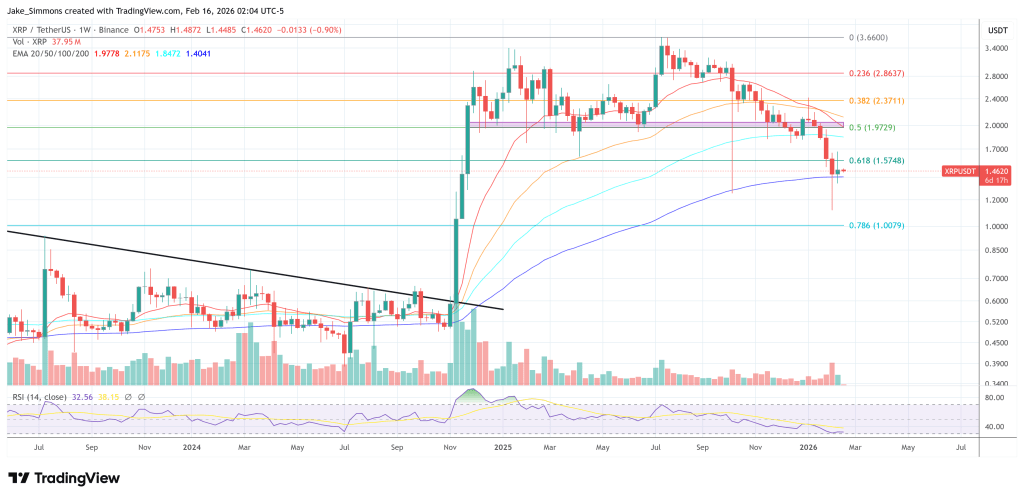
At press time, XRP traded at $1.46.