China’s Gold Rush Intensifies as Crypto Crackdown Continues

While Beijing slams the door on digital assets, it's quietly stockpiling the ultimate analog store of value.
The Great Wall Against Crypto
China's regulatory hammer keeps falling on cryptocurrency activity. Mining operations get unplugged, trading platforms face bans, and investors find their on-ramps blocked. The message is clear: digital decentralization doesn't fit the state's playbook. It's a controlled financial ecosystem, or nothing.
Betting on Bullion
Meanwhile, the People's Bank of China reports another monthly increase in gold reserves. They're not just dipping a toe in—they're making a strategic, physical accumulation. It's the oldest hedge in the book, a direct play for sovereignty and a shield against the very dollar system that underpins much of the crypto world. Gold doesn't need a network upgrade or fear a regulator's tweet.
The Sovereign Playbook
This isn't just diversification; it's a statement. Boosting gold holdings signals a retreat from perceived dollar dependency and a move toward asset control the state can literally hold in its vaults. It's the ultimate proof-of-work asset, mined from the earth, not minted by code. For a government prioritizing stability, a volatile crypto market is a risk; a growing gold reserve is a strategic asset.
So, as one door closes, another vault opens. The state opts for the asset that never flashes a 'network congested' error—proving that in high finance, sometimes the most disruptive technology is a 5,000-year-old shiny rock. (Take that, algorithmic stablecoins.)

Notably, the purchase came despite a sharp market correction. Gold prices fell nearly 10% in a single day after surging about 30% earlier in the year, following a wave of speculative buying. Prices have since recovered partially, currently at $4968, though volatility remains.
Chinese central bank’s steady accumulation suggests confidence in gold as a long-term store of value, especially during periods of currency risk and global economic uncertainty.
Global Central Banks Reinforce China’s Gold Strategy
The country's MOVE is part of a broader global trend. According to the World Gold Council, central banks around the globe bought more than 860 tons of gold in 2025. While slightly below the 1,000-ton levels seen in previous years, demand remains historically strong. Over annual demand is also surging with 2025 crossed 5,000 tonnes.
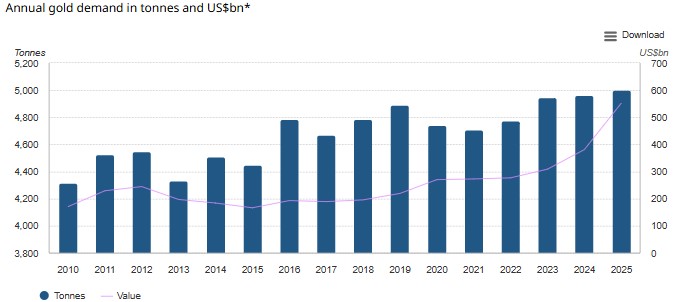
Analysts say this sustained buying supports the precious metal’s floor price and reinforces its role as a reserve asset. China’s actions may also encourage other emerging economies to diversify away from US dollar exposure, strengthening gold’s position in global reserves.
Bullish on Bullion, Why Bearish on Crypto?
Where the country explores precious metals enormously, China’s latest regulatory move restricts many crypto developments. February 6, 2026, the country released a notice clearly:
denied legal status to cryptocurrencies,
classified crypto-related business activities as financial crimes, and
barred foreign cryptocurrency platforms from operating inside China.
Authorities placed specific emphasis on unauthorized yuan-pegged stablecoins issued offshore and offshore tokenization of real-world assets linked to Chinese holdings, citing risks of capital flight and threats to monetary sovereignty.
This action reinforces the nation's long-standing opposition to cryptocurrencies. The 2026 notice follows the historical pattern:
2013: Banks and payment firms barred from Bitcoin services
2017: ICOs banned; domestic crypto exchanges shut down
2021: Nationwide mining ban and all crypto transactions declared illegal
2026: Restrictions reaffirmed, with added focus on offshore stablecoins and RWA tokenization
Authorities cite risks such as money laundering, capital flight, and threats to monetary sovereignty as key reasons behind the crackdown.
However, the measures also align closely with China’s push for its digital yuan (e-CNY) as the only acceptable digital payment system. The central bank digital currency has been piloted in over 20 cities since 2020 and remains a priority over private cryptocurrency alternatives.
How Does It Affect the Markets: Impact and Changes
The latest update does not criminalize individual holding of crypto, but continues to outlaw trading, mining, and business activity involving digital assets. Offshore platforms remain inaccessible to Chinese users, and businesses engaging in crypto services face stricter enforcement risks.
For market perspectives, Community analysis shows that each major announcement historically triggered short-term market sell-offs, but often coincided with long-term price recoveries.
For now, the crypto market is comparatively performing better, while the recent downturn and bitcoin drop below $65,000, were mainly caused by the broader market crash.
In Conclusion
Taken together with China’s ongoing gold accumulation, and restrictions on crypto highlights a clear policy preference: reliance on physical reserves and state-controlled digital money, rather than decentralized assets.
The article above is for informational purposes only. It does not promote any financial claim and advice.
