Trade War Alert: Trump Tariffs Target Iran’s Trade Partners - Global Markets Brace for Impact

Trump's latest tariff salvo isn't just hitting Iran—it's scorching the earth for anyone doing business with them. Trade partners from Beijing to Brussels are now in the crosshairs, facing punitive measures that could reshape global supply chains overnight.
The Geopolitical Domino Effect
Secondary sanctions are the new primary weapon. Countries that thought they could quietly maintain economic ties with Tehran are discovering their access to dollar-denominated markets evaporating. The administration's message is clear: choose between Iranian oil and American financial infrastructure.
Supply Chain Shockwaves
Manufacturers are scrambling as component shortages loom. Everything from automotive parts to rare earth minerals faces disruption as the tariff net widens. Companies built on just-in-time delivery are suddenly recalculating with just-too-late reality checks.
The Currency Conundrum
Alternative payment systems are getting their trial by fire. SWIFT alternatives and bilateral currency agreements are being tested under real pressure—most are buckling faster than a budget airline seat. Because nothing says 'stable international trade' like relying on untested financial infrastructure cobbled together during a geopolitical crisis.
Markets React—Then Overreact
Commodity prices are swinging wildly while traditional safe havens see unusual flows. Gold's up, but so are cryptocurrencies as capital seeks borders less concerned with political affiliations. The volatility index is having its best week since the last time someone tweeted about tariffs.
Long Game or Bluff?
Negotiating tactics or new economic reality? The administration claims this pressure will force better deals. Critics see another chapter in the great decoupling narrative—where global trade gets sliced into competing blocs. Either way, businesses are stuck paying the transaction costs of geopolitical theater.
One cynical finance jab: Nothing makes traditional investors consider crypto faster than watching sovereign nations get locked out of the global banking system—except maybe watching their own portfolios get caught in the crossfire.
The ultimate irony? While politicians talk about economic independence, capital is quietly voting with its wallet—and increasingly, those wallets are digital, decentralized, and don't particularly care whose trade policies they're bypassing.
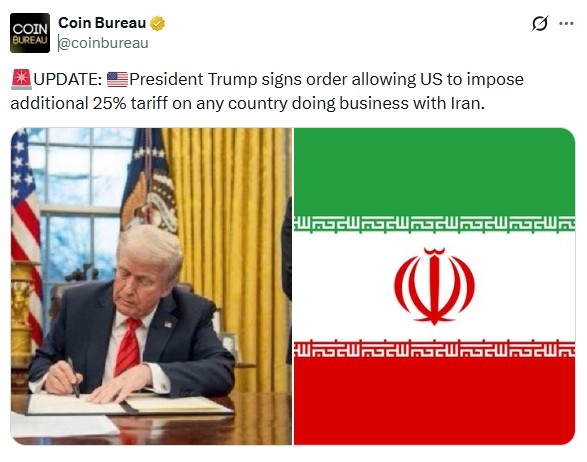
Source: X official
A History of U.S.–Iran Tensions
For decades, the United States and Iran have been locked in a fraught diplomatic and military standoff. Disagreements began after Iran’s 1979 revolution and have since been fueled by issues including Tehran’s nuclear ambitions, regional influence, and support for groups the U.S. views as hostile. Washington has previously imposed sanctions on oil, banking, and energy sectors in response to Tehran’s suspected work toward nuclear weapons, its ballistic missile program, and its backing of proxy forces in the Middle East.
What the Sanctions Mean for Crypto Markets
The threat of Trump tariffs is already rippling through financial markets, including digital assets. Although the tariff plan primarily targets trade partners, investors are watching closely — and many in the virtual asset space view this turbulence differently.
Crypto as a “Safe-Haven” in Tense Times: When geopolitical pressures rise, such as the looming tariff threat on those connected to Iran, some investors turn to financial alternatives like Bitcoin and other digital currencies. Historically, Bitcoin and XRP have occasionally climbed during riskier moments as traders seek assets perceived to be outside traditional financial systems.
Market Volatility Could Increase: Even if the tariff policy doesn’t directly change crypto networks, digital assets are sensitive to broader economic stress. Increasing fears of trade conflict or retaliation from major economies could make crypto prices swing more sharply as traders react to global uncertainty.
Indirect Effects via Sanctions and Crypto Usage: Separately, Iran has increased its use of cryptocurrencies due to isolation from international banking channels. As sanctions tighten, digital assets can be used to move value outside traditional financial systems, which has drawn scrutiny from U.S. regulators concerned about sanctions enforcement and illicit finance.
Recent Crypto Price Moves After the News
Over the past 24 hours, the broader crypto market showed tentative signs of recovery. According to CoinMarketCap data, the global market cap recently rose near $2.34 trillion, while daily trading volume hovered above $204.89 billion, indicating renewed activity among traders. Bitcoin has climbed modestly, trading up around 5.7% in the last day, with Ethereum also showing gains of nearly 7.8%, reflecting some stabilization after recent uncertainties.
