Coinbase Cuts Support, Senate Stalls Crypto Bill Vote: Regulatory Showdown Intensifies

A major exchange pulls back as lawmakers hit the brakes—again.
The Platform Retreat
Coinbase's decision to withdraw support for certain assets sends a clear signal: regulatory uncertainty is forcing platforms to play defense. It's a strategic retreat, not a surrender—a move to streamline operations and batten down the hatches ahead of potential storms. The message to users? The landscape is shifting, and even giants are recalculating their routes.
The Legislative Logjam
Meanwhile, on Capitol Hill, the much-anticipated crypto bill vote gets delayed. The Senate's pause is a masterclass in political calculus, where competing interests—from investor protection to innovation fears—create a perfect gridlock. Every day of delay is another day the industry operates in a gray zone, a fact that likely pleases old-guard finance more than it worries them. After all, nothing protects legacy profits like regulatory ambiguity.
The Ripple Effect
This one-two punch—exchange consolidation and legislative paralysis—creates a frustrating cycle. Platforms retrench, citing a lack of clear rules. Lawmakers point to industry volatility as reason for caution. The result? A holding pattern that stifles development while doing little to actually protect anyone—except, perhaps, the bankers who still think blockchain is just a fancy ledger. The path forward requires breaking the stalemate, but don't hold your breath waiting for politicians to move faster than a bear market.
Why Coinbase Changed Its Position?
Coinbase CEO Brian Armstrong said the current draft contains serious problems. He warned that it could create a hidden ban on tokenized equities, restrict DeFi in ways that hurt privacy, and weaken the role of the CFTC by making it secondary to the SEC.
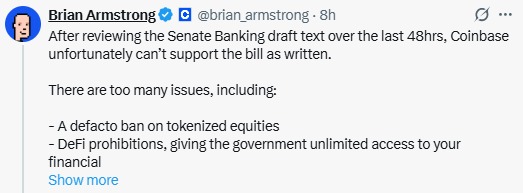
Source: X (formerly Twiiter)
Another big issue is stablecoin rewards. Draft changes may stop platforms from sharing interest earned on stablecoin reserves with users. Brian says this would raise costs for customers, reduce choices, and give banks unfair control over digital finance.
Armstrong stated clearly thatbut he also said he is optimistic that lawmakers can fix these problems with more work.
Senate Delays the Markup Vote
After Coinbase Withdraws Support, reporter Eleanor Terrett confirmed that the Senate Banking Committee pulled the scheduled markup.

Source: X (formerly Twitter)
A new date has not been announced yet. This pause shows lawmakers want to avoid passing a bill that could divide the industry.
At the same time, several major companies support the CLARITY Act. Ripple, Circle, a16z, Kraken, CoinCenter, and the Digital Chamber all backed the bill.
Ripple CEO Brad Garlinghouse said it balances innovation and safety, while protecting investors.
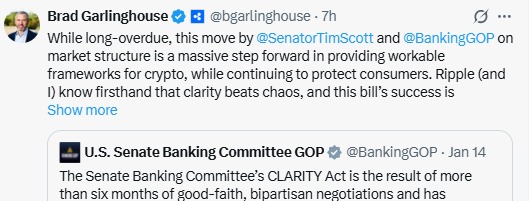
Source: X (formerly Twitter)
Lawmakers Defend the Bill
Senator Tim Scott, Chairman of the Senate Banking Committee, said all sides are still talking and working in good faith. He explained that the bill reflects months of bipartisan work and aims to protect consumers, improve national security, and keep financial innovation inside the United States.
Senator Cynthia Lummis, a strong crypto supporter, also praised the bill. She believes the CLARITY Act could help the U.S. become a global crypto leader by offering clear and fair rules.
Stablecoin Rewards at the Center of the Fight
The reason CEO Brain Armstrong withdraws support mainly comes down to Coinbase stablecoin rewards. The firm currently offers around 3–4% rewards on USDC balances. These rewards attract users and support Coinbase’s business.
Banks argue that these rewards pull money out of traditional deposits, reduce lending, and create unfair competition. Brian disagrees. It says limiting rewards would harm consumers and weaken the U.S. digital payments system. The company also warned that banning rewards could reduce the dollar’s strength in global crypto markets, especially as China now pays interest on its digital yuan.
What Does This Means for Crypto Markets?
Even though Coinbase pulls support, many leaders remain confident. Galaxy CEO Mike Novogratz said he believes a deal will be reached soon and that tension is normal when big laws are close to completion.
If stablecoin rewards survive in some form, U.S. platforms may keep growing. If they are banned, users and capital could MOVE to offshore platforms. At its heart, this debate is about who benefits from stablecoin interest: banks, crypto platforms, issuers, or everyday users.
For now, this pull-off has slowed the process, but it has not stopped it. The next version of the bill will decide the future of digital assets regulation in America.
