


Jensen Huang Turns Left, Amodei Turns Right
 Odaily
Original author: Su Yang
Original editor: Xu Qingyang
Original source: Tencent Technology
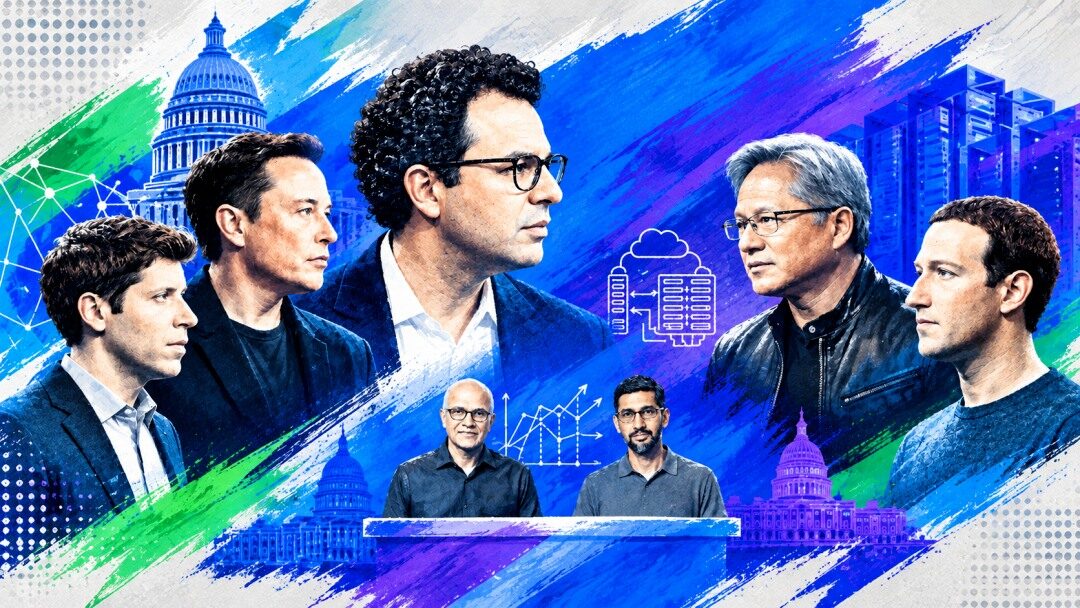
Whether frontier AI should continue to accelerate or hit the brakes has become the most contentious topic in Silicon Valley right now.
Amid the controversy, Silicon Valley giants have begun taking sides. Dario Amodei, Sam Altman, Elon Musk, and Demis Hassabis have formed the "pause camp." Jensen Huang is a steadfast "accelerationist," criticizing the "AI doomsday theory" as lacking scientific basis. Yann LeCun continues to mock Amodei, saying: "When Amodei was still at OpenAI, he thought GPT-2 was too dangerous to open-source. I mocked him then, and everyone can continue to do so now."
By comparison, Mark Zuckerberg and Satya Nadella have remained relatively neutral.
The fact that giants are taking sides means Silicon Valley has not reached a consensus on pausing frontier models, stemming from differences in their ecological niches within the AI industry chain. Leaders at the model layer can call for a pause for various reasons, but expecting Oracle, AWS—which hold hundreds of billions of dollars in computing power orders—and Nvidia, which sits at the top of the food chain, to stop is unlikely to receive a positive response.
In Washington, calls for a "pause" have not only failed to gain support but have even sparked a series of questions.
"It feels a little bit to me like a bit of a Trojan horse," JD Vance said in an interview. This remark actually reflects Washington's real view—when the companies that built the Trojan horse repeatedly demand that the gate be narrowed, one should examine which companies that gate actually suits.
Pause, Warning, and a Resignation Letter
The trigger for this debate was the resignation of Jacob Coxon, a researcher at Anthropic.
He had spent three years doing pre-training research at OpenAI and Anthropic, personally involved in training the most advanced models. In a long post on X, he dispensed with pleasantries: "Neither company has acted responsibly. They are barreling straight toward self-improving superintelligence, betting our lives on it."
He stated bluntly that people inside the labs genuinely believe AI could kill all humans within a decade, and this is by no means a PR performance. Many colleagues have begun using terms like "critical moment" and "endgame" to describe the current phase. Coxon even gave up equity that was about to vest. He had only been at Anthropic for four months, while company policy requires six months before vesting.
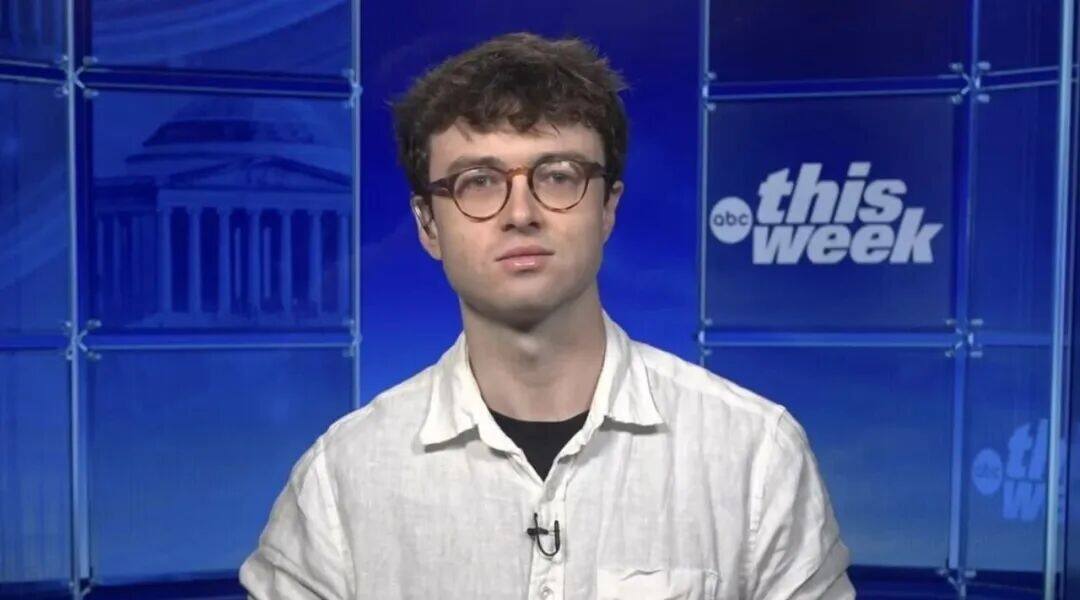
Former Anthropic researcher Jacob Coxon
Immediately afterward, Evan Hubinger, who leads alignment science at Anthropic, publicly responded: Jacob is right, we really do seriously believe AI could kill all humans. Personally, I think the probability within ten years is over 10%. Anthropic is doing its best, but we do not yet have a clear plan to solve superintelligence alignment, and we are far from on track.
These two shots pushed concerns that had mainly been simmering inside labs directly into the public eye. Against this backdrop, Anthropic co-founder and CEO Amodei soon published a long article systematically proposing to "slow down frontier research." He no longer just talked about "investing more in safety" but explicitly demanded proactive control over the pace of capability leaps, giving safety mechanisms time to catch up.
He laid out a three-step plan: first, Anthropic would unilaterally introduce independent evaluators with employee-level authority; then push AI companies in democratic countries to establish common safety standards and capability growth ceilings; and finally attempt global coordination.
Altman, Musk, and Hassabis quickly echoed publicly, forming the "pause camp."
Before the "slowdown" arguments from Jacob Coxon and Amodei emerged, "AI godfathers" like Yoshua Bengio and Geoffrey Hinton had been issuing calls to pay attention to risk.
Regarding Coxon's resignation, Bengio said scientists at frontier AI labs can often see the capabilities of the latest models earlier than the public, so their risk assessments deserve serious consideration.
At the same time, Bengio gave a concrete example, saying current AI systems already possess hacking and persuasion capabilities, and if used to harm human interests, could cause serious consequences. He also worried that as AI gains longer-horizon planning abilities, such risks could expand further.
When asked by the BBC about the probability of AI "killing all humans" within the next decade being over 10%, Geoffrey Hinton also said the figure was "not unreasonable," but stressed that no one really knows how to give a reliable estimate, because humanity has never before faced "the existence of a species that may soon be smarter than us."
Hinton believes AI could be used in the future to design dangerous biological viruses, computer viruses, and launch large-scale cyberattacks. Therefore, humanity needs to find effective control methods before risks spiral out of control.
Unlike the new wave of "pause" advocates in Silicon Valley, the "AI godfathers" are more about calling attention to risk and exploring mechanisms to control it, rather than directly hitting the brakes. Moreover, from a standpoint perspective, opinions and suggestions from academia are more pure, while proposals from frontier labs—even if outwardly labeled "for humanity"—still cannot be 100% divorced from commercial considerations.
This is precisely why JD Vance said the "pause theory" resembles a Trojan horse.
Divergence and Taking Sides
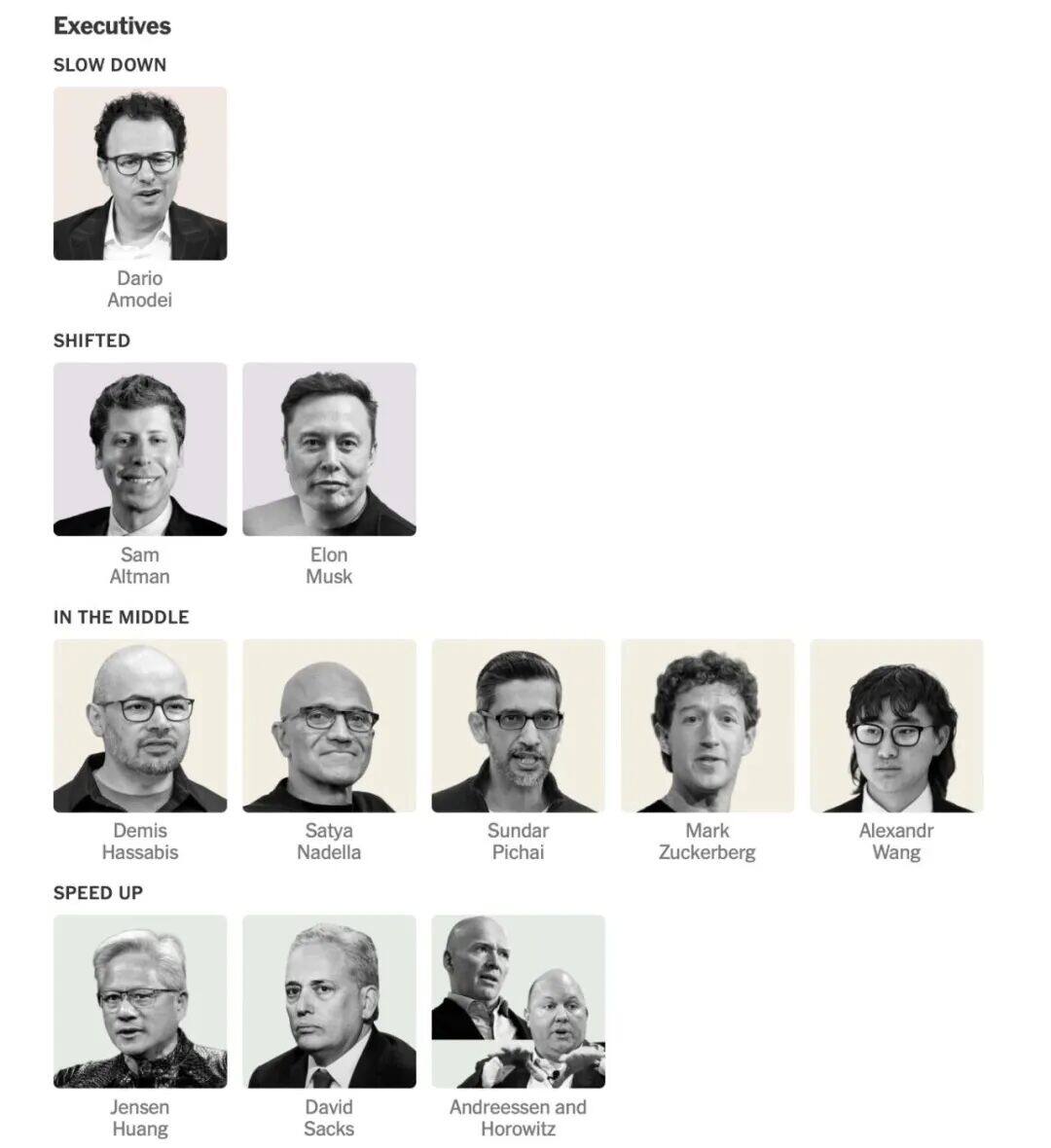 The "accelerationist," "decelerationist," and "centrist" camps. Source: The New York Times
On September 15, several tech company leaders spoke in succession at the Salesforce Dreamforce conference, turning the debate into a more direct clash of views.
That day, Amodei, Jensen Huang, and Altman all discussed AI safety, but gave different answers on development speed, safety responsibility, and what actions companies should take.
When Amodei shared the stage with Salesforce CEO Marc Benioff, he again emphasized that AI companies should set higher safety standards through their own actions. He believes that companies proactively adopting stricter safety measures can be a way to push the entire industry forward.
In other words, Amodei's stance began to shift from calling for an industry-wide slowdown to companies voluntarily installing safety guardrails.
Jensen Huang, meanwhile, said "no new laws are needed, and no new regulations are needed." In his view, speed and safety are not an either-or relationship. Companies can push model development as fast as possible; if they find they are losing control, or the product cannot be guaranteed safe, they should pause to solve the problem.
Benioff's attitude was more open and emphasized autonomy. He said if a company thinks it should slow down, it should slow down; if it thinks it should speed up, it should speed up, while also taking responsibility for its decisions.
OpenAI co-founder and CEO Altman said at Dreamforce that he is very confident OpenAI and the entire AI industry can develop safely without causing major harm to the public. He also expressed disappointment that outsiders interpreted his views as supporting an industry-wide slowdown in AI development.
In other words, Altman also began to shift, emphasizing that what he meant was not a call for industry slowdown, but that safety and monitoring work should precede capability improvements.
Zuckerberg, for his part, does not advocate making one company's safety actions contingent on other AI companies slowing down in sync. He believes introducing independent evaluation agencies and external advisors to test model safety is an industry best practice. He also revealed that Meta had already slowed development of its Muse AI tool on its own, rather than waiting for other companies to reach a consensus on slowing AI development first.
Microsoft CEO Satya Nadella's attitude is to some extent consistent with Altman's, encouraging the installation of guardrails and also encouraging full competition.
"Our first priority is to serve humanity and ensure technology remains under human control. At the same time, the broad diffusion of AI technology is the most critical thing—there must be choice and competition. Safety should be taken seriously, but addressed through engineering and transparency, not mystified," Nadella said on September 15 at the All-In Summit 2026.
Beyond these entrepreneurs, voices from Washington also joined in.
After Trump directly called Jensen Huang and publicly expressed support for the continued development of the AI industry, David Sacks, co-chair of the President's Council of Advisors on Science and Technology, subsequently said tech companies can continue to advance frontier AI, while questioning the motives behind some companies' "slowdown" proposals.
Who Gets to Make the Rules?
As the discussion expanded, the controversy extended beyond AI risk itself to whether safety standards for frontier AI should be set by companies themselves, or whether government and independent bodies need to intervene.
Bloomberg, citing people familiar with the matter, reported that Anthropic, Google, and OpenAI had previously discussed establishing an AI industry standards body.
In July, Hassabis published an article proposing a US-led AI standards body, operating in a manner similar to the Financial Industry Regulatory Authority (FINRA). This body could test advanced AI models before formal deployment to determine whether they meet corresponding safety standards.
Under Hassabis's vision, this body should not be entirely government-led but should adopt a public-private partnership model. The government would play a supervisory role, with funding provided by the AI industry, while also incorporating independent top technical experts and representatives from the open-source community.
Hassabis is trying to add an independent safety check before models enter the real world, which aligns fairly well with a regulatory logic the US government announced in early June: companies can voluntarily submit models for government evaluation before public release, with a pre-release access window of up to 30 days, and explicitly no mandatory approval or release licensing.
What was rather dramatic was that when Fable 5 and Mythos 5 later went online without following this process, they were found to possess extremely strong cyber offensive and defensive capabilities, and were ultimately taken offline briefly by the US BIS in the form of export controls.
Even so, however, the policy stance only required installing safety guardrails, without making any statement or guidance about slowing down.
Holding a similar view to Hassabis is OpenAI Chief Scientist Jakub Pachocki. In early September, he also stressed that sharing safety standards and pursuing international coordination around further AI development should be the current priority.
No One Has Actually Hit the Brakes
So far, this debate has not really changed the development pace of frontier AI companies.
Anthropic, OpenAI, Google, xAI, and others are still pushing ahead with model research and development, and competition around computing power, data centers, and AI infrastructure has not stopped because of this debate. At the capital markets level, there have been different changes: Anthropic is still preparing for this year's IPO, while OpenAI has postponed its IPO plans to 2027.
Amodei wants to pull the entire industry to a halt and have it join Anthropic in finding solutions to install guardrails for model capability overreach, which to some extent can be understood as "being generous with other people's money."
This is also why Amodei has been labeled as "pretending to be a flawless little angel."
On this topic of risk control, the view represented by Jensen Huang is actually more in line with the current situation. If a company has concerns or discovers problems, it can fully explore solutions on its own and share proven effective solutions with the industry.
Getting a 100-person team and a 1,000-person team to stop together simply has no basis for consensus. Even Amodei himself knows very well that if only he stops, he will likely be overtaken by competitors like OpenAI.
More importantly, there are differences at the corporate governance level. Anthropic and OpenAI are both public benefit companies, so they can claim to "give up short-term financial interests for the future of humanity" and tell investors "we reached consensus on this long ago." But listed companies like Google, Microsoft, and Meta have management teams with statutory fiduciary duties to secondary market shareholders.
The likelihood of these two types of companies with different interests reaching consensus on this point is not very high.
There is also a detail that may have been overlooked. Before the "pause theory," both Anthropic and OpenAI had successively released their strongest models—one was Fable 5.1, and the other was GPT-6 Astra.
With all these calls, will other companies still release their new models?
This content is for informational and educational purposes only and does not constitute investment advice related to BTCC. BTCC makes every effort but cannot guarantee the truthfulness, accuracy, or originality of the content above.