


CLARITY Act Vote Nears as BTC Pulls Back, Volatility May Rise
 BTCCAuthor: harvey
Today, the U.S. Senate will hold a key procedural vote on the CLARITY Act. The bill is widely viewed as a major milestone in U.S. digital asset market structure legislation, covering regulatory boundaries, market rules, and compliance frameworks for the crypto industry. As a result, it has drawn significant attention from the crypto market.
The Senate is scheduled to hold the procedural vote at 2:15 p.m. ET on September 15. At least 60 votes are required to end debate and move the bill into further consideration. This is not the final vote. Even if the motion passes, the bill would still need to go through amendment consideration, a final Senate vote, reconciliation between the House and Senate versions, and presidential approval.
Republicans are actively pushing the bill, but they still need support from some Democratic senators to clear the 60-vote threshold. Elizabeth Warren, the top Democrat on the Senate Banking Committee, publicly opposed the bill on Monday evening, arguing that the current provisions are insufficient to prevent Trump from continuing to profit from crypto-related businesses.
Today’s vote will therefore not only determine whether the CLARITY Act can continue moving forward, but will also test whether the two parties can reach a minimum level of consensus on crypto regulation.
Low Passage Expectations Set Up a Potential Market Surprise
Wall Street investment bank Bernstein believes the latest negotiations may be progressing better than the market currently expects. Trump’s concessions on ethics provisions and state-level enforcement authority could help win support from some Democratic senators. The bank noted that sentiment remains broadly bearish ahead of the vote, meaning a positive outcome may not yet be fully reflected in crypto assets and crypto-related stocks.
Polymarket data shows that the probability of the CLARITY Act completing the legislative process this year has fallen from around 33% a day earlier to 19%.
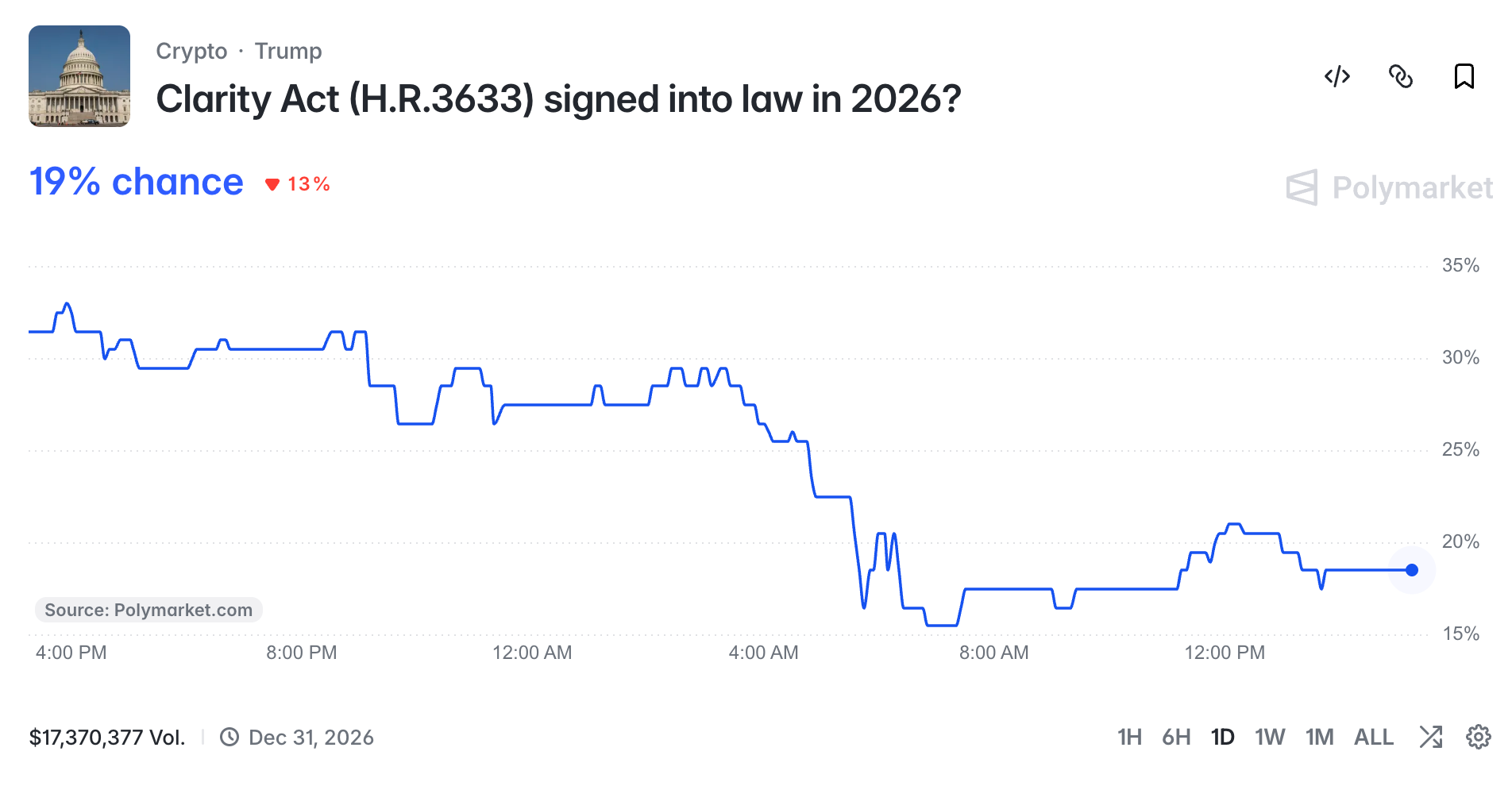
It is important to note that this figure reflects the probability of the bill completing the entire legislative process and becoming law within the year. It does not represent the probability of this procedural vote alone securing the required 60 votes.
Because market expectations are already low, a better-than-expected outcome could have a more pronounced positive impact on crypto assets and related equities.
BTC Pulls Back After a Rally as Markets Adjust Positions
Ahead of the vote, the crypto market remains cautious. BTC briefly climbed to around $79,200 before falling below $77,000, down 1.2% on the day. ETH is trading around $2,480, down 1.9% over the past 24 hours. The broader crypto market remains in a weak, range-bound pattern.
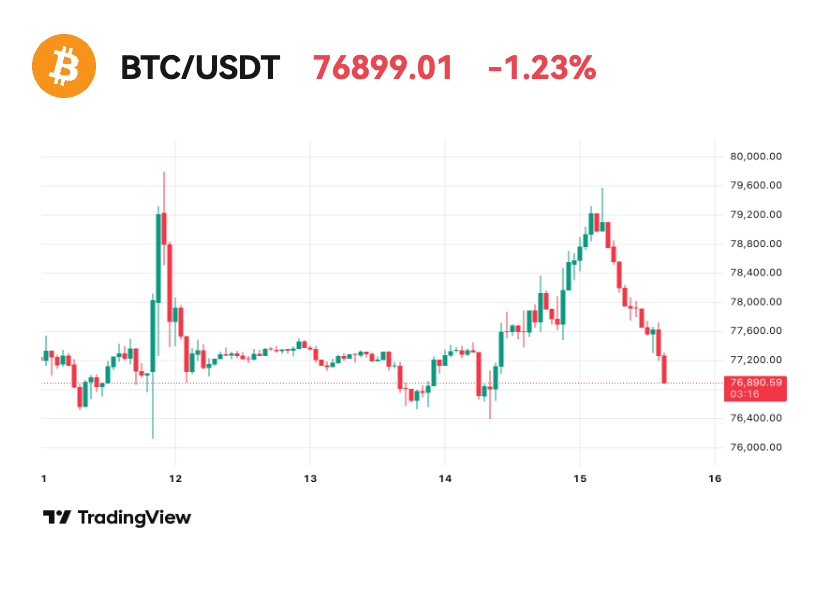
Notably, total BTC trading volume has risen by around 60% from the previous day, but the price has yet to achieve a meaningful breakout. This suggests that investors are actively adjusting positions and hedging event risk ahead of the key vote and the upcoming FOMC meeting.
At the same time, crypto analysts have noted a clear increase in the amount of altcoins flowing onto exchanges over the past seven days. Large inflows to exchanges typically indicate rising potential sell-side pressure. While current levels have not yet reached abnormal territory, the trend is worth monitoring as several major events approach.
If the procedural vote secures at least 60 votes, it would signal that the U.S. crypto regulatory framework is continuing to advance. Given the currently low market expectations, BTC could retest the $78,500-$80,000 range, while the result could also support U.S.-compliant trading platforms, DeFi, RWA-related assets, and some highly liquid altcoins.
If the vote falls short of 60 votes, expectations for the bill to become law this year could weaken further, while short-term profit-taking may accelerate. BTC would first need to hold support around $76,800, with stronger support at $76,000-$76,500. High-beta altcoins could face greater downside pressure.
However, because the market has already priced in relatively low odds of passage, the negative impact may be limited. The next move will also depend on the final vote count and whether Republicans quickly restart negotiations or schedule another vote.
The 60-Vote Threshold Remains the Biggest Question
To win more Democratic support, the White House has recently made further concessions on government ethics provisions.
White House crypto adviser Patrick Witt said that after officials briefed Trump last Friday on the ethics provisions in the revised bill, Trump agreed to further adjustments. The provisions could require government officials to divest significant crypto holdings or transfer them into qualified blind trusts, while also granting state attorneys general certain enforcement and accountability powers.
Republicans then released a revised version of the bill, calling it their “last, best, and final offer” to Democrats. The new text adds restrictions on federal elected officials, their spouses, and related individuals participating in digital asset businesses. It also revises provisions covering DeFi regulation, the application of the Bank Secrecy Act, and digital asset services offered by credit unions. Republicans said the revised version incorporates 114 amendments proposed by Democrats.
However, major disagreements remain. Democrats led by Elizabeth Warren argue that the current provisions are still insufficient to prevent politicians from profiting through crypto-related businesses. Some Democrats involved in the negotiations are preparing a counterproposal that would further strengthen divestment rules, blind-trust requirements, and enforcement powers for state attorneys general.
At this stage, the dispute has shifted from whether the U.S. should establish a digital asset market structure framework to how political conflicts of interest should be restricted and how enforcement authority should be divided. These issues will directly affect whether the procedural vote can clear the 60-vote threshold.
Risk Warning: Some of the views in this article are drawn from public media sources and are for reference only. They do not constitute any investment advice or trading recommendation. Markets involve risks, and trading should be approached with caution. Please ensure you have appropriate risk controls in place.
This content is for informational and educational purposes only and does not constitute investment advice related to BTCC. BTCC makes every effort but cannot guarantee the truthfulness, accuracy, or originality of the content above.