


Will AI Slowdown Change the Logic of CapEx and Tech Stocks?
 Blockbeats
Original title: The bottleneck isn't the model. It never was.
Original author: Saket Mehrotra, Beta to Alpha
Editor's note: Recently, Jacob Coxon, who previously worked on pre-training at OpenAI and Anthropic, announced his departure from Anthropic and publicly called on leading AI labs to coordinate limits on further increases in model capabilities. Anthropic's Head of Alignment Science, Evan Hubinger, subsequently responded that he agrees with Coxon's main risk assessment and estimates the probability of AI causing human extinction in the next decade at over 10%.
This debate is pushing "AI slowdown" from an ethical issue into the capital markets: if frontier labs really do slow down model development, will the AI capital expenditure that has been repeatedly revised upward over the past few years also reach an inflection point? And will tech stocks that have enjoyed valuation premiums based on the AI narrative need to be repriced?
Beta to Alpha author Saket Mehrotra argues in "The bottleneck isn't the model. It never was." that labs' concerns about AI risk are not the same as a cooling of infrastructure investment. As long as companies still worry about falling behind in the race, safety anxiety may continue to drive compute investment; meanwhile, the industry bottleneck has gradually shifted from GPUs, HBM, and advanced packaging to power and the grid.
This does not mean AI slowdown has no market impact. More precisely, the impact depends on which layer the slowdown occurs at: if it only extends safety testing and slows model releases, CapEx may not necessarily decline; if governments directly restrict training clusters, chip supply, or data center power usage, the entire investment framework could fundamentally change.
The following is a compiled translation of the original article:
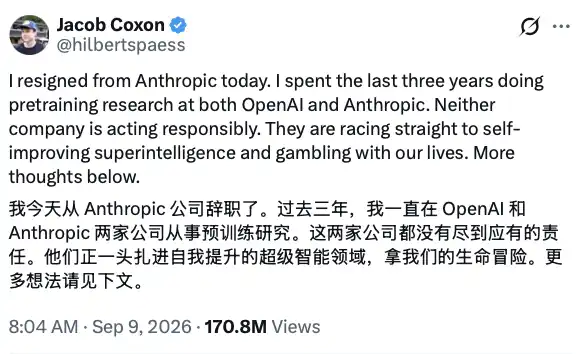
Jacob Coxon posted a departure statement on X, calling on frontier AI labs to coordinate a slowdown in the capability race
Jacob Coxon's departure once again brings the risks of frontier AI to the forefront.
Coxon believes that OpenAI and Anthropic are racing to develop superintelligence capable of self-improvement without taking sufficiently responsible safety measures. This is not an isolated voice from external critics. Anthropic's Head of Alignment Science, Evan Hubinger, subsequently stated publicly that he agrees with Coxon's main assessment and estimates the probability of AI causing human extinction in the next decade at over 10%. These statements were also covered by media outlets such as WIRED.
But for investors, another question may be more direct: when frontier labs start discussing slowdown, will tech companies' AI capital expenditure also decline?
Mehrotra argues that, at least at this stage, the two cannot be directly equated. The AI safety debate occurs at the model and lab governance level, while the constraints of this CapEx cycle have gradually shifted down to physical infrastructure such as chips, packaging, power, and data centers.
The more labs fear losing the race, the harder it is for them to proactively slow down
According to Coxon's description, frontier labs are not unaware of the risks. The real problem is that no lab is willing to be the first to slow down.
The game theory logic is: if one lab chooses to slow down, other less safety-conscious competitors may be the first to develop more powerful models. Rather than letting less cautious rivals break through first, it is better to continue investing resources to ensure one becomes the leader and strives to control the technology in a safer way.
In the author's view, this mindset is unlikely to translate into capital expenditure contraction, but may instead reinforce the arms race. The more labs believe they are engaged in a decisive technological competition, the harder it is to cut GPU procurement, training clusters, and data center investment.
Therefore, safety anxiety and CapEx growth can coexist. It may even form a self-reinforcing loop: labs worry about rapid AI capability improvement, yet invest more resources because they fear falling behind competitors, further accelerating the capability race.
This is the author's explanation of the industry's game structure, not a result confirmed by companies' capital expenditure plans. To judge whether this logic holds, it is still necessary to observe whether major cloud vendors and AI labs begin to adjust actual procurement and construction plans.
Model slowdown does not mean the infrastructure cycle is over
Mehrotra's second judgment is that the core bottleneck of the AI industry has migrated multiple times, and each migration has increased capital intensity.
Initially, GPU supply and chip quotas limited model training; subsequently, the bottleneck shifted to HBM high-bandwidth memory and advanced packaging; now, power supply, grid connection, and data center construction are becoming constraints that are harder to resolve quickly.
Chip and packaging capacity can be alleviated by expanding production lines, but power issues typically require building or restarting generation facilities, increasing gas turbine and transformer capacity, and upgrading transmission and grid interconnection systems. Such projects involve larger investment scales and longer construction cycles, and cannot be solved by a single software upgrade.
Therefore, even if the frequency of frontier model releases declines, already signed chip orders, power purchase agreements, and data center construction projects may not stop immediately. There is a time lag between model development and infrastructure construction, and CapEx usually does not turn in sync with public opinion or R&D pace.
At the same time, slowdown does not necessarily mean compute demand naturally declines. Longer safety testing, more complex inference processes, and the deployment of existing models to enterprise and consumer scenarios may still consume significant computing resources.
The author thus argues that investors should not focus only on the model layer where social media debates are most intense, but should look for new bottlenecks forming over the next 18 months. Under this framework, the scarce resource worth watching has gradually shifted from "model intelligence" to power and its supporting infrastructure.
AI tech stocks may shift from broad gains to differentiation
If model slowdown does not equal CapEx halt, its impact on tech stocks will not be a simple across-the-board negative, but more likely manifest as repricing across the industry chain.
First, companies that rely on continuous leaps in frontier models and rapid product monetization may be more vulnerable. Once model iteration slows, market assumptions about revenue growth, commercialization pace, and valuation multiples may need adjustment.
Second, companies that control GPUs, networking equipment, power distribution, cooling, and data center resources may not see their order logic deteriorate in sync. As long as cloud vendors continue to expand infrastructure, or compute bottlenecks continue to shift toward power, related investment may maintain strong inertia.
Third, the market needs to distinguish between training and inference. Even if labs coordinate to limit ultra-large-scale frontier training, inference demand from existing models, enterprise deployment, and AI application adoption may still drive compute consumption. At that point, CapEx may undergo structural change rather than a cliff-like contraction.
This means that AI slowdown may first change not the growth direction of the entire tech industry, but the situation where different assets share the same AI valuation logic. In the past, model companies, cloud vendors, semiconductor firms, and power infrastructure suppliers could all earn premiums from the AI narrative; if the model capability race slows, the market may begin to more strictly differentiate technological leadership, commercialization capability, and order fulfillment.
The variable that truly changes CapEx logic is regulation
Mehrotra believes that what could truly interrupt this AI capital expenditure cycle is not another supply chain shortage, but hard limits imposed by governments from outside the system.
Shortages of GPUs, HBM, power, and transformers are essentially bottlenecks that can be alleviated by increased investment. They may delay data center launches, but they will also direct capital to new scarce segments.
Regulation is different. If governments directly restrict high-end chip procurement, training cluster scale, compute required for model training, or data center power usage, companies will find it difficult to break through constraints merely by increasing investment. In that scenario, cloud vendors' CapEx expectations, infrastructure orders, and AI-related tech stock valuations could face downward revisions simultaneously.
However, the original article treats this scenario as a low-probability tail risk rather than a base case. This judgment also requires continuous verification and cannot be interpreted as regulatory risk having been ruled out. As concerns within AI labs become public, external policy pressure may still rise.
Going forward, what the market really needs to watch is not the vague slogan of "AI slowdown," but three more specific signals: whether frontier labs write slowdown into formal R&D plans, whether major cloud vendors cut data center orders, and whether regulation begins to directly touch chips, compute, and energy supply.
Coxon's departure proves that the safety debate over frontier AI has moved from external criticism into the labs themselves. But from researchers expressing concerns to tech companies actually cutting capital expenditure, there are still multiple links in between, including competitive pressure, construction inertia, and infrastructure shortages.
AI slowdown may not immediately end the CapEx cycle, but it may end the phase where all AI assets share the same upward logic.
This content is for informational and educational purposes only and does not constitute investment advice related to BTCC. BTCC makes every effort but cannot guarantee the truthfulness, accuracy, or originality of the content above.