


Cronos's Single-Player Philosophy: Hacked? Just Roll Back
 Blockbeats
Original title: "Cronos's Single-Player Philosophy: Hacked? Just Roll Back"
Original author: Azuma, Odaily News
On August 30, Tectonic, the largest lending protocol in the Cronos ecosystem, an affiliated chain of Crypto.com, was hacked.
The attack itself was not particularly complex. The attacker pushed the price of TONIC, Tectonic's governance token with extremely low liquidity, up by about 100 times in roughly 20 minutes. They then used these inflated TONIC tokens as collateral to borrow other assets from Tectonic, involving approximately $75 million, of which about $6 million was bridged to Ethereum.
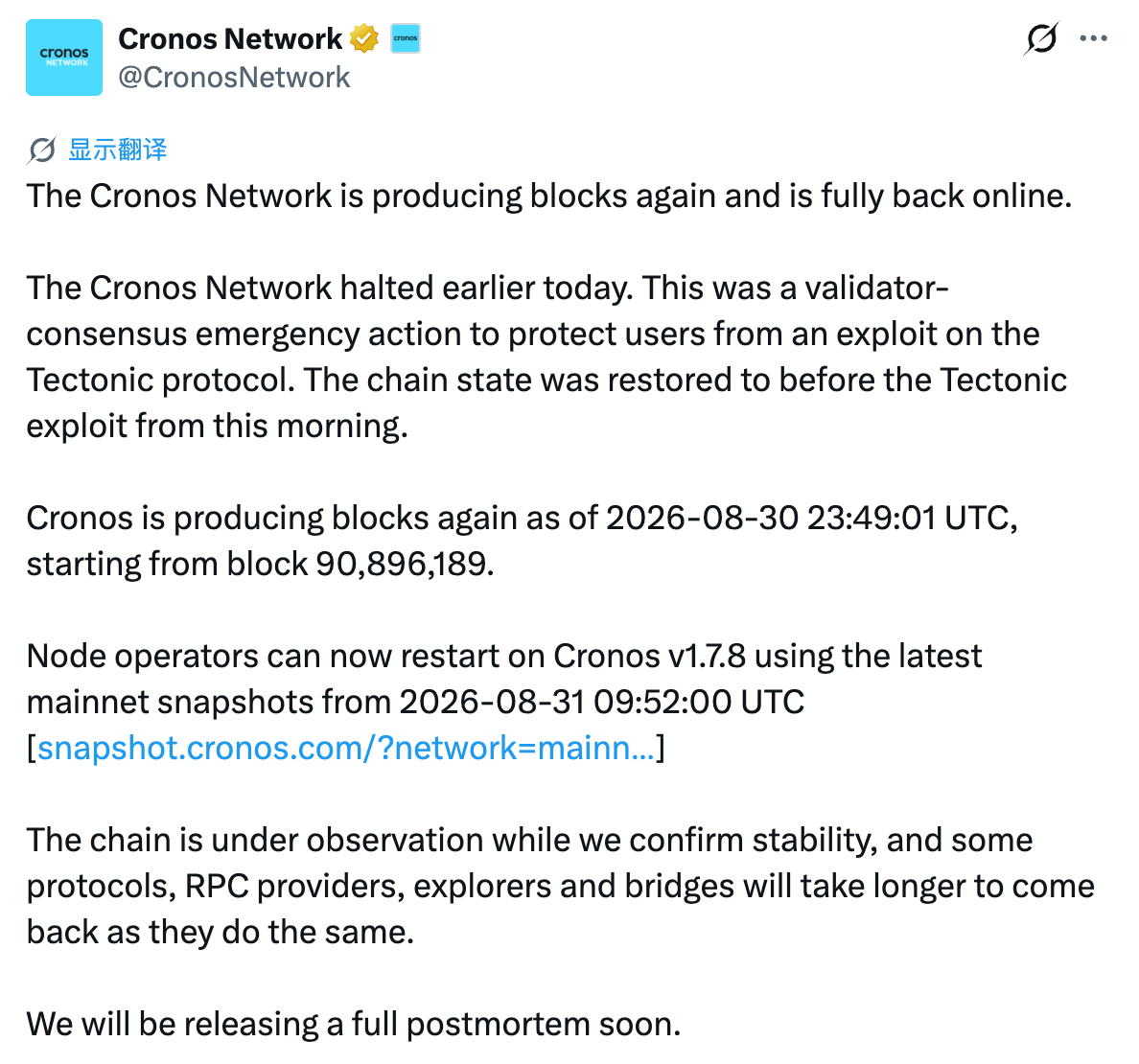
More dramatic than the attack method was Cronos's response. After the attack, Cronos first suspended the network on the evening of August 30 (stopping it just like that, an early sign), preventing further outflow of stolen funds. Then, on August 31, it released a network restart plan, announcing that the chain state would be rolled back to before the Tectonic hack on August 30, restarting the network from block height 90896189.
Huge Controversy Over the Rollback
Blockchain rollback, simply put, means "loading a save" of the network state to a past point in time. Transactions, transfers, and smart contract operations that occurred after that point would, in principle, disappear from the new chain history.
This is what Cronos chose. From a results standpoint, it was indeed the easiest and possibly the most effective solution. At the time of the attack, about $75 million in assets were affected, but before Cronos halted the chain, only about $6 million had been successfully bridged out, with most of the remaining assets still on the Cronos chain. Since the money hadn't left yet, they could simply delete the on-chain history after the attack with one click—theoretically, most of the losses would vanish along with it.
From the perspective of protecting user funds, Cronos's choice is hard to fault. Otherwise, they might have had to watch the attacker move funds layer by layer, relying on security teams to track, freeze, and negotiate, with recovery depending entirely on luck.
Of course, the cost of rollback is equally obvious. The attacker's transactions can disappear, but so can normal transfers, trades, and settlements made by ordinary users during that period. In this incident, the Cronos network restarted from block height 90896189, but before the halt, the network had reached block height 90907150, a difference of 10,961 blocks—meaning all normal transactions within those ten thousand plus blocks were canceled.
Take an extreme example: if you happened to use the Cronos network for a transfer during that time (e.g., A pays B on-chain in exchange for goods or services), the rollback would cancel the original payment transaction, potentially leading to a situation where goods are delivered but payment disappears.
The bigger controversy lies in "transaction finality." A key reason blockchain can serve as a value settlement network is that once a transaction receives sufficient confirmations, participants believe it is irreversible—the money you received truly belongs to you, and the payment I made won't suddenly vanish hours later.
Cronos's action undoubtedly weakens its "transaction finality." If something serious enough happens, even finally confirmed transactions may not truly be final.
Of course, rollback in extreme cases is not unprecedented. Historically, some public chains have modified chain state through community coordination after major security incidents. But the problem is, once this door is opened, it's hard to avoid the question: if $75 million is worth rolling back, what about $50 million? $10 million? Or, besides hacks, what other events would be enough for validators to press the "load save" button again?
This is the biggest controversy of rollback. It can solve the problem now, but it also makes every on-chain participant realize—so-called immutability is not an absolute rule on Cronos.
This Isn't Cronos's First Time "Rewriting History"
If this rollback can be explained as "special times call for special measures," then looking back a year, Cronos's attitude toward history was already evident.
In 2021, Crypto.com announced with great fanfare the burning of 70 billion CRO, slashing the total supply from 100 billion to about 30 billion. This burn was hailed as one of the largest token burns in crypto history.
Then in 2025, Cronos proposed a rather straightforward plan: re-mint the 70 billion burned CRO and allocate them to a strategic reserve, restoring the total CRO supply to 100 billion. The official reason given was "to reshape Cronos's golden age, substantial funds are needed to support the Cronos roadmap," including driving US market expansion, supporting ecosystem development, institutionalization, and potential CRO ETFs.
This decision sparked huge controversy at the time. After all, the burn was originally declared "permanent," and no one expected that a few years later they would "mint a batch back." More dramatically, despite strong community opposition, the vote was reversed at the last moment due to concentrated voting by large holders, ultimately passing the proposal.
· Odaily note: See "CRO Stages the Most Absurd Governance Farce in History: 70 Billion Tokens Minted Out of Thin Air."
Cronos's "Single-Player Philosophy"
Putting these two events together reveals Cronos's distinctive style. Burned 70 billion CRO? No problem, re-mint. $75 million stolen? No problem, roll back.
The former modifies the supply; the latter modifies the on-chain state. One brings back tokens that were "permanently burned"; the other erases transactions that have already occurred and even been confirmed from history.
Cronos has reasons for each action—re-minting 70 billion CRO is to support the ecosystem's long-term development; rolling back the chain state is to recover user assets as much as possible. Individually, neither is entirely incomprehensible.
But the problem is, when such things happen repeatedly, it becomes hard to view "immutability" as Cronos's principle. What others see as blockchain history, Cronos treats more like a draft that can be modified according to actual circumstances. This may be Cronos's "single-player philosophy": rules matter, decentralization matters, but if modifying rules, supply, or even history can solve problems faster, there's no need to pretend it can't be done.
More bluntly, Cronos seems never hesitant or secretive about centralization controversies.
This content is for informational and educational purposes only and does not constitute investment advice related to BTCC. BTCC makes every effort but cannot guarantee the truthfulness, accuracy, or originality of the content above.