


JINQIAN Plunges from $80M to $3M in Two Hours: 'Stock-Coin Pairing' Becomes a Custom Pig-Butchering Scam
 Odaily
Original | Odaily News (@OdailyChina)
Author | Golem (@web3_golem)
On the evening of Sept. 2, Robinhood Chain staged a spectacle. The stock-coin pairing meme coin JINQIAN hit an $80 million market cap within an hour of launch, then plunged to $10 million in the next hour; as of press time, JINQIAN's market cap was only about $3 million. Financial freedom or total loss of principal seemed to hinge on a single thought.
Buy Stocks, Issue Memes? A Custom Pig-Butchering Scam in Crypto
To understand what happened in those two hours, we need to start with a post by overseas KOL Rune.
On Sept. 1, Rune posted that he had spent $1.8 million to buy 37.4% of a Nasdaq-listed company over the counter. The company had a market cap of $4.8 million, a share price of $0.12, and a short interest of 92.3% of the float. His plan was to tokenize the company's stock and deploy it on Robinhood Chain, then issue a paired meme coin. As long as the community traded the meme coin, demand would flow to the stock token, which would in turn prompt the issuer to buy an equivalent amount of the real US stock to pump it, creating a short squeeze in the stock market.
This idea alone sent countless meme players into a frenzy, because it perfectly fit the public's fantasy of "retail investors beating institutions," "crypto beating Wall Street," and "a poor kid reborn as a dazzling hero." So the community was waiting for such a coin to appear. A day later, JINQIAN was born.
JINQIAN was paired with the stock token FAMI. Farmmi (FAMI) is a Nasdaq-listed company that mainly sells mushrooms. As JINQIAN's market cap rose, the on-chain stock token FAMI's price increased, and Farmmi (FAMI)'s stock price surged to as high as $0.47 during US trading hours, a gain of over 300% in one hour.
Many thought JINQIAN would be the next GameStop, but it turned out to be a pig-butchering scam tailor-made for crypto retail investors.
Although the FAMI token shares the same ticker as the Nasdaq-listed company Farmmi, it is not an officially tokenized stock, and the asset is not included in Robinhood's official contract list. In other words, when JINQIAN trading drove up demand for FAMI, the issuer behind it may not have bought any Farmmi (FAMI) shares in the stock market at all. The short squeeze logic Rune imagined never materialized.
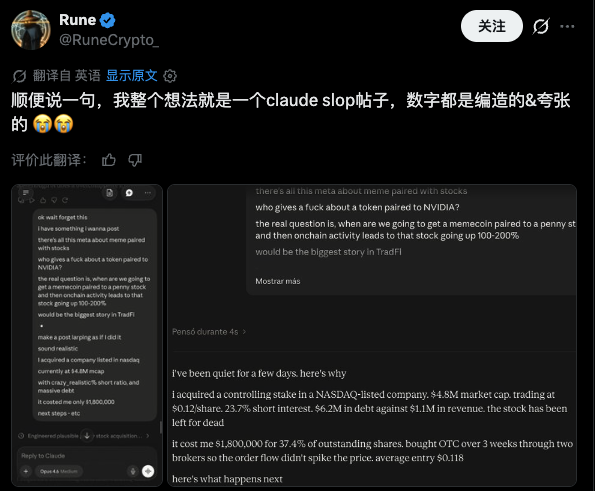
After JINQIAN crashed, Rune, who had been asking the community for an airdrop, quickly posted a clarification, saying that his earlier tweets about acquiring a US-listed company were all "AI slop" generated by Claude and were completely fabricated.
Right Result, Wrong Process
Rune's clarification was, of course, self-protective, because investors who suffered losses were already preparing to contact the FBI to arrest him. Without judging Rune for now, the real question is: since the demand for FAMI stock tokens triggered by JINQIAN did not transmit to the real stock market, who pumped Farmmi (FAMI)'s stock price?
The answer is still crypto meme players. "Smart" crypto players wanted to get ahead of market makers and Wall Street elites by buying Farmmi (FAMI) shares before they were "forced" to buy. Farmmi (FAMI) is a small-cap stock, and retail buying alone was enough to send it up more than 3x.
Chinese-language KOL 0xSun later analyzed that under normal circumstances, the logic of an on-chain stock-coin short squeeze is that retail investors who do not hold stock tokens buy meme coins, pushing up the price of the stock token that serves as the underlying asset in the liquidity pool. Market makers then buy the underlying stock due to arbitrage opportunities, convert and mint it into on-chain tokenized stock, and re-anchor the price. The market makers' buying of the underlying stock drives up the stock price, creating a short squeeze.
However, the JINQIAN/FAMI situation was different. The non-compliant project party issued the FAMI token on-chain and retained minting authority, and the liquidity pool may not have been locked. FAMI was essentially just an on-chain token with the same name as Farmmi (FAMI). Because Farmmi itself had an extremely low market cap, it triggered on-chain sentiment, and retail investors frantically bought JINQIAN, driving up FAMI as the pool asset. Some retail investors went a step further and directly bought Farmmi (FAMI), causing the stock price to rise.
Therefore, the rise in Farmmi (FAMI)'s stock price was a typical case of the right result achieved through the wrong process.
Is the Stock-Coin Pairing Meme Short Squeeze a False Proposition?
Language can describe reality, and it can also shape reality. Does the narrative of "meme coins squeezing Wall Street" really hold up, or is the meme community just looking for a nail with a hammer in hand?
Besides pure scams like JINQIAN, other stock-coin pairing meme coins have recently pushed the "meme coins squeeze Wall Street" narrative. The most typical is BONER, with a market cap of $44 million at press time. BONER is paired with the stock token HIMS. Hims (HIMS) is a company that mainly sells erectile dysfunction drugs. Chinese-language meme KOL Wang Xiaoer actively shilled BONER, saying that BONER's ultimate significance is to make meme-driven stock price increases a reality and to challenge Wall Street.
Using meme coins to pump their linked stock tokens is essentially a roundabout and inefficient form of market manipulation: the so-called "flywheel effect" is nothing more than market makers or project parties exploiting retail investors' speculative impulses to inject their funds into the underlying stock market to create short-term price spreads. However, this sentiment-driven buying lacks fundamental support, and demand is extremely fragile. Even if the token once traded at a significant premium to the underlying stock, it will eventually be quickly re-anchored to the stock price through arbitrage and value regression mechanisms.
On Robinhood Chain, there is only one issuer of stock tokens: Robinhood itself. Only authorized participants (APs) can directly subscribe to or redeem from Robinhood. When APs subscribe to stock tokens from Robinhood, the subscription funds are not transmitted to the real stock market instantly. This is constrained not only by US stock market trading hours but also by compliance, settlement, custody, and other procedural processes.
Therefore, the first reality facing this so-called logic of meme coin trading demand stimulating market makers or issuers to buy stocks is that on-chain meme FOMO ends within a few hours, while the capital transmission has not even begun.
Of course, whether the logic of "meme coins squeezing Wall Street" actually holds in reality may not matter to meme players—Wang Xiaoer is already sitting on unrealized profits of over $800,000 on BONER, with a cost of only $226.
The fastest way to unite the masses in this world is to create a common enemy, even if it is only an imaginary one. For retail investors, Wall Street/institutions have always been that "enemy," and making money from them or forcing them to do something is always exciting.
But when you pay for the "great narrative," don't forget that you are in the meme trenches, where there are no brothers, only demons who prey on each other.
This content is for informational and educational purposes only and does not constitute investment advice related to BTCC. BTCC makes every effort but cannot guarantee the truthfulness, accuracy, or originality of the content above.