Berkshire Hathaway Stock Drops 10% Post-Buffett Retirement News—Time to Buy the Dip?

Warren Buffett steps down, and Wall Street panics. Berkshire Hathaway shares tank 10%—classic overreaction or smart money fleeing?
Buffett’s exit marks the end of an era. But does it spell disaster for BRK.A, or is this a buying opportunity disguised as chaos?
The Oracle’s shadow looms large. Can Berkshire’s next-gen leaders keep the empire humming—or will the 'Buffett premium' evaporate faster than a meme coin’s liquidity?
Meanwhile, hedge funds sharpen their knives. Nothing excites Wall Street more than a legend’s retirement—except maybe shorting his life’s work.
Not much is changing
First of all, Warren Buffett will turn 95 years old on Aug. 30. Is it really that much of a surprise that he isn't going to be running Berkshire for much longer? It just seems far-fetched that the market was pricing in a more than 10% premium on the hopes Buffett WOULD continue to defy the odds and work into his late 90s. And to be honest, I feel that there's value in an orderly succession plan like this, as opposed to expecting Buffett to simply stay at the reins until he can't do it anymore.
It's also important to point out that on Jan. 1, 2026, the first day Buffett won't be CEO, not much is going to change from a day-to-day perspective. Berkshire's 60-plus subsidiary businesses largely operate with little or no oversight already. Greg Abel, who will take over as CEO, already oversees all non-insurance operations, and Ajit Jain is Berkshire's insurance head.
The biggest immediate changes will be that different people will be in control of the company's stock portfolio, and Abel will have power over Berkshire's $344 billion cash hoard. However, portfolio managers Ted Weschler and Todd Combs have been managing more of Berkshire's investments as the years have progressed.
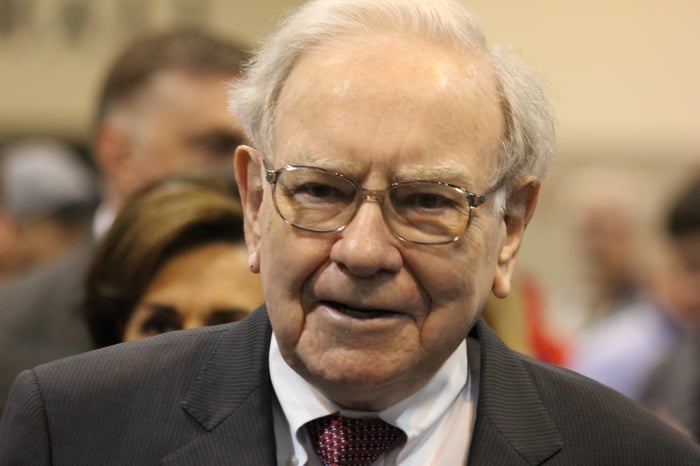
Image source: Getty Images.
If anything, Berkshire should be worth more now
From a business perspective, it's tough to make the argument that Berkshire's intrinsic value is lower than it was on May 1 before Buffett made his announcement.
There are three major components of Berkshire Hathaway's business -- the cash stockpile, the operating businesses, and the stock portfolio.
First, the cash is about $3 billion lower than it was at the end of the first quarter, but that represents about 0.3% of Berkshire's market value. And in the second quarter earnings report, there was no cause for concern about the operating businesses -- in fact, everything besides insurance underwriting profits (which are lumpy over time) grew nicely.
That leaves the stock portfolio. Consider Berkshire's top stock positions and how they've performed in the months since Buffett's announcement:
|
Apple (AAPL -0.17%) |
9.9% |
|
American Express (AXP 0.33%) |
14.2% |
|
Bank of America (BAC 1.00%) |
18.3% |
|
Coca-Cola (KO -1.27%) |
(0.5%) |
|
Chevron (CVX -0.27%) |
15.4% |
|
Moody's Corp (MCO 0.09%) |
15.6% |
|
Occidental Petroleum (OXY 0.04%) |
10.8% |
Data source: CNBC. Returns as of 8/13/25.
These are all of Berkshire's stock positions with a market value of $10 billion or more and represent nearly three-fourths of the entire stock portfolio. And the average return from this group is positive-12% since Buffett announced his retirement. It's fair to say that since Buffett made his announcement, the stock portfolio has gained tens of billions of dollars in market value.
The bottom line
To be completely fair, there's an argument to be made against buying Berkshire. For one thing, management didn't buy back any shares in the second quarter, despite the plunge after Buffett's announcement, which could suggest leadership still thinks the stock isn't a compelling value.
Plus, Berkshire's operating businesses aren't bad, but they aren't exactly industry standouts in many cases. For example, GEICO recently lost its No. 2 auto insurance market share to(PGR 0.80%), and Berkshire's management has acknowledged it has fallen behind when it comes to technology.
Having said that, Berkshire is still designed to be an incredible long-term compounding machine, and a new person in the CEO office, who has essentially been Buffett's understudy for years, doesn't change that. Berkshire is already one of my largest investments, and has been for some time, but I'm likely to add shares if this price level persists.
