Quantum Showdown: Rigetti Computing vs. IonQ – Which Stock Will Dominate the Future?

The quantum computing race heats up as investors scramble to pick winners. Rigetti Computing and IonQ emerge as frontrunners—but which one deserves your cash?
Rigetti: The Underdog with Bite
Silicon-based qubits give Rigetti an edge in scalability. Recent partnerships hint at commercial viability, but can they outpace the competition?
IonQ: The Trapped-Ion Titan
IonQ’s error-correction tech sets industry benchmarks. Heavy institutional backing fuels their moonshot—but at what valuation premium?
The Bottom Line
Quantum stocks trade on hype as much as hardware. Choose wrong, and your portfolio might vanish faster than a decohered qubit. (Wall Street won’t care—they’ve already moved on to the next shiny thing.)
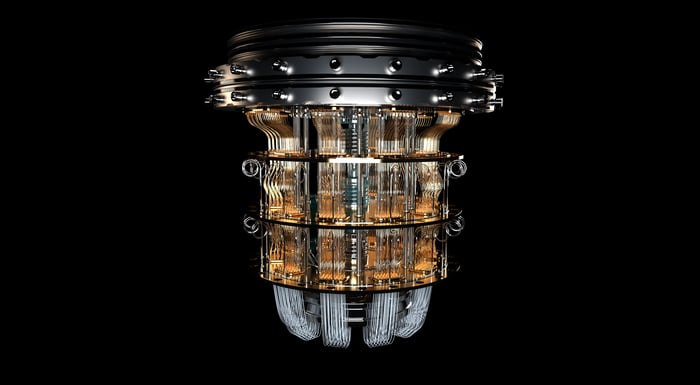
Image source: Getty Images.
Both companies are striving for increased accuracy
Because both companies are quantum computing pure plays, they must achieve commercial relevance or their stocks will go to zero. It's as simple as that. This represents a massive risk for investors, and anyone purchasing these stocks today must be willing to accept that they could become worthless in a few years.
On the flip side, because these two are quantum computing pure plays, the upside is immense. With that in mind, I'd suggest that no investor devote more than 1% of their portfolio to either of these two stocks. That way, if they lose the quantum computing race, it doesn't affect your portfolio too much. But if you pick the winner, that 1% position can rise to become a massive part of your portfolio.
Both IonQ and Rigetti Computing are offering full-stack solutions to their clients, which means that they offer everything needed to run quantum computing calculations with their products. Rigetti recently announced a significant breakthrough with its primary offering, Ankaa-3. Its 36-qubit systems, powered by four, nine-qubit chips tied together, delivered a 99.5% two-qubit gate fidelity. This is a big deal, as computing accuracy is a huge part of why quantum computing isn't more widespread today.
IonQ's platform is currently outperforming it, with a 99.9% two-qubit gate fidelity. While that 0.4% improvement doesn't sound like a ton, it's a significant improvement. Furthermore, it's due to launch its 100-qubit system soon.
IonQ appears to be in the lead, but could there be something that allows Rigetti to overtake it?
A balanced investing approach in this industry is smart
The biggest difference between these two companies is the approach they're taking in the quantum computing realm. IonQ is using a trapped ion approach, while Rigetti is using a superconducting approach. There are benefits and drawbacks to each method, and either company could be heading toward an unforeseen dead end in the future with their respective approaches.
That's why it's important not to put all of your quantum computing investing eggs in one basket.
The superconducting approach requires cooling a particle to NEAR absolute zero, which is a time-consuming and expensive process. The trapped ion approach can be done at room temperature, which could give IonQ the cost advantage it needs to scale its product quickly. On the flip side, the superconducting method can move calculations through gates faster, which could provide this technique with significant advantages over the trapped ion approach.
We're still years away from understanding which approach will be the eventual winner, so if you're interested in these two companies, I don't think picking a winner is a good idea. Instead, buying both with the expectation that one will be a huge winner and the other a loser is a smart approach. You can only lose 100% on a single investment (unless you're using some kind of leverage), while upside is unlimited. This mindset is key when investing in quantum computing, as there are bound to be both winners and losers.
