Why Arm Holdings Stock Is Taking a Dive Today – And What It Means for Tech Investors

Another rough day for chip stocks as Arm Holdings stumbles. The semiconductor designer—whose blueprints power everything from smartphones to AI servers—got caught in the sector-wide selloff. No dramatic earnings miss or guidance cut, just the market's fickle mood swinging against tech.
Wall Street's love affair with AI plays hits a snag. After riding the generative AI wave to dizzying heights, Arm's valuation now faces reality checks. Analysts whisper about stretched multiples as hedge funds rotate into 'old economy' stocks—because nothing says 'safe haven' like 20th-century industrials.
The irony? Arm's technology still underpins the AI revolution. Every Nvidia GPU and custom AI chip relies on Arm's efficient architectures. But in today's market, fundamentals take a backseat to momentum trades. One hedge fund manager quipped: 'We don't price semiconductors—we price the dopamine hits from chasing the next bubble.'
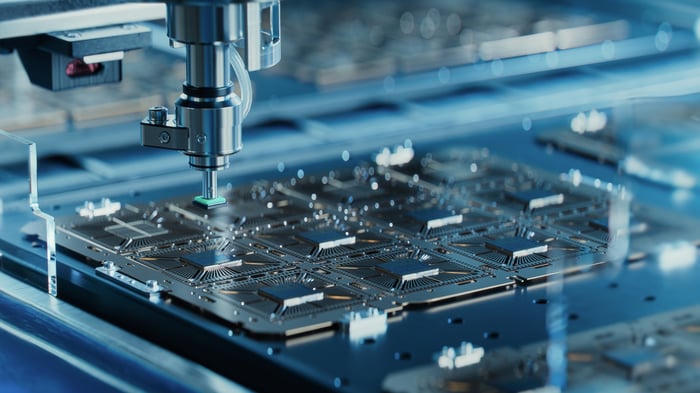
Image source: Getty Images.
Good, but not good enough
Overall revenue ROSE 12% in the quarter to $1.05 billion, a slowdown from the previous quarter, as it lapped a large licensing agreement in the quarter a year ago. That result was slightly below the consensus at $1.06 billion.
Royalty revenue, which may be a better reflection of underlying growth, rose 25% to $585 million, benefiting from increasing sales of Arm-based products in end markets including data centers, automotive, smartphones, and IoT.
Licensing revenue, on the other hand, declined 1% to $468 million, but annualized contract value (ACV) for license revenue rose 28% to $1.53 billion, reflecting strong recent growth in licensing.
The company hiked spending on research and development, which rose from $485 million to $650 million. As a result, adjusted operating income fell from $448 million to $412 million, and adjusted earnings per share slipped from $0.40 to $0.35, which matched estimates.
CEO Rene Haas touted the company's potential in artificial intelligence (AI), saying, "Arm is powering AI workloads everywhere with unmatched performance and energy efficiency," and noted that it reported its second straight quarter of more than $1 billion in revenue.
What's next for Arm?
Investors were disappointed with the second-quarter guidance, which calls for flat sequential growth at revenue of $1.01 billion-$1.11 billion and adjusted earnings per share of $0.29-$0.37. That forecast compared to analyst estimates at $1.07 billion in revenue and EPS of $0.35.
The sell-off is understandable, given Arm's pricey valuation, but the long-term growth picture remains intact as Arm's battery-efficient technology and investments in new components like NPUs, GPUs, and compute subsystems (CSS) make it well-positioned to capitalize on the AI boom.
Still, investors should expect quarter-to-quarter results to remain volatile.
