BRICS in Crisis: Member Struck, But the Bloc Stayed Silent - A 2026 Geopolitical Shockwave

Silence speaks volumes. When a BRICS member nation faced a direct economic or security strike in early 2026, the bloc's collective response wasn't a roar—it was a deafening quiet. This isn't just diplomacy; it's a stress test for the world's most watched alternative to Western financial hegemony.
The Sound of Silence
Forget coordinated statements or unified action. The immediate aftermath saw a fragmented, cautious reaction from other member capitals. Analysts are scrambling, parsing the silence for clues about internal fractures, diverging strategic interests, and the real limits of non-Western alliance building. The old playbook just got tossed.
What the Quiet Means for Markets
Institutional money hates uncertainty more than it hates losses. This geopolitical vacuum creates a premium on decentralized, borderless assets. While traditional forex pairs tied to the affected region gyrate, digital asset corridors—think cross-chain swaps and privacy-focused stablecoins—see a spike in institutional inquiry. It's a classic flight to systems that don't ask for permission.
The New Rules of the Game
The 2026 playbook is being written in real-time. The episode proves that geopolitical blocs can be as fragile as any fiat currency when under pressure. It accelerates the narrative that true resilience lies in protocol, not politics—in code that executes regardless of which capital is feeling skittish. Sovereign digital currencies, once a theoretical BRICS topic, just got a brutal, practical case study.
So, while diplomats whisper in back channels, the market is voting with its wallet. Another stark reminder that in global finance, sometimes the most powerful statement is the one you don't make—unless you're a smart contract, which never shuts up. Just ask any traditional fund manager now trying to hedge geopolitical risk with tools from last decade; they're learning the hard way that silence isn't golden—it's expensive.
How BRICS Iran Israel Tensions and Middle East Security Risks Shape Markets
The Strike That Changed Everything
Israel and the US also killed Khamenei alongside several of Iran’s top security officials — and it all happened in what was, at the time of writing the initial reports, a single coordinated window of strikes. The BRICS-Iran-Israel crisis accelerated into full institutional exposure almost immediately, as Iran instituted an interim leadership council — composed of President Masoud Pezeshkian, Chief Justice Ebrahim Raisi Eje’i, and Ayatollah Alireza Arafi — deploying constitutional succession mechanisms across several key governance layers. The Iranian Red Crescent also reported at least 201 people killed and 747 wounded — and those numbers, right now, are still being updated.
Israeli Defense Minister Israel Katz stated:
“He who acted to destroy Israel — has been destroyed. Justice has been served, and the axis of evil has suffered a mortal blow.”
US President Donald TRUMP wrote on Truth Social:
“Khamenei, one of the most evil people in History, is dead.”
Iranian President Masoud Pezeshkian said:
“This great crime will not go unanswered and will create a new chapter in the history of the Islamic and Shia world. The pure blood of this respected leader will rise like a flowing spring and will root out American-Zionist oppression and crime.”
The IRGC Leveraged the moment to launch and architect what it described as the most intense offensive operation in the history of the Islamic Republic’s armed forces, targeting numerous significant US and Israeli positions across the region. Meanwhile, BRICS geopolitical tension over the bloc’s non-response also started becoming a story of its own — and a pretty uncomfortable one, given that India, which currently holds the BRICS presidency, reportedly concluded multi-billion-dollar defense deals with Israel just hours before the strikes hit Tehran.
Global Reactions — and Russia’s Very Real Alarm
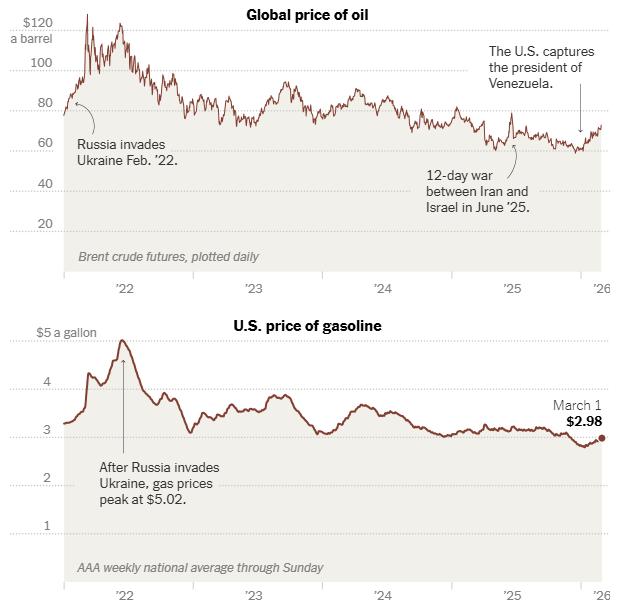
The BRICS-Iran-Israel crisis is not really playing out in isolation — and markets, right now, are also already feeling it in ways that are hard to ignore. Oil prices and emerging market assets spearheaded a rapid repricing the moment the Iran-Israel-US conflict transformed from diplomatic threat into live military exchange, reflecting the broader global economic impact across various major financial sectors and Middle East security risks that investors had not yet fully integrated.
Source: FactSet / AAA / The New York Times
Russia’s Vladimir Putin condemned the killing almost immediately — and his response was also, notably, the sharpest official reaction from any BRICS member. Alexander Dugin, the political strategist who architected several key elements of Russia’s ideological framework, issued a direct strategic warning: if Iran’s military resistance collapses, Russia faces accelerated isolation and intensified confrontation across multiple essential security fronts.
Russian President Vladimir Putin said:
“Please accept my deep condolences in connection with the assassination of the Supreme Leader of the Islamic Republic of Iran, Seyed Ali Khamenei. In Russia, he will be remembered as an outstanding statesman who made a huge personal contribution to the development of friendly Russian-Iranian relations and brought them to the level of a comprehensive strategic partnership.”
EU Foreign Policy Chief Kaja Kallas stated:
“We call for maximum restraint, protection of civilians and full respect of international law, including the principles of the United Nations Charter, and international humanitarian law. The Middle East stands to lose greatly from any drawn-out war.”
US Senator Tim Kaine had this to say:
“This is an illegal war. The Constitution says no declaration of war without Congress. The president has called this war against Iran.”
What BRICS Silence Costs
The global economic impact of this conflict has catalyzed significant volatility across various major asset classes — from energy to emerging markets — in ways that analysts say are also far from fully priced in at the time of writing. But the deeper cost, right now, may also just be to BRICS itself — and that is a cost the bloc keeps refusing to acknowledge. The Iran-Israel war has engineered a moment of institutional reckoning: BRICS geopolitical tension now operates across several key internal fault lines, and the BRICS-Iran-Israel crisis has transformed that internal fracture into something the world can plainly see. A Sri Lanka Guardian editorial put it pretty plainly — this was an acid test of whether BRICS had any real teeth, and also of whether the bloc could act when a member was struck. It failed.
At the time of writing, the Iran-Israel-US conflict is also still going — the IRGC keeps striking, and the interim council in Tehran has begun its work, and none of this looks like it is slowing down any time soon. Middle East security risks have accelerated across numerous significant dimensions, restructuring regional security architecture and maximizing pressure on every actor with exposure to Gulf stability and global economic impact. BRICS has still not found its voice — and the Iran-Israel war, along with the bloc’s silence in response to it, will also likely define what BRICS is, and is not, for a long time to come.
