Arthur Hayes Predicts: Extended Iran Conflict Could Launch Bitcoin to New Heights

Geopolitical tensions are about to rewrite the crypto playbook.
Bitcoin, the digital asset once dismissed as a speculative toy, is morphing into a geopolitical barometer. When traditional finance shudders, crypto often finds its stride.
The War Premium
Prolonged conflict disrupts. It fractures supply chains, destabilizes currencies, and sends capital scrambling for safe havens—or at least, alternatives to the usual suspects. Gold gets the historical nod, but digital gold is writing its own history.
Hayes’s thesis cuts through the noise: sustained instability doesn't just nudge Bitcoin—it can catapult it. The mechanism is simple. Fear drives capital. Capital seeks shelter. Bitcoin, with its borderless, censorship-resistant ledger, offers a shelter that bypasses legacy gatekeepers.
Beyond the Headline Trade
This isn't about morbid opportunism. It's a cold assessment of capital flows in a fragmented world. When nation-state actors flex, the traditional system reveals its fault lines. Savvy money looks for exits.
The cynical jab? Wall Street will issue a solemn report on 'hedging strategies' and 'uncorrelated assets' six months after the move happens—just in time to sell the top to their clients.
Forget 'digital gold.' Think 'geopolitical put option.' The longer the fuse burns, the more attractive a decentralized, apolitical network becomes. The market isn't waiting for an invitation. It's pricing in the risk, right now.
Why Bitcoin Could Surge
In his March 2 essay iOS Warfare, the BitMEX co-founder laid out a simple thesis: if President Donald TRUMP commits the US to a prolonged and expensive campaign tied to Iran, the political and fiscal strain could raise the odds of monetary easing. For Hayes, that matters more than the conflict itself. “The longer Trump engages in the extremely costly activity of Iranian nation-building,” he wrote, “the higher the likelihood the Fed lowers the price and increases the quantity of money to support Pax Americana’s latest bout of Middle Eastern adventurism.”
Hayes’ argument rests on a historical pattern rather than a direct forecast on oil, geopolitics or battlefield outcomes. He points to prior US military engagements in the Middle East and says major conflicts were followed, or accompanied, by easier monetary policy. In his reading, wars do not just damage confidence and strain public finances; they also create conditions in which the Fed has cover to cut rates, support liquidity and help stabilize asset markets.
To support that view, Hayes cites several episodes going back to 1990. After the Gulf War began, he notes, the Fed initially stayed put but signaled that worsening conditions could force a shift. From the August 21, 1990 FOMC discussion, he quotes: “The heightened uncertainties and the prospectively less satisfactory performance of the economy stemming from events in the Middle East had greatly complicated the formulation of an effective monetary policy. In the opinion of several members, events appeared likely to unfold in a direction that WOULD require an easing of policy at some point to counter weakening tendencies in the economy that had been in train before the oil price increase.”
He also highlights the Fed’s response after the September 2001 attacks and the launch of the Global War on Terror. In an emergency meeting, then-Chair Alan Greenspan said: “It’s clear that the events of last week, at a minimum, have created a heightened degree of fear and uncertainty that is placing considerable downward pressure on asset prices, increasing the probability of an asset price deflation, with its obvious impact on the economy. Therefore, I propose a 50-basis point cut in the federal funds rate target.”
For Hayes, those episodes show that geopolitical shocks can become monetary events. His framing is blunt: when war dents confidence, threatens growth or pressures markets, the policy answer tends to be lower rates and more liquidity. That, in turn, is the backdrop he believes tends to favor Bitcoin.
Still, Hayes is not calling for an immediate risk-on trade. He says the market does not yet know how long Trump would stay committed to reshaping Iran, nor how much market or political pain the administration can absorb before changing course. Because of that, he argues the cleaner trade is to wait for confirmation from policy rather than front-run the thesis too early.
“The prudent action is to wait and see,” Hayes wrote. “The time to back up the truck and buy bitcoin and high-quality shitcoins like HYPE is immediately after the Fed cuts rates and or prints money to support the government’s goals in Iran.”
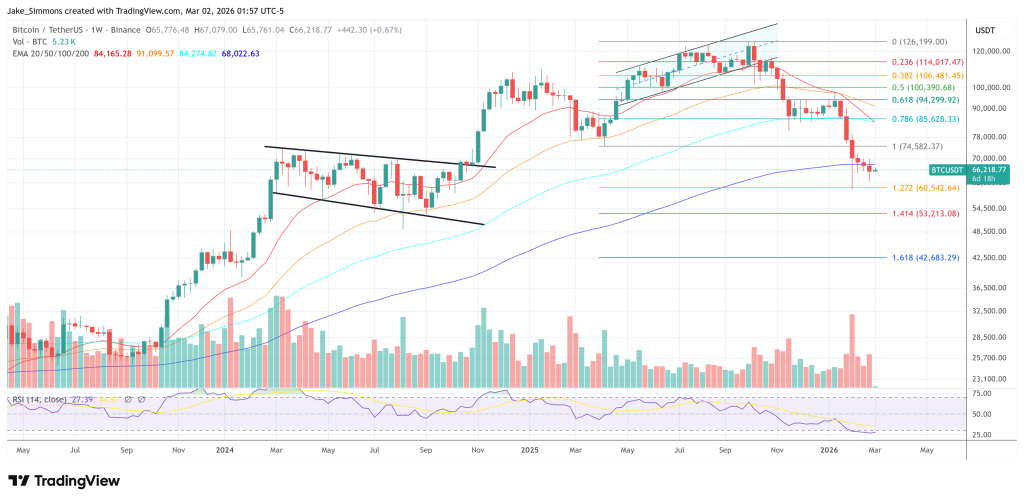
At press time, Bitcoin traded at $66,218.