Russia Sees 10X Surge in Registered Crypto Mining Firms—Is the Gold Rush Back?

Russia's crypto mining sector just got a jolt of adrenaline—registered firms have exploded tenfold. Behind the numbers? A mix of cheap energy, regulatory gray zones, and miners fleeing tighter regimes elsewhere.
The Siberian advantage: Forgotten Soviet-era power plants now hum with ASICs instead of tractors. Meanwhile, Moscow’s waffling on crypto laws creates the perfect loophole buffet for industrial-scale mining.
Follow the rubles: Local officials suddenly love blockchain—or at least the tax revenue and 'digital economy' talking points. (Funny how budget gaps make regulators creative.)
One hedge fund manager quipped: 'If Russia bans mining tomorrow, they’ll just rebrand as 'thermal data centers'—classic CIS arbitrage.'
Rise in Russian Crypto Mining Firms
The head of the New People People Party, the lawmaker Alexey Nechaev, told attendees at a State Duma plenary session on July 23:
“When crypto mining was emerging [in Russia], there were many who wanted to ban it. But it is clear now that the future belongs to cryptoassets. Mining will continue to develop.”
He also confirmed that per FTS data, the number of “white” miners in Russia has increased 10 times since the start of the year.
A new Russian law, introduced last year, stipulates that all crypto miners using more than 6,000 kWh of electricity per month must sign up to the register.
Regulation Trumps Bans, MP Claims
The FTS requires firms on its list to provide it with data on the number of coins they mine and the wallets where they hold their crypto.
The tax body will also begin requiring firms on the list to pay taxes on their earnings. This could bring the Russian Treasury revenues of over $500 million per year, industry chiefs have claimed.
Nechayev praised his fellow lawmakers for adopting the mining law in the fall of 2024. He said that MPs had acted with prudence by choosing to regulate, and not outlaw, mining. The lawmaker explained:
“Driving people into the shadows with fines and bans is not an effective strategy.”
Nechayev added that prior to the rollout of the new law, miners were forced to work in a grey, quasi-legal manner.

Some miners, he noted, had tried to be transparent about their activities, but could not pay taxes as most of their businesses were not officially recognized.
Nechayev said that this had previously led to “entire cities and districts” being left without electricity because miners overloaded power grids.
Miners: Investing in AI
Prior to the law, only 91 firms with crypto mining operations were able to register their businesses. This figure has now shot up to over 1,000, Nechayev said.
Turkish Foreign Minister Fidan speaks after Russia and Ukraine peace talks https://t.co/f4gqZC5IJc
— Reuters (@Reuters) July 23, 2025The New People chief added that industrial miners are also investing in AI. He claimed that this year alone, crypto miners had spent 5 billion rubles ($63 million) on AI development.
Nechaev claimed miners were now more likely to invest their money in Russia, rather than send it abroad.
Furthermore, he concluded, many mining-related power outages have stopped.
World’s Number 2 Bitcoin Miner?
The Association of Industrial Miners, the doemstic mining sector’s biggest industry group, claims Russia is now consistently ranking second in the world in terms of bitcoin (BTC) mining volume.
Outputs are second only to those of the USA, the association says. And mining continues to develop, the body noted.
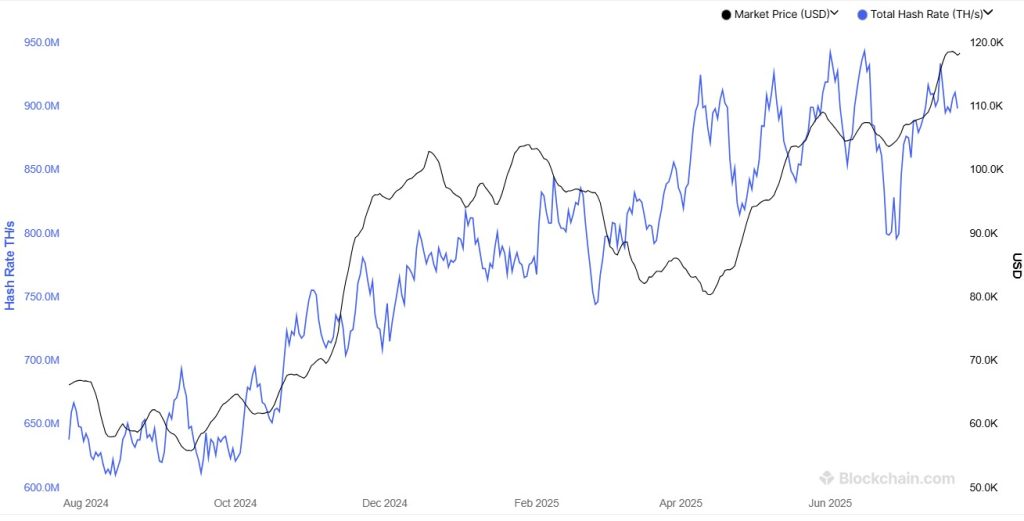
This summer, Russian crypto mining firms say their hashrate exceeded 150 EH/s (exahash per second), accounting for 16.6% of the global hashrate.
Domestic experts think up to BTC 40,000 (about $4.7 billion) was mined in Russia during the course of 2024.
Earlier this month, a top Russian policymaker urged the state to start seizing crypto from illegal crypto miners.
He said that a move to officially recongizing coins as a form of intangible property WOULD help courts seize assets from illegal miners.
