Vitalik Buterin Withdraws 16,384 ETH as Ethereum Foundation Enters ’Austerity Phase’ — What’s the Real Play?

Ethereum's co-founder just made a major move. Vitalik Buterin has withdrawn a cool 16,384 ETH from the Ethereum Foundation's multi-signature wallet. This isn't a casual sell-off—it's a strategic shift that signals a new era of fiscal discipline for the organization that stewards the world's leading smart contract platform.
The 'Austerity Phase' Begins
The withdrawal coincides with the Foundation publicly declaring an 'austerity phase.' Forget the free-wheeling, grant-heavy days of the bull market. The new mandate is lean operations, focused spending, and extending the runway. It's a stark pivot from building at all costs to building with precision. The message is clear: sustainability trumps speculation, even for crypto's blue-chip foundation.
Decoding the 16,384 ETH Move
So, what's the plan for that stack of ETH? The Foundation isn't splurging on marketing blitzes or vanity projects. The capital is earmarked for operational continuity—covering salaries, essential grants, and core protocol development. Think of it as moving treasury assets from a savings account into the checking account to pay the bills. In a world where other projects blow through treasuries on memes, this is a masterclass in fiduciary responsibility. Or, as a cynical trader might mutter, 'Finally, someone in crypto remembers what a budget is.'
Why This Bullish Signal Matters
Forget the fear. This isn't a red flag; it's a green light for long-term health. A foundation that manages its treasury with rigor ensures Ethereum's development isn't hostage to market cycles. It builds through winters and thrives in springs. This austerity phase isn't about scarcity—it's about focus. By streamlining, the Foundation can double down on the upgrades that matter: scalability, security, and user experience.
The ultimate takeaway? The smart money isn't just watching the price charts. It's watching the stewards. And right now, Ethereum's stewards are acting more like seasoned CFOs than crypto cowboys. That's the kind of boring, responsible move that builds foundations for the next all-time high.
Buterin Links ETH Withdrawals to Open-Source Funding and Fiscal Discipline
Under that change, Buterin said he is taking up the role of working on it himself, where it could have been done as individual foundation projects.
He described the ETH withdrawal as being over a period of years to assist in open-source, secure, and verifiable software and hardware in financial, communication, governance, operating systems, secure hardware, and privacy-preserving technologies.
He also indicated that he was also considering decentralized staking alternatives, which may enable future staking incentives to be redirected to the identical objectives.
The pullback coincides with a broader decline in crypto markets, with Ether trading at around $2,720, significantly lower than its October high of about $4,831.
According to blockchain analytics company Arkham Intelligence, Ethereum Foundation has a crypto portfolio worth approximately $554.5 million, and about 172,719 ETH constitute the majority of the treasury at present.
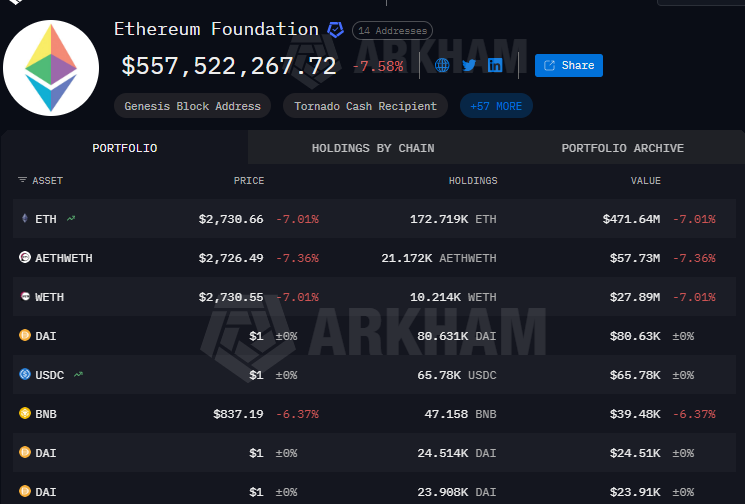
Other investments are ETH that is held in Aave, wrapped ETH, and smaller investments in stablecoins like DAI and USDC.
Buterin himself is estimated to own crypto assets worth approximately $666 million.
The foundation has described its current phase as one of fiscal discipline rather than retrenchment.
Officials and researchers familiar with its finances have said the “austerity” framing refers to more conservative spending and longer planning horizons during a market downturn, not a shortage of funds.
Included in its foundation activities are CORE protocol development, research, and grants, with the foundation reevaluating discretionary spending.
Vitalik Buterin Sets Vision for a Leaner Ethereum in 2026
The remarks made by Butterin can be classified into a wider range of new statements explaining his vision of the future of Ethereum.
In early January, he cautioned that Ethereum WOULD become too complicated unless developers take the active step of simplifying the protocol by removing features.
 Vitalik Buterin (@VitalikButerin) is urging developers to tackle protocol bloat, warning that endlessly adding new features while rarely removing old ones risks trustlessness and self-sovereignty#Ethereum #VitalikButerinhttps://t.co/ZRSGvofqph
In a separate January post, Vitalik Buterin said 2026 would mark a push to restore self-sovereignty, citing easier full-node operation via zero-knowledge tools, stronger privacy, and reduced dependence on centralized infrastructure.
Those proposals emphasized Ethereum as “people-first” infrastructure, prioritizing users who rely on it for financial autonomy and secure communication over convenience-driven mainstream adoption.
The timing also coincides with signs of renewed activity on the Ethereum network.
Following the Fusaka upgrade in December, average transaction fees fell sharply, and mainnet activity has increased.
Data from Token Terminal and Etherscan show daily active addresses nearing one million in mid-January, briefly surpassing activity across major layer-2 networks.

Weekly decentralized exchange volumes on Ethereum have risen to about $13 billion, up from just over $8 billion a month earlier, while the broader Ethereum ecosystem reached nearly $27 billion in weekly DEX volume.
Despite the foundation’s tighter spending posture, Ethereum remains the largest platform for decentralized applications and smart contracts, securing tens of billions of dollars in value across DeFi and other use cases.
