Ethereum Transaction Fees Plunge to 9-Year Low - Here’s Why This Changes Everything

Gas prices just hit rock bottom. For the first time since 2017, sending ETH or interacting with smart contracts costs pennies instead of fortunes—a seismic shift for the world's dominant smart contract platform.
The Fee Collapse Explained
Layer-2 networks finally ate Ethereum's lunch. Arbitrum, Optimism, and Base now process transactions off-chain before settling batches on Ethereum—dramatically cutting congestion and slashing costs. Users voted with their wallets, migrating en masse to cheaper alternatives.
Developer Renaissance
Builders are rushing back. Those experimental DeFi protocols and NFT projects that were too expensive to test? Suddenly viable. The barrier to entry—once measured in hundreds of dollars per failed transaction—has evaporated. Expect a surge in innovation as developers rediscover what they can build without burning venture capital on gas alone.
Mainstream Adoption Suddenly Possible
Remember when microtransactions were a pipe dream? Not anymore. Gaming assets, social tokens, and subscription models—previously choked by fees—now flow freely. Traditional finance's slow, expensive legacy systems look increasingly archaic next to this new cost structure. (Wall Street bankers still charge 2% for a wire transfer that takes three days—some disruption.)
The Cynical Take
Of course, some venture capitalists are sweating—their 'scaling solution' investments just lost their primary selling point. And let's be honest: lower fees mean less ETH burned, potentially impacting the deflationary narrative that fueled the last bull run. The ecosystem traded fee revenue for accessibility—a gamble that could redefine Ethereum's value proposition entirely.
This isn't just cheaper transactions. It's Ethereum shedding its luxury tax and finally competing on utility. The network just cut its own throat on fee revenue to stay relevant—and that brutal efficiency might be exactly what saves it.
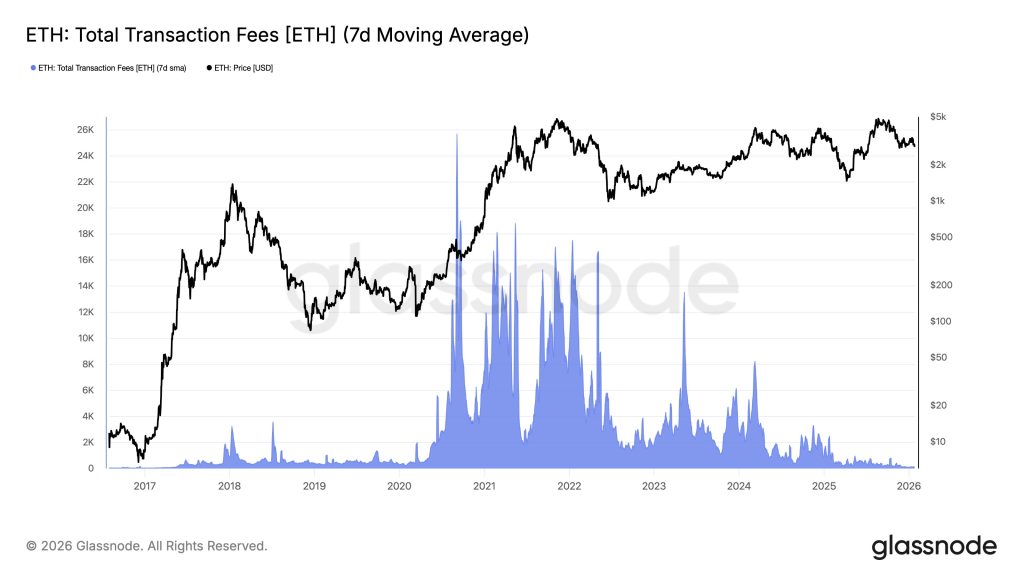
Ethereum Transaction Volume at ATH as Fees Fall
Validators receive transaction fees each time they add transactions to a block, with higher fees getting priority. Low transaction fees often point to a decline in demand to use Ethereum block space, analysts say, which in a way signals there is less activity taking place on the blockchain.
The metric is volatile, and fees can rise dramatically from one day to the next, depending on ETH price action. Volatility spurs trading, which in turn propels on-chain activity and an increase in transaction fees, analysts say.
“There’s no mystery behind Ethereum’s falling transaction fees,” Georgii Verbitskii, founder of DeFi crypto service Tymio, told Cryptonews.
“It’s basic supply and demand. Fees rise when many transactions compete for limited block space, and they fall when demand drops. Right now, we’re simply seeing fewer transactions.”
Verbitskii said the decline in Ethereum network fees fits the broader “cool-off” phase that the crypto market is going through. He says activity tends to slow after periods of intense speculation and hype, as “users transact less, developers pause launches, and capital becomes more selective.”
“During these phases,” Verbitskii avers, “networks like Ethereum look cheaper to use, not because the system changed dramatically, but because demand temporarily stepped back.”
“Once market activity picks up again, whether through new applications, renewed DeFi usage, or a broader risk-on environment, transaction volumes will rise, and fees will adjust accordingly.”
It is notable that Ethereum’s LAYER 1 network activity is at an all-time high, even as fees fall. According to Leon Waidmann, head of research at Lisk, Ethereum’s transaction volume hit more than 16 million this January.
Ethereum is now processing three times the number of transactions at just a third of the cost compared to the peak of the “fee-driven explosion” in 2021, Waidmann wrote in a post on X.
“What’s different: 2021 was a speculation-driven fee explosion. Now it’s actual usage at scale. People are paying for real economic activity,” he said.

Could Lower Fees Impact Validators?
While lower transaction fees are typically a welcome relief for ethereum users, there is some concern that may pose a challenge to validators, who rely on transaction fees as a major source of income.
But Marcin Kaźmierczak, cofounder of crypto data provider RedStone, poured cold water on the fears. He told Cryptonews that Ethereum’s switch to the Proof-of-Stake mechanism in 2022 “eliminated miner revenue dependency on transaction fees entirely.”
“Validators now earn via staking yields, making MEV and priority fees less critical to network economics,” he said, adding:
“For network security, this is broadly healthy. Validator economics remain solid through staking rewards (~3% APY), so the network doesn’t depend on fee spikes for security.”
Kaźmierczak said low fees reduce friction for oracle submissions and data aggregation from companies like RedStone, an infrastructure layer that “benefits from cheaper, frequent state commitments” and updates.
“The real question isn’t security (which is robust),” he explains, “but whether Ethereum’s fee structure now properly incentivizes data availability to stay competitive as Layer 2 demand matures.”
As of this writing, ETH is trading at $2,714, down 7.7% on the day. The price has barely moved compared to this time a year ago, though it soared above $4,770 in August 2025.
