Meme Coin WhiteWhale Crashes 60% Amid Rug Pull Allegations—Whales Dump $1.3M in Tokens

WhiteWhale, a meme coin that surfed the speculative wave, just hit a tsunami of doubt. The token plunged 60% in hours as accusations of a classic 'rug pull' flooded social channels. Large holders—the so-called 'whales'—didn't just jump ship; they torpedoed it, offloading a staggering $1.3 million worth of tokens and leaving retail investors treading water.
Anatomy of a Suspect Sell-Off
The timing was textbook suspicious. A coordinated dump from several large wallets triggered the initial collapse, sparking immediate panic. On-chain sleuths pointed to irregular token movements in the hours before the crash—transfers to decentralized exchanges, sudden liquidity withdrawals. The community's trust, once the coin's only real asset, evaporated faster than the liquidity pool.
When Meme Coins Meet Market Reality
This isn't just another altcoin blip. It's a stark reminder that in the meme economy, fundamentals are often just a funny dog picture and a prayer. The 'team' behind WhiteWhale, typically anonymous, went radio silent as the price cratered—a deafening silence that speaks volumes. It's the crypto equivalent of a magician's vanishing act, except the only thing disappearing is your money.
The Aftermath: Scattered Shards and Legal Murmurs
Exchange listings are getting reviewed. Telegram groups are fracturing between furious 'bag holders' and stubborn believers calling it a 'shakeout.' Regulators, always a few steps behind, are likely adding this to a growing case file on decentralized finance's wild west. For every legitimate project building in crypto, there's a WhiteWhale—a reminder that in a market driven by narratives, the most compelling story is sometimes a cautionary tale.
One cynical finance jab? It's the ultimate 'community-driven token'—the community drives the price up, and the founders drive away with the money. The only 'white whale' here was the investors' chase for a 1000x return that turned into a 60x loss. In the end, the real meme was the financial prudence they forgot along the way.
Early Investors Secured Larger Gains
Market analyst Darky initially flagged the massive crash on social media. He wrote that the “viral memecoin” plummeted from $200 million to $20 million within minutes.
The viral memecoin $WHITEWHALE just rugged.
From 200M to 20M. -45% candle in the last few minutes.
Thanks for playing pic.twitter.com/FfEFVOzAo2
However, per blockchain data, at least one investor secured larger gains. A trader named ‘Remus’ bought 1.5% of the total token supply for $370. The position later peaked at a value of $1.2 million during the rally. Remus later sold $220,000 worth of tokens, leading to the major crash.
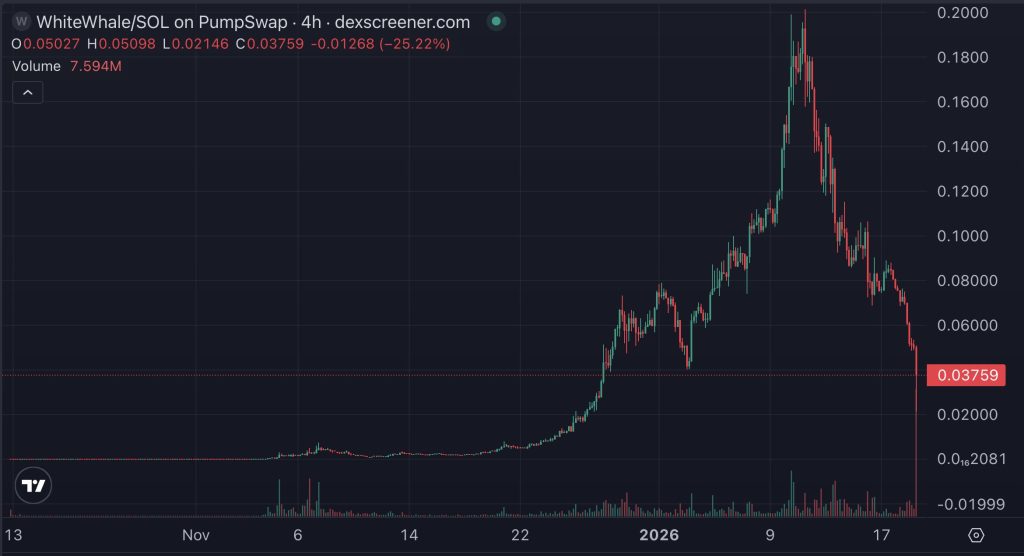
The trader still holds close to $1 million in WhiteWhale, even though the value of the token has dropped.
WhiteWhale memecoin community called it a planned liquidity event to spread ownership and reduce risks.
By Tuesday, the token has recovered to a $33.8 million market cap at $0.033 per token at press time.
Half of Meme Coins Have Already Failed – Research
A recent CoinGecko analysis shows that more than 50% of cryptocurrencies have failed.
“In 2025 alone, 11.6 million tokens failed, representing a large majority of token failures, or 86.3%,” the report read.
Memecoins took the blow of broader market turbulence throughout the year, leading to a sharp decline in token survivability.
“Alarmingly, the fourth quarter of 2025 alone saw the collapse of 7.7 million tokens, making up 34.9% of all recorded project failures.”
Besides, 2024 saw nearly 1.4 million projects fail, accounting for 10.3% of all failures in the past five years.
