Bitcoin Braces for Impact as Trump Slaps 25% Tariffs on Europe Over Greenland

Digital gold faces its latest geopolitical stress test.
The Tariff Tango
A fresh 25% levy on European goods—punishment for a trade spat over Greenland—just rewired the global risk calculus. Capital’s old playbook gets shredded when tariffs fly. Traditional markets flinch, but crypto’s decentralized ledger doesn’t care about border disputes. It just keeps hashing.
Flight to Digital Sovereignty
When nation-states weaponize trade, assets trapped within their jurisdictions become political footballs. Bitcoin’s network, borderless and permissionless, offers an exit. It’s not about ideology; it’s about portfolio insulation. History shows capital flows to the hardest, most neutral asset available—and right now, that’s looking increasingly digital.
The Liquidity Shuffle
Watch the flows. Tariffs disrupt supply chains, squeeze corporate margins, and spook equity investors. A slice of that fleeing liquidity inevitably seeks alternatives. Crypto markets, operating 24/7, are the first to absorb the shock and reflect the new reality—often while traditional finance is still drafting its cautious morning memo.
Beyond the Headline Noise
The real story isn’t the tariff itself; it’s the accelerating pattern. Each geopolitical flare-up reinforces Bitcoin’s narrative as a non-sovereign store of value. It’s a hedge not just against inflation, but against the whims of policymakers who still think in terms of 20th-century borders and blunt-force tariffs.
So while headlines scream about trade wars, the smart money is quietly checking its on-chain metrics. After all, in a world where a dispute over a frozen island can trigger a 25% tax on commerce, maybe the real safe haven is the one that exists entirely outside the system. The cynic might say traditional finance is just a slower, more expensive way to lose money to political theater.
European Leaders Unite Against Unprecedented Threat
The tariff announcement triggered an extraordinary diplomatic crisis as EU ambassadors convened emergency meetings on Sunday afternoon.
European Commission President Ursula von der Leyen emphasized that “tariffs WOULD undermine transatlantic relations and risk a dangerous downward spiral,” while declaring full EU solidarity with Denmark and Greenland.
Swedish Prime Minister Ulf Kristersson stated bluntly, “We will not let ourselves be blackmailed,” characterizing Trump’s demands as an EU-wide issue requiring a collective response.
Finland’s President Alexander Stubb, previously considered a Trump ally through shared golf interests, urged that “among allies, issues are best resolved through discussion, not through pressure.“
Norway’s Prime Minister Jonas Gahr Støre agreed, stressing “threats have no place among allies.“
Even Trump supporter Nigel Farage criticized the tariffs, admitting “we don’t always agree with the US government and in this case we certainly don’t. These tariffs will hurt us.“
We don’t always agree with the US government and in this case we certainly don’t. These tariffs will hurt us.
If Greenland is vulnerable to malign influences, then have another look at Diego Garcia. https://t.co/z0r0IUlD6I
Spain’s Prime Minister Pedro Sanchez delivered perhaps the sharpest rebuke, warning that a US invasion of Greenland “would make Putin the happiest man on earth” by legitimizing Russia’s Ukraine invasion and spelling “the death knell for Nato.“
EU foreign policy chief Kaja Kallas also echoed this sentiment, noting “China and Russia must be having a field day” as they “benefit from divisions among Allies.“
Denmark’s Foreign Minister Lars Løkke Rasmussen also expressed surprise at Trump’s announcement following what he described as “” with Vice President JD Vance and Secretary of State Marco Rubio earlier in the week.
Given Trump’s threats over Greenland, German MEP Manfred Weber suggested halting the recently negotiated EU-US trade deal, stating, “The 0% tariffs on US products must be put on hold.“
Meanwhile, thousands protested across Greenland and Denmark, carrying banners reading “” and ““
Tariff Uncertainty Clouds Bitcoin Recovery
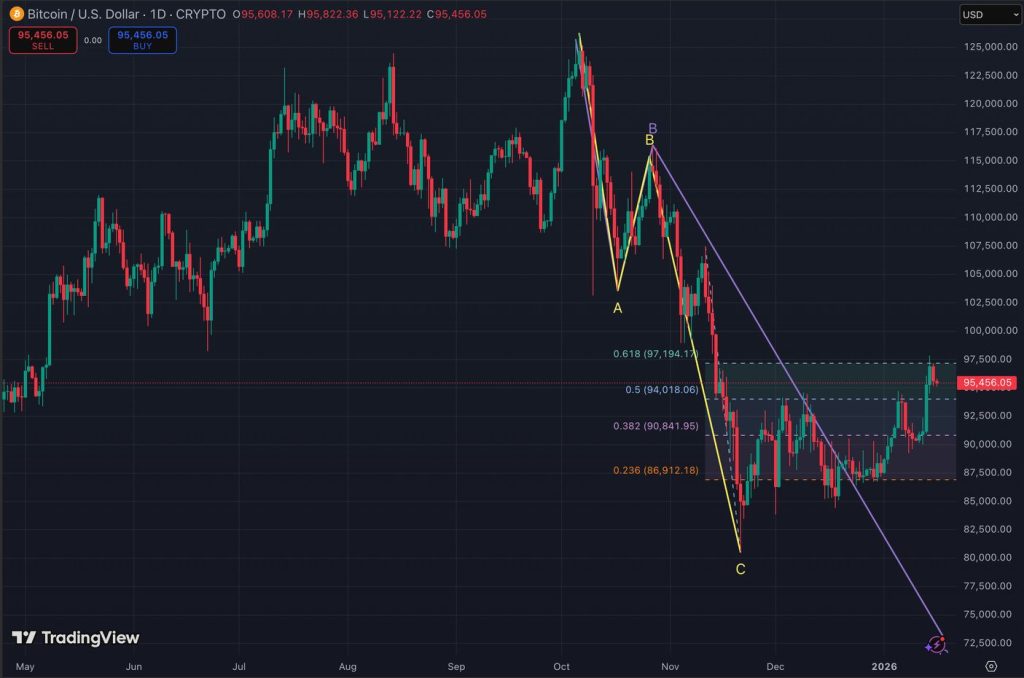
Bitcoin currently trades around $95,000 after weeks of range-bound movement between $94,000 and $97,000.
Market participants remain cautious following Trump’s latest geopolitical escalation, which adds fresh uncertainty to an already fragile recovery.
The crypto has avoided revisiting lower support levels in 2026, though gains remain thin amid persistent geopolitical risks.
CryptoQuant founder Ki Young Ju expects bitcoin to enter “” rather than experiencing sharp rallies or deep crashes.
Capital inflows into Bitcoin have dried up.
Liquidity channels are more diverse now, so timing inflows is pointless. Institutions holding long-term killed the old whale-retail sell cycle. MSTR won't dump any significant chunk of their 673k BTC.
Money just rotated to stocks and… pic.twitter.com/Ha866TP857
“Capital inflows into Bitcoin have dried up. Liquidity channels are more diverse now, so timing inflows is pointless,” he stated, noting money has “rotated to stocks and shiny rocks.“
Despite a lack of buying pressure, large holders, including US banks, continue to accumulate Bitcoin, with no clear signs of capitulation yet.
Speaking with Cryptonews, John Glover, Chief Investment Officer at Ledn, suggests Bitcoin remains in Wave IV of its bull cycle, with completion targets between $71,000 and $84,000.
“Confirmation as to which path we’re following will come from either a break and close above $104,000 which would confirm we are now starting Wave V, or a break below $80,000, which means a move to the low $70s before we head higher,” Glover explained.
October Tariff Precedent Raises Concerns
Trump’s aggressive tariff strategy previously devastated crypto markets in October 2025 when 100% tariffs on Chinese imports triggered one of history’s largest single-day liquidation events.
Bitcoin plunged below $105,000 as $19 billion in Leveraged positions unwound within 24 hours, forcing 1.6 million traders into liquidations, with nearly 87% being long positions.
Open interest in Bitcoin futures collapsed by more than 30% during that selloff before recovering above $114,000 days later.
The current tariff threat targets America’s closest European allies rather than adversaries, creating unprecedented uncertainty about transatlantic relations.
Markets now face potential Supreme Court rulings on the legality of tariffs alongside escalating geopolitical tensions over Greenland, Venezuela, and broader global trade policy.
These combined factors threaten to replicate October’s volatility despite Bitcoin’s recent price stability.
