Crypto Plunge: Why Digital Assets Are Tumbling Today – December 23, 2025

Crypto markets hit a sudden downdraft. December 23rd, 2025, opened with a sea of red across major exchanges. Bitcoin, Ethereum, and altcoins alike are taking a sharp haircut, rattling even the most diamond-handed investors.
The Liquidity Squeeze
It's not a single villain, but a perfect storm. Traditional markets are winding down for the holiday season, pulling crucial liquidity out of the crypto sphere. Thin order books amplify every sell order, turning a trickle into a cascade.
Regulatory Headwinds Bite
Fresh rumblings from global watchdogs are adding pressure. Unconfirmed reports suggest a major financial authority is drafting stricter custody rules for institutional holders. The mere whisper of tighter controls is enough to trigger preemptive portfolio rebalancing—a classic case of sell the rumor.
Technical Breakdowns Fuel the Fire
Key technical levels shattered like glass. Bitcoin's breach of a critical support zone triggered automated sell-offs across countless algorithmic trading strategies. These bots don't feel fear; they just execute, creating a self-reinforcing feedback loop of selling pressure.
The Leverage Unwind
Over-leveraged positions are getting obliterated. As prices fall, margin calls force liquidations, dumping more assets onto an already saturated market. It's a brutal, mechanical process that shows the dark side of easy credit in crypto—sometimes, the smart money is just the one that borrowed less.
So, is this the end of the bull run? Unlikely. These sharp, sentiment-driven corrections are a feature, not a bug, of crypto's volatile adolescence. It shakes out weak hands and resets the board for the next leg up. Consider it a stark reminder: in a market that never sleeps, sometimes the most profitable trade is to simply step aside and let the panic burn itself out. After all, Wall Street is on vacation—this is crypto's own special brand of year-end bonus season.
Crypto Winners & Losers
At the time of writing, most of the top 10 cryptocurrencies by market capitalization are posting losses over the past 24 hours.
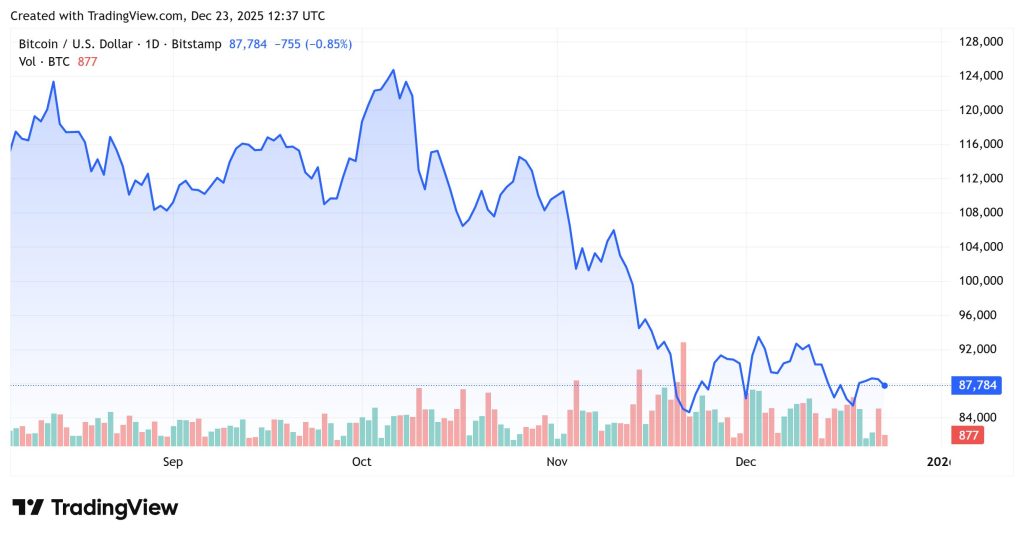
is down 2.4% on the day, currently trading at $87,780. Despite the decline, Bitcoin remains relatively resilient compared to several major altcoins.
has slipped 2.6%, changing hands at $2,968, while BNB is down 1.6% to $851.51.
has fallen 1.7% over the same period and is trading at $1.90, whilerecorded a 3.0% daily drop, now priced at $124.77, marking one of the sharper declines among the top assets.
is also under pressure, down 1.5% in 24 hours to $0.1308.
Outside the top tier, losses are more uneven. Midnight (NIGHT) stands out on the downside, plunging 23.2% to $0.0777, making it one of the day’s weakest performers among trending assets.
On the positive side, a handful of smaller-cap tokens are defying the broader market trend. RaveDAO leads the gainers, surging 37.0% to $0.6357, followed by Impossible Cloud Network, which climbed 32.9% to $0.496. ECOMI also posted strong gains, rising 31.0% to $0.0002373.
Meanwile, 10x Research analysts said that October marked a decisive turning point for bitcoin in 2025, as a sharp crash on Oct. 10 flipped the market from a bull phase into a sustained bearish regime.
After Crypto’s October 10 Crash: Are We Entering the Final Stage of Deleveraging?
October proved to be the most consequential month for Bitcoin in 2025, marking the point at which the bull market decisively turned bearish amid a convergence of overlapping shocks.
Understanding… pic.twitter.com/W6iAKdCAA3
Roughly $1.3 trillion in crypto market value was wiped out in the weeks that followed, while leverage-heavy venues such as Binance and Hyperliquid absorbed massive liquidation activity, and Ethena’s USDe stablecoin saw $8.3 billion in net outflows, signaling a loss of confidence in synthetic collateral structures.
Bitcoin Lags Stocks and Gold as Whale Selling and ETF Outflows Weigh on Price
In a recent post on X, CryptoQuant said that traditional SAFE assets are flashing stretched conditions, with gold trading about 25% above its 200-day moving average and silver nearly 45% above, levels last seen during the 2020 COVID shock.
At the same time, equities remain resilient, with the S&P 500 and Nasdaq hovering just a few percentage points below all-time highs, suggesting risk appetite has not collapsed.
Bitcoin, however, has failed to follow either trend. CryptoQuant pointed to a breakdown in BTC’s correlations with both tech stocks and Gold since mid-2024, driven largely by sustained selling from large holders and ETF outflows totaling about $5.1 billion.
So why isn’t Bitcoin catching up?
The answer: selling pressure from large players.
Two key signals stand out:
– ETF drawdown from ATH: -$5.1B
– Sustained whale selling since October pic.twitter.com/h6zKZkY30J
With capital rotating toward metals and AI-linked equities, Bitcoin remains under pressure, leaving upcoming inflation data, such as the PCE report, as a potential catalyst to shift sentiment.
Meanwhile, Linh Tran, a market analyst at XS.com, said the policy stance of the US Federal Reserve still sets the short to medium-term rhythm for Bitcoin.
“Although US inflation has eased from its peak (with CPI y/y at 2.7% released last week), recent data indicate that the disinflation process is progressing slowly and unevenly,” she said.
 Bitcoin has fallen below the $90,000 level, extending a pullback as investors grapple with uncertain macroeconomic signals.#Bitcoin #BTChttps://t.co/mNXHPWUVtu
Levels & Events to Watch Next
At the time of writing, Bitcoin is trading around $87,784, down just under 1% on the day. The session saw BTC attempt a mild recovery early on before slipping lower, briefly testing the $85,000–$86,000 zone.
Since then, price action has remained choppy, with BTC consolidating below the psychologically important $90,000 level. If downside pressure resumes, a move toward $84,000 is possible, followed by the $82,000–$83,000 support range. On the upside, bulls WOULD need to reclaim and hold $90,000 to signal a stronger recovery.
Ethereum is currently changing hands NEAR $2,961, posting a daily decline of about 1.5%. ETH traded higher earlier in the session but failed to sustain momentum above the $3,000 mark, pulling back sharply into the $2,800–$2,900 range before stabilizing.

The chart shows continued lower highs since October, reflecting persistent selling pressure. If weakness continues, ETH could retest $2,800, with a deeper pullback opening the door to $2,700. A bullish reversal would require ETH to decisively reclaim $3,000 and build support above that level.
Meanwhile, crypto market sentiment remains firmly in fear territory.
The Crypto Fear and Greed Index currently stands at 29, unchanged from yesterday, signaling persistent caution among investors. While sentiment has improved slightly compared to last week’s reading of 22 and last month’s extreme fear level of 10, it remains well below neutral levels.
Ongoing price weakness across major assets continues to weigh on confidence, with uncertainty still elevated.
US spot Bitcoin exchange-traded funds (ETFs) recorded another day of net outflows, with $142.19 million exiting the products, according to the latest data. Despite the daily pullback, cumulative net inflows remain strong at $57.26 billion, while total assets across US BTC ETFs stand at $114.99 billion, equal to about 6.5% of Bitcoin’s market capitalization.
Grayscale’s GBTC led losses with $28.99 million in net outflows, followed by Grayscale’s BTC fund with $25.40 million and Bitwise’s BITB, which shed $34.96 million. ARK & 21Shares’ ARKB also saw $21.36 million leave the fund, while VanEck’s HODL posted $33.64 million in outflows.
On the other hand, US spot ethereum ETFs posted $84.59 million in net inflows, extending their recent positive flow streak.. Cumulative net inflows across Ether ETFs have now reached $12.53 billion, while total net assets stand at $18.20 billion, representing roughly 5.1% of Ethereum’s total market capitalization.
Inflows were driven primarily by Grayscale’s ETH ETF, which attracted $53.70 million, followed by Grayscale’s ETH Trust, adding $30.89 million on the day. Other major issuers, including BlackRock’s ETHA and Fidelity’s FETH, reported flat daily flows, while smaller products from Bitwise, VanEck, Franklin, 21Shares and Invesco also saw no material inflows or outflows.
Meanwhile, BlackRock has placed its spot Bitcoin ETF among its three biggest investment themes for 2025, ranking the product alongside Treasury bills and US mega-cap technology stocks.
 @BlackRock has placed its spot Bitcoin exchange-traded fund among its three biggest investment themes for 2025.#ETF #Bitcoinhttps://t.co/k1zRml0omY
