Bank of Japan Hikes Rates to 30-Year High as Yen Weakens – The Catalyst for Bitcoin’s Rebound?

Japan's central bank just made its biggest move in a generation. The Bank of Japan hiked interest rates to a level not seen in three decades, a direct response to a yen that's been sliding against the dollar. It's a tectonic shift for the world's last major holdout on ultra-loose monetary policy.
The Great Unwind Begins
For years, the BoJ played the outlier, clinging to negative rates while everyone else tightened. That era is over. The move signals a desperate bid to shore up a currency that's been pummeled, making imports painfully expensive and stoking domestic inflation. It's a classic central bank dilemma: fight currency weakness or choke economic growth.
Digital Gold's New Narrative
So where does Bitcoin fit in? Every traditional finance shockwave now ripples into crypto markets. A stronger yen, in theory, could dampen the 'cheap money' carry trades that often fuel risk assets. But it also highlights a deeper fragility in the global fiat system—precisely the narrative Bitcoin was built on.
When central banks scramble to defend their paper, it doesn't exactly inspire confidence. It reminds everyone that national currencies are just promises, subject to the whims of policy committees and trade deficits. Bitcoin's fixed supply and algorithmic rules start looking less like a speculative toy and more like a lifeboat.
The Cynical Take
Let's be real—the finance world loves a crisis it can monetize. Traders will spin this as 'macro bullish for crypto' regardless of the actual mechanics. After all, fear sells, and nothing sells like the fear of a central bank losing control. It's the oldest play in the book: create a problem, offer a volatile, unproven solution, and collect the fees on the way up and down.
Watch the flows, not the headlines. If capital starts fleeing Japanese government bonds or the stock market searches for an inflation hedge, some of it might find its way to crypto. Or, higher rates might simply suck liquidity out of every risky corner of the market. The only certainty? Volatility is back on the menu.
The BoJ's historic hike isn't just about Japan. It's a signal that the global era of free money is truly, irrevocably over. And when the old system cracks, people look for alternatives. Whether Bitcoin is the answer remains to be seen, but the question is getting louder by the day.
 Source: TradingView
The central bank voted unanimously to lift short-term rates from 0.5%, stating that “real interest rates are expected to remain significantly negative,” and that “accommodative financial conditions will continue to firmly support economic activity.“
Governor Kazuo Ueda emphasized the bank WOULD “continue to raise the policy interest rate and adjust the degree of monetary accommodation” if the economic outlook materializes as projected.
Historic Move Confronts Deepening Fiscal Challenges
The rate increase represents Japan’s most aggressive monetary tightening since 1995, though borrowing costs remain far below those in other major economies.
The decision arrives as Takaichi’s government pushes through expansive fiscal policies funded largely by issuing more bonds.
More than half of the stimulus spending will come from additional debt issuance, raising concerns about Japan’s already massive public debt, more than twice the size of its economy.
Speaking to The New York Times, George Goncalves, head strategist at MUFG, noted the “volatile mix of growing debt, higher interest rates, aggressive fiscal spending and tariffs make the path forward for Japan’s economy difficult to predict.”
Market reactions were mixed, with the yen initially strengthening before giving up those gains as investors digested the statement’s implications.
Christopher Wong, currency strategist at OCBC, speaking with Reuters, added that “the yen initially strengthened but quickly surrendered those gains, in part reflecting thin market liquidity that amplified short-term price action rather than a reassessment of fundamentals.“
Divergent Policy Paths Signal Volatility Ahead
The rate hike comes amid broader regulatory shifts in Japan’s crypto landscape.
The Financial Services Agency recently proposed requiring exchanges to hold dedicated reserves against customer losses, extending a framework long used in traditional securities markets.
The MOVE follows major breaches, including Bybit’s February 2025 hack, which resulted in roughly $1.46 billion in losses.
Japan is also simultaneously preparing its most sweeping overhaul of crypto oversight in almost a decade, planning to move digital assets under the Financial Instruments and Exchange Act.
The transition would impose stricter disclosure requirements and explicit insider-trading rules covering token listings, major system breaches, and large-scale issuer sales.
Arthur Hayes, former BitMEX CEO, reacted bullishly to the decision on social media. “Don’t fight the BOJ: -ve real rates is the explicit policy,” Hayes wrote. “$JPY to 200, and $BTC to a milly.“
Don’t fight the BOJ: -ve real rates is the explicit policy. $JPY to 200, and $BTC to a milly. pic.twitter.com/PdZh87ruVI
— Arthur Hayes (@CryptoHayes) December 19, 2025Speaking with Cryptonews, Ignacio Aguirre, CMO at Bitget, offered measured Optimism despite near-term uncertainty.
“However, the BOJ’s tightening stands in contrast to widely expected Fed rate cuts in early 2026, setting up a period of heightened volatility that often creates attractive accumulation windows for long-term investors,” Aguirre said.
He projected Bitcoin could retest the $95,000–$100,000 range by early 2026.
Market Analysts Split on Bitcoin’s Near-Term Trajectory
Trader Michael van de Poppe downplayed the hike’s lasting impact on crypto markets.
“Markets knew this beforehand, so the actual impact of this rate hike is firstly, going to have less impact the more those will take places as the marginal impact for the Carry Trade is getting less and less,” van de Poppe said.
He argued markets had “overpriced this to the downside prior to the event expecting a big crash to occur,” adding that given the soft inflation outlook, “it’s time to get back to the fair price for Bitcoin.“
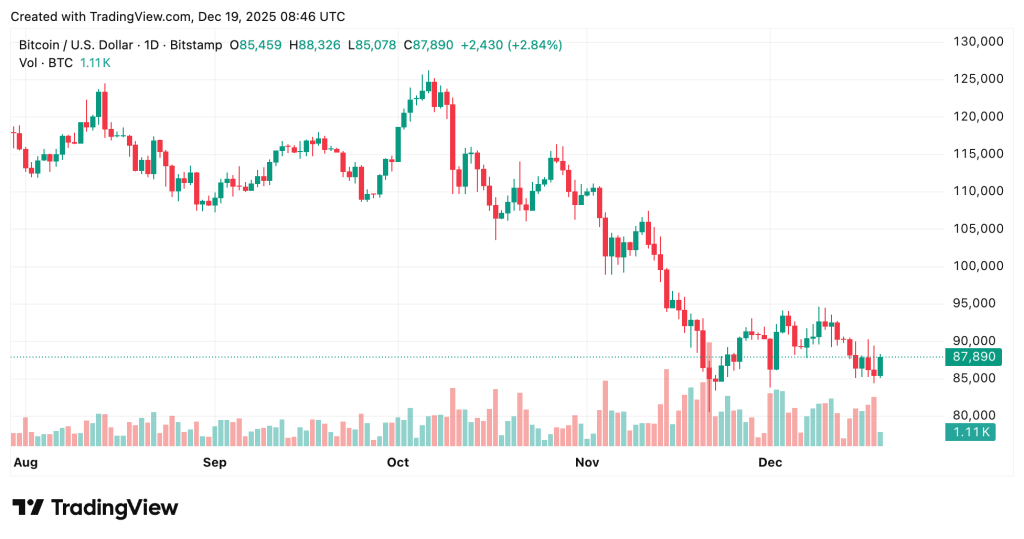
Bitcoin initially dipped belowfollowing the announcement due to yen carry trade unwinds, but quickly rebounded aboveas pre-event downside fears proved overblown.
CryptoMichNL noted the hike’s reduced marginal impact on carry trades from prior adjustments, with markets having priced in a severe crash that didn’t materialize.
TOM LEE SAID #BITCOIN IS STILL GOING TO $200,000 IN THE NEXT 45 DAYS pic.twitter.com/2lpo0wlJPN
Meanwhile, Fundstrat’s Tom Lee also reaffirmed his prediction that bitcoin will reach $200,000 by late January 2026 in a recent CNBC interview, implying a near-doubling from current levels around $85,500 amid post-election consolidation.
Lee’s forecast draws on surging spot ETF inflows exceeding $30 billion year-to-date and anticipated regulatory easing under the TRUMP administration, aligning with his accurate 2024 call for Bitcoin surpassing $100,000 during the halving cycle.
