SAFE Crypto Act Takes Aim After $9.3B in Losses — Is a Federal Task Force the Cure?

Regulators are sharpening their knives. A new legislative push promises to carve out a federal task force dedicated solely to hunting crypto scams—a direct response to the staggering $9.3 billion siphoned from investors.
The Enforcement Blueprint
The proposed framework seeks to centralize efforts that are currently scattered across agencies. It’s a move to cut through jurisdictional red tape and coordinate a more aggressive pursuit of bad actors, from pump-and-dump schemers to sophisticated DeFi exploits.
Why the Crackdown Now?
Mounting losses have turned up the political heat. Lawmakers are under pressure to show they’re not just watching the digital gold rush from the sidelines—especially when that rush keeps funding someone else’s Lamborghini. The sheer scale of the $9.3 billion figure makes for an irresistible soundbite and an undeniable mandate for action.
The Industry's Double-Edged Sword
For legitimate builders, this could be a welcome development. Clear rules and dedicated enforcers might finally separate the innovators from the grifters, potentially paving the way for broader adoption. But the devil is in the details—overreach could stifle the very experimentation that defines the space.
The Bottom Line
While the promise of a federal crypto task force sounds tough, the track record of government agencies chasing fast-moving tech isn't exactly stellar. It often feels like watching your grandfather try to use a new app—a lot of earnest effort, but you're not sure he'll ever find the right button. The real test won't be the announcement, but whether they can actually outsmart the scammers.
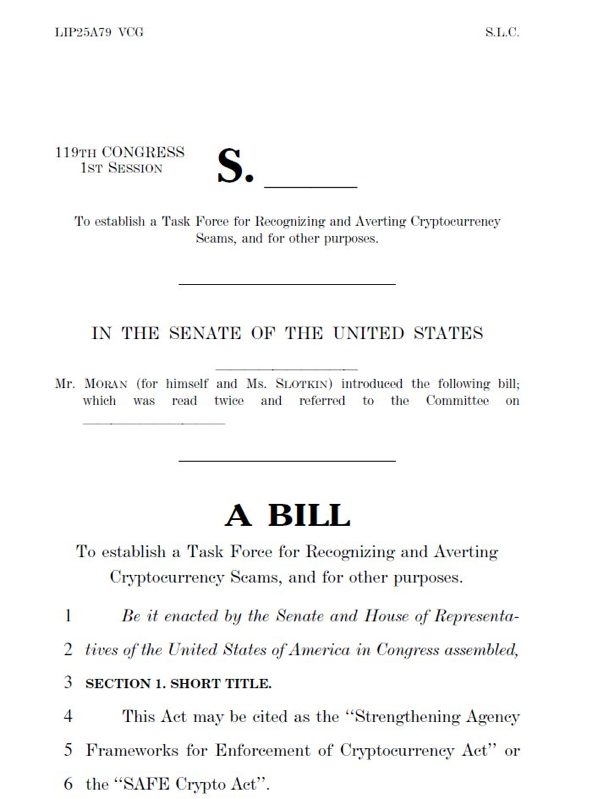 Source: congress
The bill seeks to create a federal task force focused on identifying, tracking, and preventing crypto-related scams while improving coordination between government agencies, law enforcement, and private-sector experts.
Crypto Scams Cost Americans $9.3B in 2024, Hitting Older Investors Hardest
The legislation comes as crypto-related scams continue to hit more Americans, with older investors particularly at risk.
The Federal Bureau of Investigation reports that U.S. residents lost around $9.3 billion to crypto investment schemes in 2024. That’s up 66% from the year before.
 The FBI recorded $9.3 billion losses spread across various crypto-related investment scams, extortion, ATM and kiosks, among others, in 2024.#FBI #CryptoFraud #CryptoScamhttps://t.co/1Eb8KStAHk
The FBI said many of these scams don’t rely on hacking crypto networks. Instead, they use tricks like social engineering, pretending to be someone else, and slowly gaining trust over time to get people to hand over their money.
U.S. Lawmakers Seek Cross-Agency Task Force to Tackle Crypto Scams
Under the SAFE Crypto Act, the Treasury Secretary WOULD be required to establish a task force for recognizing and averting cryptocurrency scams within 180 days of the bill becoming law.
The Task Force would bring together top officials from the Treasury, the Department of Justice, the Financial Crimes Enforcement Network, the Secret Service, and other federal agencies. State and local law enforcement would also get a seat at the table.
The bill also calls for participation from digital asset service providers, stablecoin issuers, custodians, blockchain intelligence firms, consumer protection organizations, and victims’ advocacy groups.
The task force would be charged with examining trends across a wide range of crypto-related fraud, including Ponzi schemes, rug pulls, fraudulent token offerings, money laundering operations, and so-called financial grooming scams.
SAFE Crypto Act Builds on Washington’s Push to Protect Seniors From Crypto Scams
Senator Elissa Slotkin, who supports the bill, says crypto scams are getting trickier as the technology catches on, and local police just don’t have the right tools to keep up.
The legislation also emphasizes real-time collaboration between the public and private sectors to help trace and stop the FLOW of funds linked to scams.
It requires authorized stablecoin issuers to have the technical ability to freeze, seize, burn, or reissue digital assets tied to illegal activity, all in accordance with due process and existing laws.
The proposed task force would be mandated to meet at least three times in its first year and produce a public report for key congressional committees within that period.
Following the initial report, it would provide annual updates, and the task force would automatically disband three years after its first submission.
The SAFE Crypto Act is just one piece of a bigger push in Washington to crack down on investment scams, especially the ones that go after seniors and other people who are often targeted.
Before this, lawmakers floated the National Senior Investor Initiative Act of 2023. That bill would set up a special task force at the SEC focused on protecting older investors.
Then there’s the Fraud Prevention and Recovery Act from 2024, which tries to give the government more power to go after all kinds of fraud.
On top of that, the SEC put together a cross-border task force at the end of 2025 to deal with international securities scams hitting Americans. Clearly, people are getting more worried about fraud rings that stretch across countries.
