Bitcoin Lightning Network Shatters Capacity Records as Major Exchanges Flood Network with Liquidity

The Bitcoin Lightning Network just flexed its muscles, hitting an unprecedented capacity milestone. This isn't just a technical footnote—it's a direct result of major cryptocurrency exchanges finally opening the liquidity taps.
Why This Surge Matters
Think of the Lightning Network as Bitcoin's express lane. It's the layer-2 solution designed to bypass the main blockchain's congestion and high fees for small, fast payments. Capacity—the total amount of bitcoin locked in its payment channels—is its lifeblood. More capacity means more robust, reliable, and cheaper transactions for everyone, from buying coffee to cross-border remittances.
The recent record isn't an accident. It's being driven by a critical mass of exchanges integrating Lightning nodes and routing services. They're not just supporting the network; they're becoming its backbone, providing the deep liquidity needed for it to scale from a promising experiment to a global payments rail.
The Road to Mainstream Adoption
This exchange-driven liquidity solves a classic chicken-and-egg problem. Users needed a reliable way to move funds on and off Lightning; exchanges needed user demand to justify the infrastructure. That logjam is breaking. The result? A network that's suddenly more useful, attractive, and primed for the next wave of users and developers.
It cuts transaction times to seconds and costs to fractions of a cent, making Bitcoin viable for microtransactions it could never handle on-chain. It bypasses the old financial plumbing altogether—no need for a bank's permission or a credit card network's 3% vig. The traditional finance crowd, still obsessed with yield on stagnant fiat, might call it a solution in search of a problem. But then again, they said the same thing about the internet.
The Lightning Network's new capacity record is more than a number. It's a signal that the infrastructure for a faster, cheaper Bitcoin economy is being built right now, not by hobbyists, but by the industry's heaviest hitters. The race to scale is on.
 Read us on Google News
In brief
- Lightning Network capacity reached a new high above 5,600 BTC as major exchanges increased Bitcoin deposits into existing payment channels.
- Node and channel counts remain well below 2022 peaks, showing higher liquidity per channel rather than broad growth in network participation.
- Exchange activity from firms such as Binance and OKX played a major role in the recent capacity jump in November and December.
- Taproot Assets v0.7 adds auditable supply and reusable addresses, supporting stablecoins and other assets on Bitcoin via the Lightning Network.
Bitcoin Lightning Capacity Rises While Node Counts Remain Below Peak
Lightning Network capacity climbed to a new all-time high this week, reflecting renewed interest from exchanges and infrastructure providers. According to bitcoin Visuals, total capacity reached 5,606 BTC on Monday, passing a previous peak set in March 2023. Amboss, a Lightning analytics platform, reported a slightly higher figure of 5,637 BTC on Tuesday, valued at roughly $490 million.
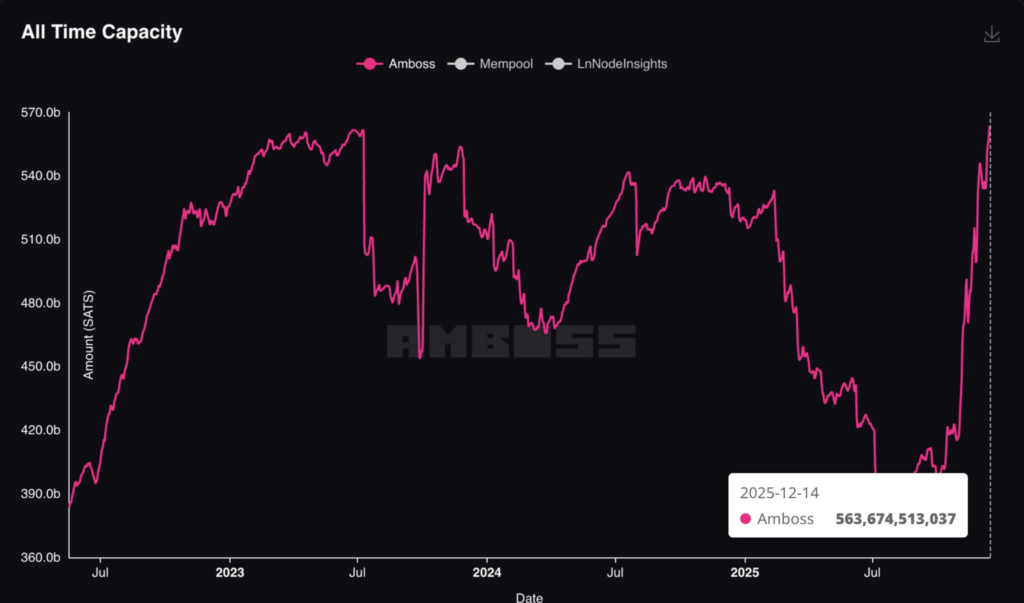
Capacity growth picked up in November and December after a long period of decline. Data shows more Bitcoin being added to existing payment channels, allowing faster and cheaper transfers across the network.
Despite this rise, overall network activity remains mixed. Lightning node count stood at 14,940, down from a high of about 20,700 in early 2022. Channel count followed a similar pattern, falling to 48,678 from earlier peaks.
For context, Lightning works by letting nodes open payment channels funded with Bitcoin. Transactions MOVE across these channels without being recorded directly on Bitcoin’s base layer, with balances updated off-chain. This structure reduces fees and speeds up payments while still relying on Bitcoin’s security model.
Taproot Assets Upgrade Advances Multi-Asset Use
Recent capacity gains appear tied to growing exchange participation. Amboss noted that the increases are not coming from a single source, but from several large players adding liquidity simultaneously. Binance and OKX were cited as exchanges that deposited additional Bitcoin into Lightning channels during the month, helping drive the latest record.
Key factors behind the recent capacity increase include:
- Larger Bitcoin deposits by major exchanges.
- More funds are flowing into existing Lightning channels.
- Renewed interest after months of declining capacity.
- Focus on lowering payment costs for users.
- Infrastructure improvements supporting higher balances.
Broader ecosystem activity also points to expanding use cases. Stablecoin issuer Tether announced an $8 million investment in Bitcoin startup Speed to support stablecoin payments over the Lightning Network. Meanwhile, MetaMask added Bitcoin support, although transactions will rely on Native SegWit rather than Lightning.
On the development side, Lightning Labs released Taproot Assets v0.7, adding reusable addresses, auditable asset supply, and support for larger transactions. Taproot Assets allows assets such as stablecoins to be issued on Bitcoin and transferred through Lightning channels.
Auditable supply features allow users to verify asset issuance without relying on trust, a step that could make Bitcoin and Lightning more attractive for asset issuance beyond BTC.
According to Lightning Labs, the recent update lays the groundwork for large-scale asset movement across Bitcoin and the network. Furthermore, it signals a broader push toward multi-asset support within the network.
Maximize your Cointribune experience with our "Read to Earn" program! For every article you read, earn points and access exclusive rewards. Sign up now and start earning benefits.
