Do Kwon’s 40-Year Prison Sentence: Judge Demands Clarity on Looming South Korea Verdict

Do Kwon faces a legal reckoning that could span decades. A South Korean judge is pushing for definitive answers as the Terraform Labs co-founder confronts the possibility of a 40-year prison term.
The Legal Countdown
The courtroom drama centers on sentencing clarity. Prosecutors built their case on the collapse of Terra's ecosystem—an event that wiped out an estimated $40 billion in market value. The judge isn't mincing words, demanding precise legal arguments to justify what could amount to a life sentence for the fallen crypto magnate.
From Blockchain to Lockdown
Kwon's journey from industry titan to defendant reads like a finance thriller. His algorithmic stablecoin, TerraUSD (UST), and its sister token, LUNA, promised financial innovation. They delivered catastrophic failure instead. The 40-year figure now hanging over him symbolizes the sheer scale of the fallout—investor losses measured in the tens of billions.
The Ripple Effect
This sentencing demand sends shockwaves beyond the courtroom. Regulators worldwide are watching, using the case as a blueprint for future crypto prosecutions. For investors, it's a brutal reminder that 'code is law' until traditional law decides otherwise. The judge's insistence on clarity suggests the final ruling will be meticulously crafted to withstand scrutiny—and set a precedent.
Finance's cynical take? Another 'visionary' discovered that disrupting banks is easier than disrupting prison timetables. The gavel falls, the cell door clicks, and suddenly decentralization feels very far away.
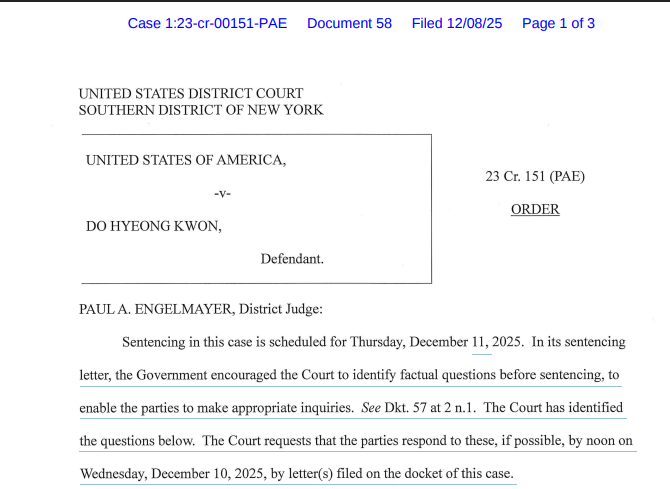 Source: Court Document
The filing shows that the court is weighing how Kwon’s foreign legal exposure, previous detention, and the mechanics of international prisoner transfer programs may affect the punishment imposed in New York.
Court Seeks Clarity on Kwon’s Potential 40-Year Korean Prison Term
The judge’s first set of questions focuses on South Korea’s ongoing criminal case against Kwon.
He asked both parties whether they have any reliable information about the likely outcome of the charges he faces there, whether any agreements have been made with Korean authorities, and what sentencing ranges apply if he is convicted.
South Korean prosecutors previously said they WOULD seek up to 40 years in prison for the same conduct that forms the basis of the US case.
The court also asked whether a Korean sentence could run concurrently or consecutively with a US sentence, a detail that could influence the final terms.
The order also seeks clarification on how to treat the nearly two years Kwon spent in custody in Montenegro. He was arrested in March 2023 while traveling under a false passport and remained detained until extradition.
The judge wants to know whether the Bureau of Prisons will credit any portion of that 21-month period toward his US term and whether the government’s recommendation of a 12-year sentence was based on the assumption that none of that time will count.
Federal prosecutors have already urged the court to impose the full 12 years permitted under Kwon’s plea agreement.
US prosecutors demand 12-year sentence for Do Kwon after Terra's $40B collapse that destabilized crypto markets and aided FTX implosion.#FTX #DoKwon #TerraFormhttps://t.co/LfzwEWH4XG
— Cryptonews.com (@cryptonews) December 6, 2025Defense Pushes Back as Prosecutors Call TerraUSD Collapse “Colossal”
They described the TerraUSD collapse as “colossal in scope,” citing the broader market chain reaction that contributed to the downfall of major firms, including Sam Bankman-Fried’s FTX.
Kwon pleaded guilty in August to conspiracy and wire fraud, admitting that he made false statements about TerraUSD’s stability mechanisms and concealed Jump Trading’s role in supporting the stablecoin during a 2021 depeg event.
 US agrees to recommend a 12-year prison sentence and a $19m fine for Do Kwon after he has pleaded guilty to wire fraud and conspiracy#DoKwon #TerraUSD https://t.co/ktCCrKzob4
Kwon’s lawyers have asked for a five-year term instead, arguing that the time he spent in Montenegro was served in “brutal conditions” and should weigh heavily in the court’s decision.
They also point to the likelihood that he will be extradited to South Korea after completing his US sentence, where he faces a much longer potential punishment.
The defense says that imposing the full recommended term would result in an excessively long combined period of imprisonment.
Judge Seeks DOJ Clarification on Victim Compensation and Asset Forfeiture
The judge’s order shows he is taking that possibility seriously. He asked both sides to explain whether supervised release would even matter if Kwon is likely to be removed from the United States.
He also questioned what guarantees the U.S. would have that another country would enforce the rest of Kwon’s sentence if he is transferred overseas.
Prosecutors have already said they will support a transfer request once Kwon serves half of his sentence.
But the judge noted that these transfers usually require detailed recommendations to the Bureau of Prisons before they can MOVE forward.
The filing also points to several administrative problems tied to forfeiture and victim payments.
The judge asked the Justice Department to clarify how its remission process would decide which victims qualify for compensation from the seized assets.
This question is especially important because the losses span multiple countries, and no restitution order was requested in the case.
