UK Moves to Ban Crypto Political Donations, Potentially Crippling Farage’s Reform Party War Chest

Westminster sharpens its knives for digital asset donors.
### The Regulatory Hammer Swings
British politicians are drafting rules that could slam the door on cryptocurrency contributions to political campaigns. The move targets a funding avenue that's become increasingly popular for its speed and perceived anonymity. If passed, it would force parties to rely solely on traditional fiat channels—slower, more traceable, and far less appealing to the tech-savvy donor.
### A Direct Hit on Disruption
The proposed ban isn't happening in a vacuum. It lands as a potential body blow to Nigel Farage's Reform UK party, which has been vocal about embracing modern financial tools. The party's war chest, reportedly bolstered by crypto donations, now faces a significant threat. Cutting off this pipeline doesn't just limit funds; it signals a rejection of the very innovation some parties champion.
### The Transparency Trade-Off
Regulators argue the crackdown is about accountability and preventing illicit finance. They want every pound, euro, or dollar accounted for under existing financial surveillance frameworks. Critics fire back, calling it a protectionist move for the old banking guard—another case of legacy systems building walls to keep out the new money. After all, nothing threatens a stable, fee-heavy industry like a system that bypasses it entirely.
The UK's political arena is gearing up for a fight that pits regulatory control against financial innovation. One side sees a necessary safeguard; the other, a strategic stifling of competition. The outcome won't just reshape campaign finance—it'll send a clear signal about whether digital assets have a place at the table of power, or if they're to be kept firmly in the political wilderness.
Calls Grow to Restrict Digital Asset Contributions to UK Political Parties
The possibility of a prohibition comes as Reform UK continues to position itself as the most crypto-friendly political force in the country.
Earlier this year, Farage opened the door to digital asset contributions and launched a dedicated donations portal.
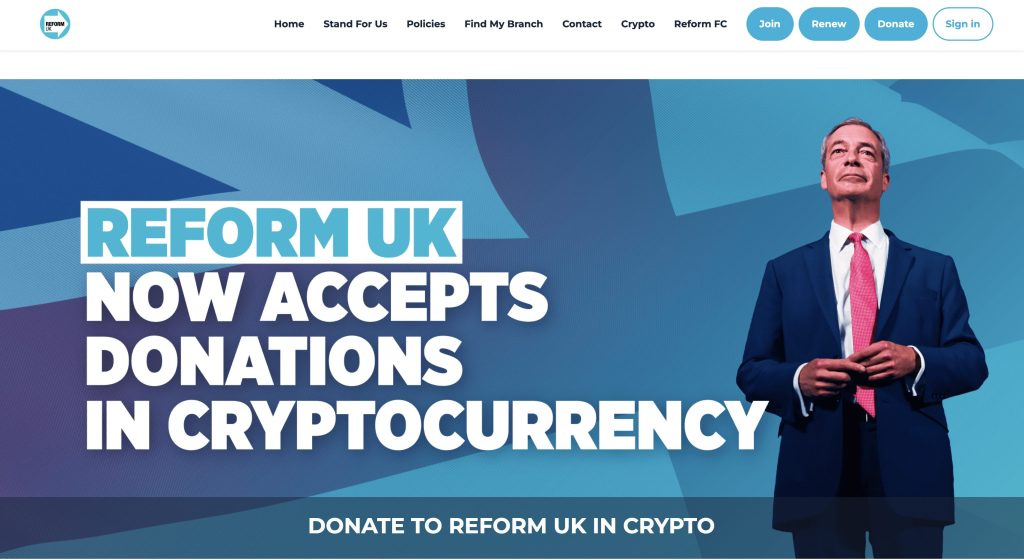
He has described the move as part of a broader “crypto revolution” in Britain and has repeatedly told industry audiences that he is the “only hope” for UK crypto businesses.
In October, he told Reuters the party had already received “a couple” of crypto donations after notifying the Electoral Commission, showing the first time such a contribution had ever been recorded in British politics.
For now, the value of those donations has not been disclosed. The debate over crypto political financing has also grown more intense as Reform surges in national polls and the Labour government faces mounting questions about foreign interference.

Transparency experts have warned that digital assets, while publicly traceable on-chain, can mask the true origin of funds when moved through multiple wallets.
Tom Keatinge, director at RUSI, noted that crypto transfers allow money to cross borders into the UK “much easier” than through traditional banking, raising concerns about illicit financing, especially under a system that already bans foreign political donations in almost all circumstances.
Calls for stricter oversight have come from multiple quarters, including former Cabinet Office Minister Pat McFadden, Business Select Committee Chair Liam Byrne, and Phil Brickell, chair of the All-Party Parliamentary Group on Anti-Corruption and Fair Tax.
 UK Cabinet Office Minister Pat McFadden has called for election officials to consider banning political donations made in digital currencies. #Crypto #UKhttps://t.co/qhoReMm5hG
Lawmakers have argued that existing regulations are insufficient to prevent misuse of cryptocurrency in political donations, noting the potential for anonymity and the difficulty in tracing the original source of funds.
High-Profile MEP Case Sparks Calls for Tighter Electoral Finance Rules in UK
Their warnings have been amplified by recent national security concerns, particularly after former Reform Wales leader Nathan Gill was jailed for more than ten years for accepting payments to make pro-Russian statements while serving as an MEP.
Farage has distanced himself from Gill, calling him a “bad apple,” but the case has intensified calls for tougher rules on political funding.
The Ministry of Housing, Communities and Local Government, responsible for the Elections Bill, stated that the political finance system inherited by the U.K. had left democracy vulnerable to foreign influence.
Officials emphasized that new rules, including those potentially targeting crypto donations, would aim to protect electoral integrity while allowing parties to fund their campaigns responsibly.
The Elections Bill is expected to include new requirements for parties and donors, including restrictions on shell-company contributions and mandatory risk assessments for donations that could expose campaigns to foreign interference.
The UK’s caution stands in sharp contrast to the United States, where digital asset donations have become a major force in federal elections.
American crypto-backed PACs poured more than $190 million into the 2024 cycle, aided by clear reporting rules under the Federal Election Commission.
 A cryptocurrency-backed super PAC, Fairshake, is heading into the upcoming midterm elections with more than $140 million in the bank.#Fairshake #PAChttps://t.co/7AE1JZjV2Y
In Britain, crypto’s political footprint remains minimal. No major party mentioned digital assets in its manifesto during the 2024 general election, and the total number of reported crypto donations remains close to zero.
