13.5B Fed Injection Fails To Move Bitcoin Price: The Unshakable Digital Fortress

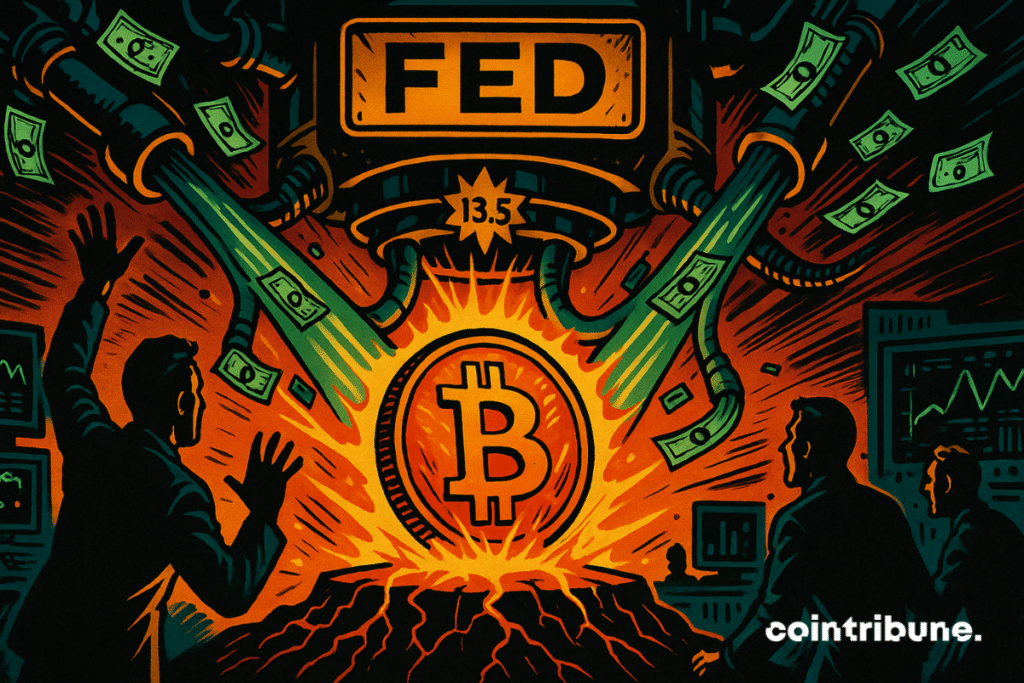
The Federal Reserve just pumped $13.5 billion into the system. Bitcoin didn't flinch.
Wall Street's Old Playbook Meets a New Rulebook
For decades, a massive liquidity injection from the central bank was a guaranteed market-moving event. Stocks would rally, bonds would shift, and traders would scramble. This time, the script flipped. The flagship cryptocurrency absorbed the news like a digital sponge and held its ground—a silent but powerful statement on its evolving maturity.
Decoupling Narrative Gains Steam
The non-event speaks volumes. It fuels the growing argument that Bitcoin's price drivers are increasingly distinct from traditional macro liquidity pulses. The market's focus appears locked on its own internal rhythms: adoption metrics, network activity, and the looming halving—not the Fed's balance sheet maneuvers. It's a sign of an asset class forging its own path, one that increasingly bypasses the old gatekeepers of capital.
A Cynical Wink to Traditional Finance
Meanwhile, in traditional finance, that $13.5 billion will dutifully circulate—padding bank reserves, influencing bond yields, and giving analysts another data point to overanalyze for quarterly reports. Bitcoin, it seems, has better things to do.
The takeaway is stark. The largest central bank in the world fired a $13.5 billion stimulus round, and the world's largest digital asset didn't even blink. That's not just price action; it's a message. The era where crypto reflexively jerked on every Fed string may be closing. The fortress walls are getting thicker.
 Read us on Google News
In brief
- Grayscale questions Bitcoin’s historical four-year cycle, based on halvings.
- According to the asset manager, Bitcoin could reach new highs as early as 2026, without following its usual pattern.
- The prospect of a Fed rate cut and progress in US crypto regulation strengthen the bullish scenario.
- Meanwhile, the Fed injected $13.5 billion in liquidity, a record since the COVID crisis, potentially boosting risky assets.
Grayscale bets on the break of bitcoin’s historical cycle
In its latest report after the official filing for its IPO, asset manager Grayscale questions a pillar of crypto analysis: bitcoin’s four-year cycle, traditionally tied to halving events.
The company states this model could be broken as early as next year, opening the way to an unprecedented bullish movement by 2026. “Although prospects are uncertain, we believe the four-year cycle thesis will prove incorrect and the asset’s price could reach new heights next year”, the report reads.
This statement comes as Bitcoin dropped 32 % from its previous highs, but some technical signals already reveal a reversal. Among them, bitcoin options imbalance, exceeding 4, indicates according to Grayscale that investors have already “extensively hedged their downside risk exposure”.
Beyond these technical indicators, several factual elements support the thesis of a cycle reversal :
- Spot Bitcoin ETFs recorded in November $3.48 billion in net outflows, their second worst month historically. However, an inflection is emerging with four consecutive days of inflows, including $8.5 million on the Monday before the report’s release ;
- The probability of a Federal Reserve monetary easing, estimated at 87% for a 25 basis point cut at the December 10 meeting, according to the CME FedWatch Tool ;
- The evolution of the US regulatory framework, with advances on structuring texts like the Digital Asset Market Structure Bill and the CLARITY Act, which could encourage stronger institutional capital inflows as early as 2026.
For Grayscale, these elements converge toward an unprecedented scenario: bitcoin freeing itself from its traditional cyclic rhythm, supported by changing macro and structural fundamentals. The dynamic remains dependent on the confirmation of these trends in the coming months.
When Fed liquidity enters the crypto universe
Another key event, external this time to the crypto ecosystem, could have a significant impact on the Bitcoin price : the surprise injection of $13.5 billion in liquidity by the US Federal Reserve on December 1st.
Indeed, this is the second-largest operation since the COVID crisis. This decision marks, according to several analysts, the effective end of the Fed’s quantitative tightening (QT) program. Bitcoin and risky assets can benefit from a new liquidity boost.
Despite this monetary easing, bitcoin has not yet capitalized on this favorable wind, unlike equity markets. The S&P 500 index continues its rise, supported by historically bullish seasonality in December, while BTC remains behind.
For Mike McGlone, senior strategist at Bloomberg Intelligence, this divergence could signal a reversal in risky assets led by bitcoin. He points to an excessive BTC valuation compared to gold, with a 20x ratio versus a “fair value” estimated at 13x.
According to his models, this imbalance could expose bitcoin to a correction, especially since the implied volatility of the S&P 500 is at historically low levels, reinforcing the hypothesis of a general market complacency.
Bitcoin replays the 2022 bear market, but the framework has changed. While the hypothesis of a peak in 2026 is gaining ground, nothing indicates that the old cycles still hold. The market is testing new benchmarks, and uncertainty remains the only constant.
Maximize your Cointribune experience with our "Read to Earn" program! For every article you read, earn points and access exclusive rewards. Sign up now and start earning benefits.
