Pig-Butchering Scams Surge: Chainalysis Flags Crypto Fraud as National Security Crisis

The 'pig-butchering' scam epidemic isn’t just draining wallets—it’s morphing into a full-blown national security threat, according to blockchain sleuths at Chainalysis.
How crypto’s darkest grift went mainstream
These aren’t your grandma’s phishing emails. Sophisticated romance scams now leverage decentralized finance tools, turning heartstrings into profit margins with military precision. Victims get fattened with fake affection before the digital slaughter.
The security implications are staggering. When a single scam can funnel millions through mixers and offshore exchanges, it’s not just about stolen cash—it’s about untraceable funding flows that could bankroll anything. (Wall Street bankers, take notes—this is how you really hide illicit money.)
Chainalysis warns that without coordinated global action, these operations will keep evolving faster than regulators can react. The ultimate irony? The very transparency of blockchain might be our best weapon against these predators.
 Source: Chainalysis
Why Are Pig-Butchering Rings Exploding Despite Billions in Seizures?
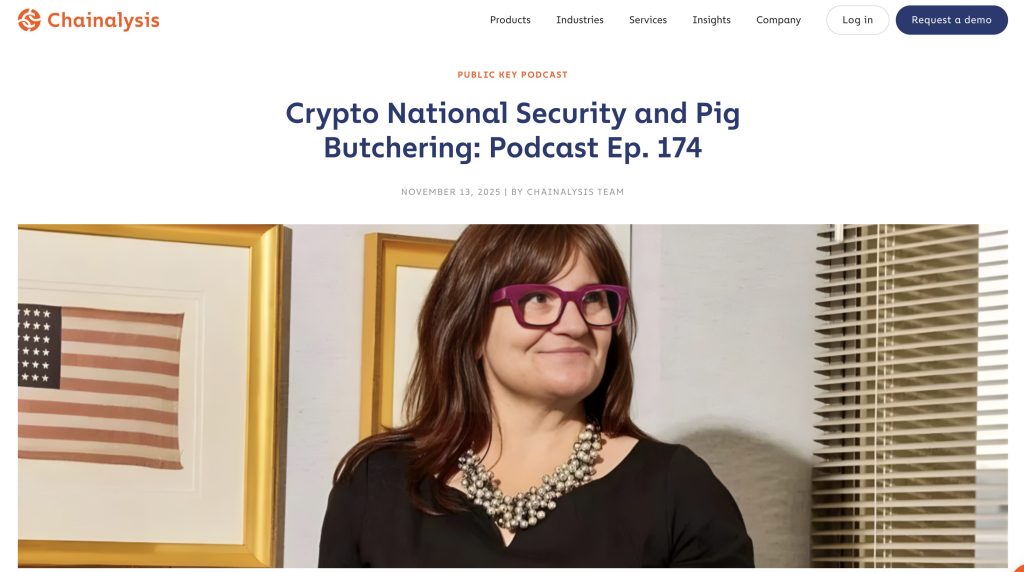
West said the threat now touches every corner of the financial system. “If anybody is touching money in any way, you’re part of this,” she said, stressing that the issue requires deeper awareness from banks, exchanges, and regulators.
Pig-butchering scams rely on long-term social engineering. Criminals build trust with victims, often through dating apps, social media, or unsolicited messages, before steering them toward fake cryptocurrency investment platforms.
The goal is to “fatten” victims with false profits before draining their accounts entirely.
Fierman and West described how criminal groups across Southeast Asia run dormitory-style compounds where trafficked workers are forced to operate these schemes.
Victims abroad lose life savings, while victims inside the compounds are held against their will and coerced into participating.
Chainalysis data shows that pig-butchering activity surged by nearly 40% in 2024, contributing to more than $9.9 billion in overall crypto scam revenue that year.

The U.S. Department of Justice seized about $225 million linked to these scams in 2023, one of several early indicators of how large the ecosystem has become.
The experts also pointed out a secondary LAYER of exploitation that often goes unreported.
After victims are defrauded, they are frequently contacted again by fake recovery firms posing as law enforcement or private investigators.
“Once this happens to you, you will be put on a list,” West said. “You are even more likely to get hit up again.”
Pig-Butchering Scams Spur Coordinated Global Enforcement as Losses Reach Record Levels
The surge in pig-butchering scams is unfolding alongside a series of major international enforcement actions.
In October, U.S. authorities announced the largest crypto seizure ever tied to global online fraud, targeting Cambodia-based Prince Holding Group and its chairman, Chen Zhi.
 @USTreasury has moved to make its largest-ever cryptocurrency seizure, targeting $12B in #Bitcoin from a global "pig butchering" scam. #US #PigButcheringhttps://t.co/6JpciJNrod
At the same time, the Treasury Department’s Office of Foreign Assets Control (OFAC) sanctioned 146 people and entities connected to the group, describing it as a transnational criminal enterprise engaged in fraud, extortion, and forced labor.
Private-sector involvement has expanded alongside these government efforts. In August, Tether froze nearly $50 million in USDT linked to a Southeast Asia-based pig-butchering ring after investigators traced the funds across 19 addresses.
That same month, Binance joined the T3+ intelligence initiative, led by TRON, Tether, and TRM Labs, helping freeze nearly $6 million tied to another scam case.
 @Binance has joined the new T3+ crime-fighting alliance — and in its first case, helped freeze $6M from a pig butchering scam. #CryptoCrime #Binance https://t.co/Twontg49DA
The exchange said its internal systems prevented 7.5 million users from losing almost $10 billion to fraud between December 2022 and May 2025.
Coinbase has participated in similar efforts. In June, the exchange assisted the U.S. Secret Service in recovering $225 million in USDT, one of the agency’s largest crypto seizures.
Investigators traced the funds to 140 OKX accounts, many registered under trafficking victims coerced into running scam operations.
 @coinbase helps US Secret Service seize record $225 million in USDT from pig butchering scams in landmark operation targeting international criminal networks.#Coinbase #CryptoScamhttps://t.co/ksWEAw0vCD
The scale of losses continues to escalate. The FBI’s latest Internet Crime Report shows Americans lost more than $9 billion to online investment fraud last year.
TRM Labs estimates that more than $53 billion in crypto-related fraud has been tracked globally since 2023—likely only a fraction of actual losses.
