Bitcoin ETFs Bleed $860M in Second-Largest Outflow on Record – Is the Bull Run Stalling?

Wall Street's crypto experiment hits a snag as Bitcoin ETFs hemorrhage capital at alarming rates.
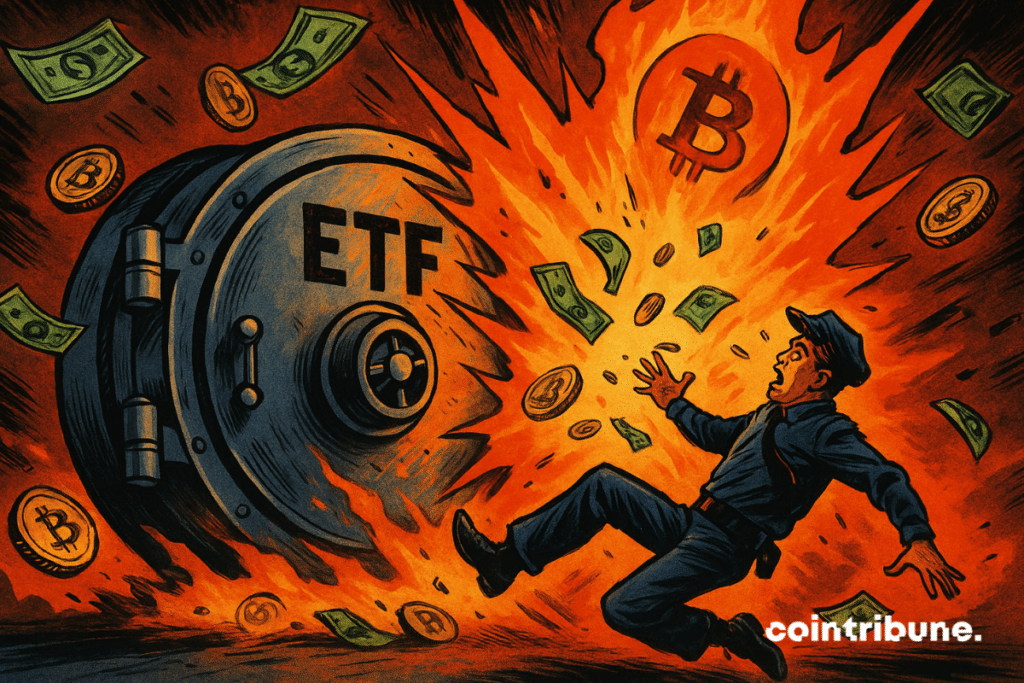
The great ETF unwind continues: Investors yank $860M from Bitcoin funds in a single day—marking the second-worst exodus since launch.
Context bites harder than volatility: These outflows eclipse Bitcoin's 30-day price drop, suggesting deeper institutional skittishness than retail FUD.
Bonus jab: Traders who begged for 'regulated exposure' now proving they'll panic-sell paper Bitcoin faster than actual BTC holders dump during crashes.
 Read us on Google News
In brief
- U.S. spot Bitcoin ETFs recorded over $860 million in net outflows on Thursday, marking their second-largest single-day withdrawal since launch.
- Analysts said the wave of withdrawals reflects growing investor caution and a shift toward safer assets amid macroeconomic uncertainty.
- Bitcoin continued to slide below $97,000, reaching levels not seen since early May.
Investor Outflows and Market Sentiment Weigh on BTC
Data from SoSoValue revealed that Grayscale’s bitcoin Mini Trust experienced the largest single-day outflow, with roughly $318.2 million redeemed, followed by BlackRock’s IBIT at $256.6 million and Fidelity’s FBTC at $119.9 million.
So, how do other recorded outflows compare?
- Grayscale’s GBTC fund had an additional $64.5 million withdrawn, while Bitwise’s BITB and Invesco’s product saw outflows of approximately $47.03 million and $30.80 million, respectively
- Further reductions occurred from Ark and 21Shares’ ARKB, Valkyrie’s BRRR, and Franklin Templeton’s EZBC, adding to the overall outflow totals
- Collectively, these withdrawals represented the second-largest single-day outflow in U.S. spot Bitcoin ETF history, with only February 25, 2025, seeing a higher exit of roughly $1.14 billion
Kronos Research’s Chief Investment Officer, Vincent Liu, interpreted the wave of withdrawals as a sign that investors were adopting a more cautious, risk-off approach amid growing macro uncertainty. He indicated that this change in positioning could restrain short-term momentum in Bitcoin but did not necessarily alter longer-term interest in the asset. Liu viewed the scale of selling as typical of a market that may be entering oversold conditions, a phase that often draws in buyers with a longer investment horizon.
The negative sentiment extended beyond ETFs, as the broader crypto market saw declines across major tokens, a trend that critics of Bitcoin pointed to when questioning its stability. Market commentator Peter Schiff highlighted Bitcoin’s performance over the past year, noting that while it surpassed $100,000 in December 2024, it had fallen below that level by mid-November 2025. He also compared it to gold, which rose roughly 60% over the same period, suggesting that Bitcoin has struggled to maintain its earlier gains.
Technical Levels and Macro Factors Shape Bitcoin’s Slide
Bitcoin continued its slide below $97,000, a level it had not reached since early May, with Liu attributing the decline to a liquidity gap in which a wave of liquidations met a shrinking pool of buy orders. He pointed to interest building in the $92,000–$95,000 zone, where buyers appear to be gradually restoring support. He added that volatility will likely continue until new inflows stabilize market depth.
Further perspective came from trader Michaël van de Poppe, who said a trend reversal WOULD require Bitcoin to reclaim a former support level. With the asset still under $100,000, he noted that regaining the area around $101,000 would be the first step before any recovery attempt. He added that ongoing selling—despite firm equity markets—reflects sentiment from investors who believe Bitcoin may have already topped within the usual four-year cycle. He said this mindset must clear out within the current range for the market to advance.
Adding macro context, Min Jung, a research associate at Presto Research, noted that the pullback also reflects investor caution amid broader economic unpredictability and a reduced appetite for risk. She pointed to recent ADP and NFIB data showing signs of a slowing labor market, suggesting the Federal Reserve is likely to MOVE cautiously on interest rates ahead of the December FOMC meeting. CME Group’s FedWatch shows that market expectations for a December rate cut have now fallen to approximately 50%.
Maximize your Cointribune experience with our "Read to Earn" program! For every article you read, earn points and access exclusive rewards. Sign up now and start earning benefits.
