Hyperliquid Unleashes Permissionless Revolution with HIP-3 - Takes Direct Aim at CEX Giants Despite 500,000 HYPE Entry Barrier

Decentralized finance just declared war on traditional exchanges.
The Permissionless Gambit
Hyperliquid's HIP-3 proposal shatters the centralized mold—handing control back to users while demanding serious skin in the game. That 500,000 HYPE entry ticket? Either you're building the future or funding someone else's yacht.
CEX Disruption Mode
Traditional exchanges are watching their moats evaporate as Hyperliquid bypasses gatekeepers entirely. No more begging for listings. No more arbitrary delistings. Just pure, unadulterated market dynamics—if you can afford the cover charge.
The Real Cost of Freedom
Half a million tokens might sound steep until you calculate the hidden fees of centralized platforms. Spreads, withdrawal limits, and that sinking feeling when your funds get 'temporarily held' during volatility. Suddenly 500K HYPE looks like a bargain—or the ultimate whale filter.
Wall Street would call this disruptive innovation. Crypto natives call it Tuesday. Either way, the establishment just lost another brick in their wall.
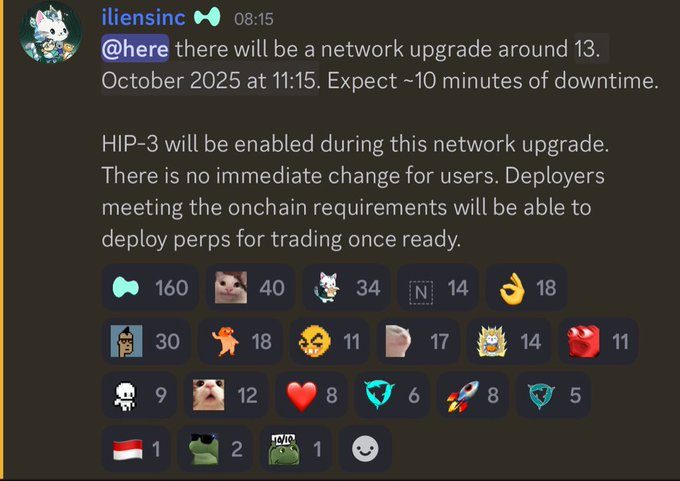 Source: Hyperliquid Discord
With HIP-3, qualified developers can deploy perpetual contract markets by staking 500,000 HYPE tokens, a requirement that serves both as a bond and a safeguard against spam.
Once deployed, builders must provide their own liquidity, oracles, and front-end interfaces. In return, they can earn up to 50% of trading fees from the markets they create, incentivizing a new wave of on-chain innovation.
Hyperliquid Challenges CEX Model as HIP-3 Lets Anyone Deploy Perps On-Chain
An administrator confirmed in Hyperliquid’s Discord that HIP-3 enables “builder-deployed perpetuals,” emphasizing that while the upgrade introduces no immediate changes for users, it fully decentralizes the process of listing new perpetual markets.
“Deployers meeting the on-chain requirements will be able to deploy perps for trading once ready,” the statement said.
Integrated with HyperEVM, HIP-3 supports smart contracts, governance, and security features such as validator slashing and open interest caps.
The upgrade is designed to reduce entry barriers for new projects while maintaining system integrity, allowing builders to test new markets efficiently and safely.
The shift positions Hyperliquid as a direct competitor to centralized exchanges (CEXs), which have long dominated crypto trading. In recent months, developers and founders have publicly criticized the high costs associated with CEX listings.
Jesse Pollak, a developer at Base, recently wrote, “Raise your hand if you’re ready to go to war against CEX listings that charge 2–9% of a token supply to be listed.”
Another developer, Jeffy Yu, claimed on X that centralized exchanges had demanded substantial listing fees, including $1 million cash from Binance and hundreds of thousands from other exchanges, calling the process “disgusting and unethical.”
if you wanna know how we were being handled by these companies when building zerebro@binance asked for $1mil cash to list
i honestly don’t even think @cz_binance knows his listing team is cabaling devs,
esp since he was locked up still
think we paid @krakenfx like $100-200k… https://t.co/36QaQiomPo pic.twitter.com/hpBfdhI60h
By contrast, HIP-3 aims to introduce a transparent, on-chain framework for market creation, requiring only the 500,000 HYPE stake.
Notably, the upgrade seeks to allow market makers to plug into the shared infrastructure through HyperCore, which supports high-performance order matching and sub-second trade finality.
The integration allows for scalable and interoperable trading, with reduced costs and faster market deployment compared to building from scratch.
Industry analysts view the upgrade as a major step toward decentralization in derivatives trading.
According to one crypto commentator, Akshay BD, the MOVE is “a big deal” for teams wanting to launch markets quickly.
“They can buy HYPE, stake it, spin up markets, and earn fees. They don’t need to worry about infrastructure or token alignment,” he said, noting that HIP-3 could intensify competition among ecosystems vying to launch new assets efficiently.
this is a big deal imo. teams can now buy 1M HYPE, stake it and spin up markets around hyperliquid and earn fees.
they don’t need to worry about infra, launching a token, or aligning incentives between the network, app LAYER and users. everyone coordinates around a single asset.… https://t.co/GFC4pC3XEQ
The upgrade could also broaden Hyperliquid’s scope beyond crypto, enabling the creation of perpetual markets for assets like equities, commodities, and even prediction markets.
Several early-stage projects, including those building pre-IPO equity contracts and structured derivative products, are reportedly preparing to deploy under HIP-3.
Tensions Flare Between Hyperliquid and Binance
The launch of its permissionless upgrade comes as tensions between Hyperliquid and Binance resurfaced this week after Hyperliquid co-founder Jeff Yan accused centralized exchanges of underreporting liquidations during last week’s market crash.
In a post on X, Yan claimed that “underreported CEX liquidations” distort market data and transparency. He said Hyperliquid’s on-chain system, which publicly records all liquidations and orders in real time, prevents such discrepancies.
 @cz_binance pushed back after Hyperliquid’s Jeff Yan @chameleon_jeff accused centralized exchanges like Binance of underreporting user liquidations during last week’s market chaos.#ChangpengZhao #Hyperliquid https://t.co/oHnrmm4g26
Binance founder Changpeng Zhao (CZ) responded indirectly, saying Binance and its affiliates had “taken hundreds of millions out of their own pockets to protect users” during the turmoil, adding that different players in the industry “operate under different value systems.”
The debate followed a steep market sell-off on Oct. 10–11 that erased more than $19 billion in Leveraged positions and briefly caused technical disruptions on Binance.
In contrast, Hyperliquid reported handling up to $70 billion in volume without downtime, strengthening its case for on-chain transparency.
Speculation also resurfaced around Binance’s historical links to Hyperliquid. Zhao clarified that while Yan participated in Binance Labs’ 2018 incubation program through a separate startup called Deaux, Binance no longer holds any stake or tokens in Hyperliquid. The earlier project failed, he said, and “no investment was recovered.”
 Binance’s CZ says Hyperliquid’s founder joined Binance Labs’ 2018 incubation for a failed project but confirms no current ties. #DeFi #Hyperliquid #Binancehttps://t.co/IU1EuSfNIN
Since launching its own Layer-1 blockchain, Hyperliquid has grown into one of DeFi’s most active perpetual trading platforms, now holding roughly 70% of the total decentralized perpetuals market, according to DeFiLlama and Token Terminal data.
