BIP-360: Bitcoin’s Quantum Leap or Fracture? The Protocol Dividing Crypto’s Core

Bitcoin faces its ultimate stress test—and the community is splitting at the seams.
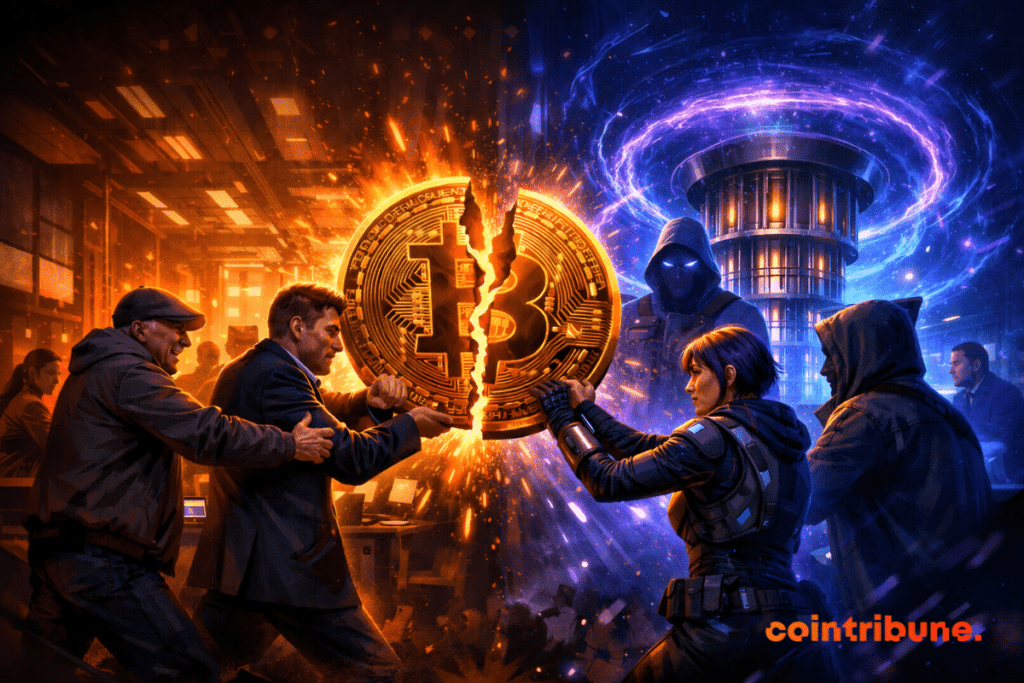
A new proposal, BIP-360, has landed like a cryptographic grenade in developer circles. Its mission? To future-proof the blockchain against a threat that still lives mostly in theory: quantum computing. The debate isn't about *if* such machines could one day break Bitcoin's encryption; it's about whether preparing for that day now could break Bitcoin's soul.
The Quantum Countdown Clock
BIP-360 isn't a gentle upgrade. It's a hard fork blueprint, demanding a decisive shift to new, quantum-resistant signature schemes. Proponents argue the clock is ticking. Waiting for a quantum 'Sputnik moment'—when a powerful machine suddenly cracks a wallet—would be a disaster of epic, irreversible proportions. This is pre-emptive defense at its most extreme.
The Schism Over Sovereignty
Opposition is fierce. Critics blast the proposal as a dangerous overreach, a 'solution' in search of a problem that may be decades away. They see it as engineering hubris, potentially introducing new bugs while fixing a non-existent one. The core tension? Forcing a mandatory, network-wide change flies in the face of Bitcoin's decentralized, voluntary ethos. It’s a top-down mandate in a bottom-up ecosystem.
The divide cuts to the heart of what Bitcoin is: a stateless protocol or a product that needs proactive management. One side sees prudent stewardship; the other sees a dangerous precedent—the kind of 'for your own good' governance that traditional finance uses to justify endless intervention. After all, Wall Street's favorite trick is selling you insurance against risks they invented.
Survival or Purity?
The standoff leaves no easy middle ground. Adopt BIP-360 and risk a chain split from purists who reject the change. Reject it, and risk being labeled negligent by those who believe the quantum threat is real and imminent. The community must weigh its legendary immutability against a potential future vulnerability. It's a high-stakes gamble: bet on the protocol's current resilience, or bet on a future it may not survive intact.
One thing's certain—the debate proves Bitcoin's most fragile component isn't its code, but the human consensus behind it. And that, not a quantum computer, might be what truly gets tested first.
 Read us on Google News
In brief
- BIP-360 revives the debate on bitcoin’s quantum resistance.
- Some want to accelerate from 2026, others consider the threat still distant.
- The real battle will be address migration, more political than technical.
BIP-360, the post-quantum option shaking up bitcoin
BIP-360 proposes adding a new type of address to Bitcoin capable of using so-called “post-quantum” signatures. The idea is to offer an escape route before more powerful machines make some current signatures fragile.
Technically, the proposal is often summarized as a “pay-to-quantum-resistant-hash.” It mainly targets bitcoins that could become exposed if, one day, a quantum computer can derive a private key from a public key. BIP-360 therefore tries to anticipate a future where this scenario is no longer science fiction.
But the most important thing is not the formula. It is the political signal. For bitcoin, any serious evolution requires rare coordination: hardware wallets, nodes, miners, exchanges, integrators. A good idea without alignment remains a PDF on the Internet.
Urgency or Excess Caution: the Bitcoiner Split
Supporters of accelerated action speak of a market risk even before a technical risk. Charles Edwards (Capriole) insists on a tight schedule and mentions a 2026 window to finalize and deploy. He goes further. According to him, coins that do not migrate to BIP-360 should even be “burned” by 2028. This radicalism shocked, but it also awakened the conversation.
Opposite, very respected profiles remind us that panic can be a bad advisor. Adam Back emphasizes that bitcoin does not “do encryption” in the sense many understand it, and that short-term break scenarios mostly come from FUD. He considers the threat significantly distant, over decades.
Samson Mow, meanwhile, chooses sarcasm to deflate the bubble. His argument is almost pedagogical: if quantum is still at modest demonstrations, why imagine it will swallow bitcoin tomorrow morning? The mockery mainly targets the idea of a “panic sale” triggered by a misunderstood fear.
Taproot Retreats: technical signal or psychological symptom?
An element has added fuel to the fire: the use of Taproot is declining. According to Willy Woo, the share of transactions using Taproot has dropped from about 42% in 2024 to around 20% recently. He says he has “never seen” the newest format lose adoption in bitcoin.
It’s tempting to see this as a vote by users. Taproot is associated with Schnorr signatures, therefore with a cryptographic family that quantum could theoretically threaten via Shor’s algorithm. In this reading, less Taproot WOULD mean “less attack surface.” And the idea is virally simple, so it spreads quickly.
Except that the reality is more nuanced. The vulnerability mainly depends on a precise point: when the public key is revealed on-chain, and how long it remains exploitable. Many formats reveal the public key at the time of spending. Taproot is not magically “the only” concerned, even if its public perception can become so. And, on a market, perception often ends up weighing as much as cryptography.
2026-2028: the real challenge is migration
Even if everyone agreed tomorrow, the hardest part would then begin. A post-quantum transition is a mass migration. It must be compatible, gradual, and understandable by non-specialists. Otherwise, it creates a new risk: user errors, losses, or stuck funds.
This is also why alternatives are circulating. On the Blockstream Research side and discussions on the bitcoindev mailing list, one explored path is “hash-based” signatures. The appeal is clear: security would mainly rely on hash function assumptions, a terrain already familiar to bitcoin.
At heart, the BIP-360 debate goes beyond technique. It touches bitcoin’s DNA: MOVE slowly, but survive everything. The “impatient” fear a confidence shock before the real attack. The “patients” fear a rushed update, more dangerous than the threat. Between them, the network advances as it always does: through frictions, trials, and consensus… when it eventually emerges. And regarding the price, Tom Lee sees a strong signal.
Maximize your Cointribune experience with our "Read to Earn" program! For every article you read, earn points and access exclusive rewards. Sign up now and start earning benefits.
