Nvidia’s Crypto Charm Offensive: How Courting Trump Paid Off Big in 2025

Nvidia just pulled off the ultimate power play—and the crypto markets are feeling the heat. Forget backroom deals; this was a full-scale, public-facing charm offensive that rewrote the rulebook on tech-political alliances.
The Courtship Playbook
It started with strategic positioning. Nvidia didn't just lobby; it showcased. Demos of next-gen AI accelerators weren't held in Silicon Valley boardrooms but in venues that captured a very specific, populist imagination. The message was clear: this tech isn't for the coastal elites; it's the engine for a new American industrial boom—one that just happens to run on blockchain protocols.
The Payout: Market Momentum
The payoff was immediate and seismic. Trading algorithms, always the first to smell blood—or opportunity—went into overdrive. A wave of capital, previously sidelined by regulatory uncertainty, flooded into AI-crypto hybrids and infrastructure tokens. It wasn't a gentle nudge; it was a tidal shift in sentiment, proving that in modern finance, perception isn't just reality—it's liquidity.
Beyond the Hype Cycle
This move did more than spike a few charts. It legitimized a narrative. The fusion of frontier AI hardware with decentralized networks stopped being a fringe thesis and became a investable pathway. Venture portfolios pivoted overnight. Suddenly, every project needed an 'AI-agent' or a 'ZK-proof' attached to its name, a classic case of the tail wagging the dog—or in this case, the chip wagging the chain.
The New Political Calculus
The implications stretch far beyond a single earnings cycle. Nvidia's maneuver demonstrates a cold, hard truth: in the battle for technological supremacy, political capital is a currency as crucial as any crypto. They didn't ask for permission; they created a new playing field. Other tech giants are now forced to recalculate their own strategies, realizing that sometimes, the most efficient processor is a well-placed relationship.
One cynical finance jab? Wall Street analysts, who spent years dismissing crypto as a 'pet rock,' are now frantically rebranding as 'digital asset strategists'—nothing boosts credibility like a soaring portfolio you previously mocked.
Nvidia's play cut through regulatory fog, bypassed traditional gatekeepers, and connected silicon sovereignty directly to political will. The result? A blueprint for the next decade of tech growth—where chips, chains, and charm are the only trinity that matters.
 Read us on Google News
In brief
- Nvidia’s market capitalization has surged, and Trump has chosen to make the company a strategic partner, despite resistance within his own camp.
- Jensen Huang secured direct access to the White House and influenced the battle over chip exports to China.
- This standoff over “compute” shows how politics can steer liquidity and shape narratives in the crypto market.
Nvidia and Trump, an alliance that surprises Washington
Driven by demand for artificial intelligence and its global expansion, Nvidia has seen its capitalization soar to 4.68 trillion dollars. And at this level, Washington could no longer look away, crypto or not. Until recently, Jensen Huang was almost invisible in the corridors of power. Then everything accelerated, too fast for competitors, who are still searching for the formula.
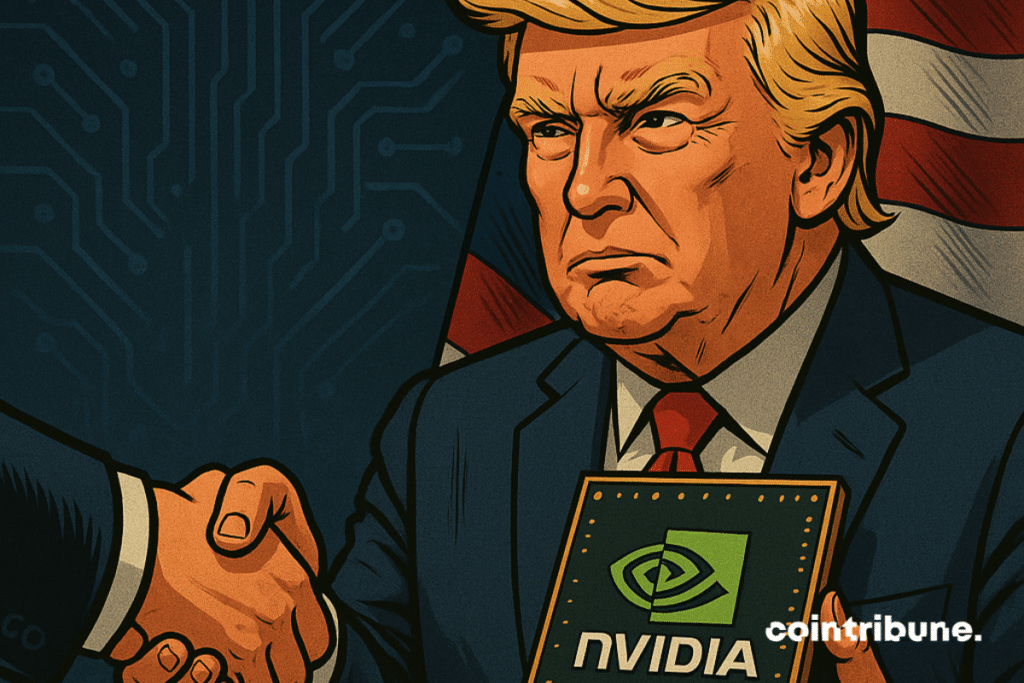
The shift is embodied in a simple-to-summarize and complicated-to-digest agreement, crypto or not. The WHITE House approved exports of H200 chips to China, after direct exchanges between Jensen and Trump. And the U.S. government would recover 25% of the sales.
Trump had even already said that he had never heard of Nvidia or Jensen. Yet, he ended up overriding voices from his MAGA coalition to let the company MOVE forward. This is not a sentimental gesture. It is a power struggle decision, which markets, including crypto, take note of.
Jensen Huang, the calm method and direct access
The starting point lies in a meeting. Howard Lutnick, Secretary of Commerce, serves as a gatekeeper. Jensen obtains access to the president that resembles a direct line, with an implicit promise of total availability.
What strikes is the style. Jensen speaks little, but he establishes a logic. Nvidia is presented as a national asset, a key piece, almost a sovereignty tool. In a Washington obsessed with China, the message fits together effortlessly.
At the same time, Nvidia understands the unwritten rule of Trumpism. It requires something concrete, quickly. The company joins a consortium that promises to invest 500 billion dollars in the United States over four years, just to check the domestic production box.
Then come the images, those that sustain a relationship. Dinner at Mar-a-Lago, one million dollars per guest. At least six private meetings, direct calls, trips with the president to the United Arab Emirates, Saudi Arabia, and the United Kingdom. In July, a summit on the artificial intelligence action plan at the White House, TRUMP slips in a public compliment. Later, a ballroom project also receives Jensen’s contribution.
An export battle, and a signal for crypto
Jensen does not stop at the executive branch. He also pushes Congress. His argument is summed up in one sentence: banning U.S. sales does not stop China; it accelerates its alternatives. He cites Huawei as a replacement already ready to enter the breach.
Nvidia then professionalizes its presence. Tim Teter, head of legal, leads the offensive. The company stays away from large associations, hires a Republican lobbyist who passed through Ivanka Trump’s entourage, and focuses the debate on a single field: exports. Nvidia sells hardware, not models. It thus avoids taking on debates about employment or mental health, which stick to platforms.
Opposition exists on the other side. National security officials and think tanks oppose. Steve Bannon criticizes the H200 deal. Elizabeth Warren denounces too partisan closeness. A text aiming to restrict the H20 was abandoned, but a bipartisan project is now seeking to limit the administration’s maneuvering room to approve these sales.
In this saga, one detail sums up the power struggle. A first attempt to relaunch the H20s planned 15% tax for the United States, but Beijing rejected these less powerful chips. Nvidia pivots to the H200, more advanced, more desirable, more strategic.
And what about cryptocurrency? It is not a bystander. When politics becomes a switch on global computing power, it also influences market narratives. The same capital that chases performance can move from stocks to tokens, then back, at the rhythm of Washington’s decisions. Liquidity follows. And price never waits for the end of debates.
Maximize your Cointribune experience with our "Read to Earn" program! For every article you read, earn points and access exclusive rewards. Sign up now and start earning benefits.
