Indian Women Crypto Investors Surge: 85% Plan to Invest in Digital Assets

Forget the traditional portfolio—India's financial landscape is getting a digital makeover, led by women.
The Demographic Shift
A seismic shift is underway. A staggering majority of Indian women are now actively planning to enter the cryptocurrency market. This isn't just dabbling; it's a calculated move towards asset classes that promise autonomy and growth outside conventional systems.
Bypassing the Old Guard
This surge represents more than an investment trend—it's a direct challenge to the paternalistic gatekeeping of legacy finance. Women are leveraging technology to build wealth on their own terms, often starting with mobile-first platforms that traditional brokers still struggle to comprehend.
The Ripple Effect
When a demographic this significant moves, markets notice. Their entry could reshape trading volumes, influence which projects gain traction, and inject fresh perspective into an industry still dominated by a very specific, and often reckless, archetype. It turns out the real 'moon' might be financial inclusion.
Of course, Wall Street veterans will call it a bubble—right before they launch a women-focused crypto ETF with a 2% management fee.
Survey Shows Strong Interest in Crypto
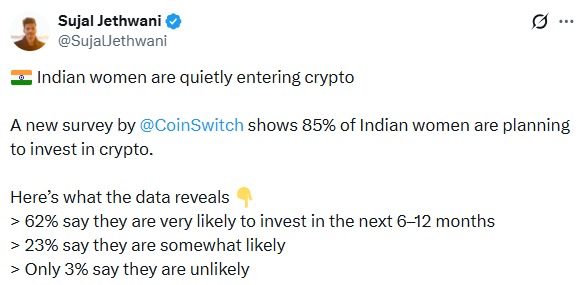
The CoinSwitch survey collected responses from 1,000 women from different parts of India. The results show strong interest in cryptocurrency as an investment option.
Source: X (formerly Twitter)
About 62% of respondents said they are very likely to invest in crypto within the next 6 to 12 months, while 23% said they are somewhat likely to invest. Only 3% of the women said they are unlikely to invest, which depicts that most respondents are open to exploring digital assets.
This growing interest suggests that the number of Indian female crypto investors could rise significantly in the coming months.
Women Aged 25–44 Leading the Trend
The survey also found that most female investors fall in the 25 to 44 age group. Woman aged 25–34 make up about 43% of respondents, while 28% belong to the 35–44 age group.
This means more than 70% of the participants are millennials or mid-career. Many of them are working professionals who are earning and looking for ways to grow their savings.
However, the trend is not limited to office workers. The survey shows that 28% of respondents are homemakers, making them the second-largest group among Indian female crypto investors, while 34% work in the private sector.
Careful Approach to Crypto Investments
Even though interest is rising, most Indian female investors are taking a careful approach to investing.
According to the survey, nearly 60% invest less than 5% of their monthly income in crypto. This shows that many female see digital assets mainly as a way to diversify their investments rather than rely on them completely.
Investment decisions are also becoming more independent. Around 57% of respondents said they make their crypto investment decisions on their own. About 18% rely on advice from friends or family, and 8% consult professional advisors before investing.
Bitcoin Remains the First Choice
When it comes to choosing cryptocurrencies, Bitcoin remains the most popular option.
The survey shows that 56% of respondents feel comfortable investing in Bitcoin, while 27% said they prefer altcoins.
Data from CoinDCX also shows,
That women investors often choose well-known cryptocurrencies like Bitcoin and Ethereum, along with other assets such as Polygon, Solana, XRP, Cardano, Dogecoin, and Avalanche.
On average, they hold around four cryptocurrencies in their portfolios, showing that many prefer spreading their investments instead of relying on just one asset.
Conclusion
The rise of shows how the digital currency space in India is gradually becoming more inclusive. Females from different age groups and backgrounds are starting to explore digital assets as part of their financial journey.
With better awareness, easier access to investment platforms, and growing financial education, the number is likely to grow further in the coming years.
