Florida’s Bold Leap: Stablecoin Regulation Bill Passes, Setting New State-Level Precedent

Florida just flipped the script on digital asset oversight. The state legislature greenlit a landmark bill that brings stablecoins—those crypto tokens pegged to traditional assets like the dollar—under a formal regulatory framework. This isn't just another piece of legislation; it's a direct challenge to the federal government's pace and a potential blueprint for other states.
The Sunshine State's Framework
Forget waiting on Washington. The bill establishes clear licensing requirements for issuers, demanding robust reserves and regular attestations. It aims to kill two birds with one stone: providing consumer protection that critics say is sorely lacking while creating a legitimate pathway for crypto businesses to operate. The message is clear—innovation can coexist with guardrails, even if you have to build them yourself.
A Nationwide Domino Effect?
Florida's move is a shot across the bow. It pressures other states to define their own rules and could force federal lawmakers to accelerate their own stalled efforts. The result? A potential patchwork of state regulations that, while messy, might actually get things moving faster than the glacial pace of congressional committees—committees that still can't agree if a 'stablecoin' is a security, a currency, or just something that makes their heads hurt.
What This Means for the Market
Expect volatility in the short term as the industry digests the new rules. Long-term, however, this is a net positive. Regulatory clarity, even at the state level, reduces existential risk for serious projects and could attract more institutional capital. It separates the wheat from the chaff, pushing out fly-by-night operators while giving compliant firms a huge marketing advantage. After all, nothing says 'trust us with your money' like a government stamp of approval—even if it's just from one state.
Florida's gamble proves that when the feds drag their feet, states will just write the rules themselves. It's a messy, decentralized approach to regulation that, ironically, feels perfectly on-brand for crypto. Wall Street might scoff at the inconsistency, but in the race for the future of finance, sometimes you have to build the track as you're running on it.
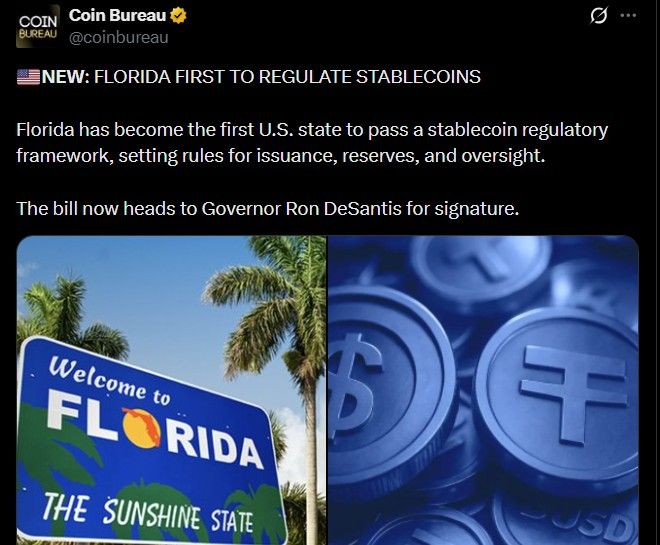
Source: X Official
Once signed, the legislation will allow regulated stablecoins to be used for payments, financial transfers, and selected yield-based services within a compliant structure. The framework could also enable peer-to-peer transactions and transfers between individuals and banking institutions.
Lawmakers and industry observers say that once the governor signs the measure, Florida may become the first regulatory testing ground for stablecoin policy in the United States, potentially influencing broader national crypto legislation.
Legislature Approval Completed, Governor's Signature Still Required
The Florida House and Senate have approved the stablecoin bill, but it needs the governor’s signature to become law.
After approval, digital dollar tokens could be used for payments, peer transfers, and interactions with financial institutions.
The proposed framework aims to define rules for payment tokens backed by reserves. Issuers will likely need to follow compliance standards designed to protect users and maintain financial stability.
Until the governor signs the legislation, however, the framework remains a policy proposal rather than an active regulatory structure.
Stablecoin Market Growth Shows Why Regulation Matters
The global stablecoin sector is currently valued at about $313 billion.
The sector has recorded around 0.89% growth in the past seven days, reflecting steady demand for dollar-pegged assets.
Within this market, USDT remains dominant with a roughly 58.76% share, highlighting the strong position of Tether in digital dollar liquidity. Circle’s USDC also continues to play a major role in institutional crypto payments and decentralized finance platforms.
If Florida’s framework becomes law, large issuers such as Tether and Circle could benefit from clearer operational guidance and stronger institutional confidence.
Meanwhile, smaller projects, including WLP and USAT, may gain opportunities to expand as emerging players within the regulated digital payment ecosystem.
Impact on the Broader Crypto Industry
Florida could become a regulatory experiment for blockchain-based payment systems.
Success at the state level may influence national digital asset policy.
A clear regulatory framework may encourage businesses and fintech companies to adopt blockchain payments. If stablecoins can operate under defined rules, companies may integrate them into payment gateways, cross-border transfers, and financial platforms.
Industry analysts believe this could strengthen the broader crypto ecosystem by improving regulatory clarity and attracting institutional participation.
Will the CLARITY Act Follow After This State-Level Test?
The CLARITY Act was initially expected to move forward in March.
The legislative timeline has now shifted toward mid-2026 after delays in congressional discussions.
Some experts believe that Florida’s approach may provide practical insights for federal policymakers evaluating nationwide crypto frameworks. A working state model could help regulators better understand risk management, compliance requirements, and consumer protections.
If lawmakers view the Florida system as effective, the federal CLARITY Act could gain stronger support later in 2026. However, nationwide implementation would still require further legislative review.
Conclusion:
Florida’s move toward Stablecoin regulation could reshape the digital payment landscape in the United States, offering a real-world test that may influence federal crypto policy and support the expanding $313 billion stablecoin economy.
