BlackRock Slams Gates on $26B Credit Fund as Panic Withdrawals Surge

When the tide goes out, you see who's been swimming naked—and who's just locked the pool gates.
BlackRock, the world's largest asset manager, just hit the emergency brake. Facing a tsunami of redemption requests from its massive $26 billion credit fund, the firm has imposed strict withdrawal limits. It's the institutional equivalent of a bank run, and the velvet rope is now up.
The Liquidity Mirage
These funds promise daily liquidity, but that promise hinges on a calm market. When too many investors head for the exit at once, the underlying assets—often complex, hard-to-sell securities—can't be offloaded fast enough to meet the cash demands. The fund's structure, designed for stability in normal times, becomes a trap door.
BlackRock's move isn't a failure; it's a feature. The gates are built into the fund's rules to prevent a fire sale that would torch value for everyone left inside. It's a brutal calculus: freeze some to save the whole.
A Signal Flare Over Traditional Finance
This isn't just about one fund. It's a stark demonstration of the inherent friction and fragility in traditional finance's plumbing. The system relies on trust and timing. When trust evaporates, the gates come down, and your capital is suddenly hostage to a queue—a poignant reminder that in TradFi, your money is often just an IOU with a fancy prospectus.
Contrast this with the transparent, on-demand settlement of a blockchain-based system. There are no hidden gates, no manager's discretion to halt transactions—just code-executed rules visible to all. While crypto markets have their own volatility, the settlement finality and 24/7 nature expose a different model entirely.
One cynical take? This is classic Wall Street alchemy: transforming 'liquid' assets into 'locked-up' capital faster than you can say 'management fee.' The fees, of course, continue to accrue.
BlackRock's gatekeeping move protects the fund's integrity but shreds the illusion of seamless liquidity. It's a powerful, real-time case study for why the search for uncensorable, programmable, and transparent financial infrastructure isn't just a crypto niche—it's becoming a glaring mainstream necessity. The old world is showing its seams. The new one is being built to have none.
BlackRock Limits Withdrawals After Surge in Investor Requests
The situation began when investors attempted to pull about $1.2 billion from BlackRock’s $26 billion HPS Corporate Lending Fund. This fund mainly invests in loans given to midsize companies.

Source: X (formerly Twitter)
However, the fund has a rule that only 5% of its assets can be withdrawn in a single quarter. Since requests reached about 9.3% of the fund’s total assets, the asset manager limits withdrawals and approved only about $620 million in payouts.
Because of this limit, nearly half of the investors who wanted their money back could not withdraw their full amount.
Funds like these are called “semi-liquid funds.” They invest in assets that cannot be sold quickly. When too many investors request cash at once, managers sometimes use a mechanism called a “gate.” This is exactly why BlackRock moved like that in this case.
Market Reaction and Stock Impact
The news quickly shook markets. Shares of BlackRock dropped sharply on March 6 and were among the worst performers in the S&P 500 that day.
The stock fell more than 7%, showing how sensitive investors are to liquidity concerns in the private credit market.
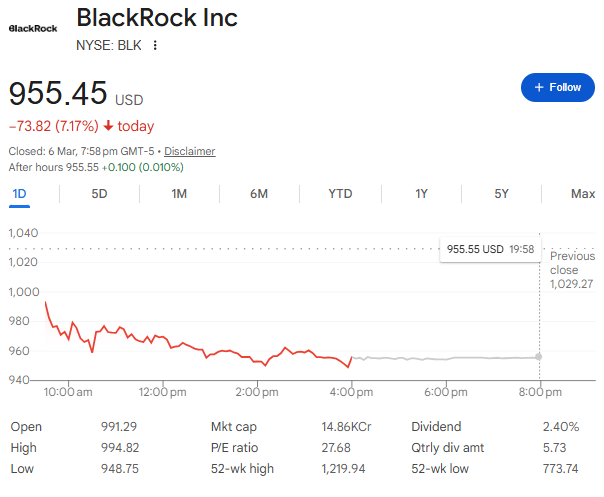
Source: Google Finance
At the same time, Blackstone faced its own pressure. Its flagship BCRED fund, which manages about $82 billion, also saw large redemption requests. Investors attempted to withdraw nearly $3.8 billion.
Blackstone responded by increasing its withdrawal limit and injecting around $400 million of its own capital to help meet investor requests.
Why BlackRock Limits Withdrawals Matters for Markets?
The private credit market has grown rapidly and is now estimated to be worth nearly $1.8 trillion. These funds provide loans to companies that may not receive financing from traditional banks.
However, experts say the sector is facing new risks. Concerns include rising bankruptcies, pressure from artificial intelligence disruptions in some industries, and higher interest rates.
According to Fitch Ratings, the default rate for privately monitored loans reached 9.2% in 2025. This is significantly higher than the 4.5% default rate in the broader syndicated loan market.
Because of these risks, more investors are requesting withdrawals. When too many investors want cash at the same time, managers may act quickly to protect the fund’s stability. That is another reason why BlackRock Limits Withdrawals became necessary.
Possible Ripple Effects in Crypto Markets
Some analysts say liquidity pressure in traditional finance can affect digital assets as well.
If people cannot access their capital in private funds, they may sell liquid assets such as Bitcoin or Ethereum to raise cash.
This creates a short-term liquidity squeeze in the broader financial system. At the same time, some crypto supporters argue that decentralized finance offers more transparent liquidity compared with centralized credit funds.
Conclusion
For now, BlackRock Limits Withdrawals appears to be a risk-management step rather than a full financial crisis. The firm emphasized that such limits are part of the normal structure of semi-liquid investment products.
Still, the event highlights growing stress inside the private credit sector. As the industry continues to expand, fund holders will likely watch liquidity conditions more closely in the months ahead.
