India’s Crypto Legal Limits Exposed: Court Refuses Forced Regulation in Landmark 2026 Decision

India's regulatory dance with cryptocurrency just hit a dramatic new beat. The nation's judiciary has drawn a hard line, refusing to mandate a comprehensive crypto framework—exposing the legal vacuum that leaves both investors and innovators navigating uncharted territory.
The Judicial Pushback
Forget about a quick regulatory fix. The court's stance underscores a fundamental principle: regulators can't be forced to act by judicial fiat. This hands-off approach throws the ball squarely back into the legislature's court, highlighting the complex, often glacial, pace of crafting digital asset laws. It's a stark reminder that in the race between technological innovation and bureaucratic process, the latter is still catching its breath.
Navigating the Gray Zone
This decision amplifies the existing ambiguity. Without clear rules of the road, the market operates in a persistent state of limbo—neither fully embraced nor outright banned. This gray zone creates a paradoxical environment where massive capital flows coexist with regulatory uncertainty, a classic case of market momentum outpacing policy deliberation. It's the financial equivalent of building a high-speed train while the tracks are still being debated.
The Global Context & Local Reality
While other major economies grapple with their own crypto frameworks, India's situation remains uniquely tense. The court's refusal to intervene means the sector's future hinges on political will and legislative priority, factors as predictable as the crypto markets themselves. For now, the industry is left to self-police, innovate, and hope its growth doesn't attract a heavier, more restrictive hand later—a familiar dance for any sector that moves faster than a government committee.
The verdict is clear: India's crypto journey will be dictated by policy, not courtroom mandates. Whether that leads to clarity or continued confusion is the billion-rupee question hanging over every exchange and wallet. One cynical take? It's just another day where decentralized dreams meet centralized delays—the oldest story in modern finance, just with a digital ledger.
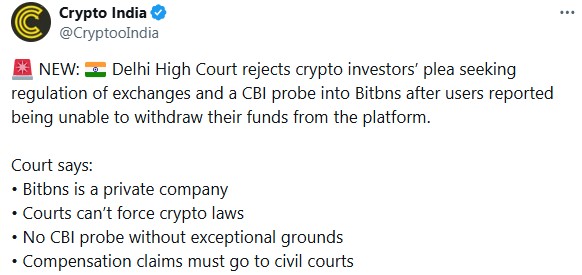
The ruling highlights a growing concern over India crypto framework among users: while crypto trading is legal in the country, investor protection remains thin, fragmented, and largely dependent on civil remedies.
What the Bitbns Case Is And Why the Court Rejects It
Bitbns, founded in 2018, is among India’s large digital asset exchanges, began facing backlash in late 2024 after suspending withdrawals, citing “technical issues” and past security incidents. Users allege that both INR and cryptocurrency withdrawals were frozen, suddenly imposed daily limits, and account balances appeared far lower.
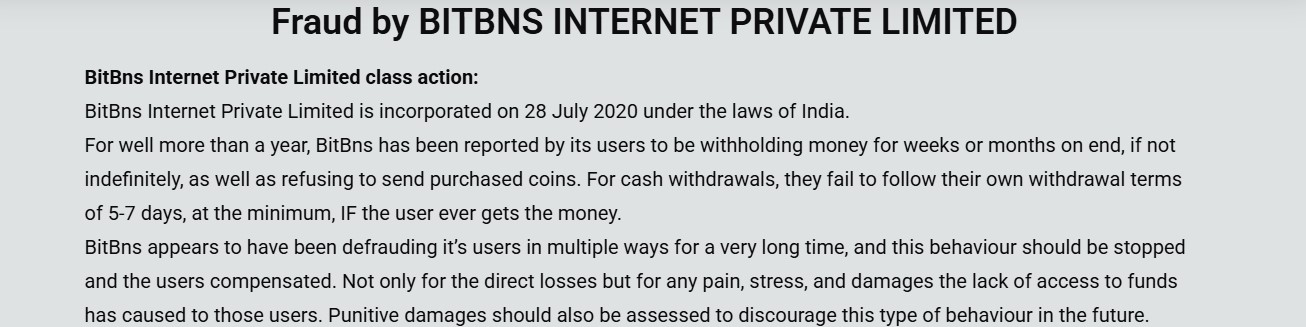
Some Investors claim that more than ₹1,000 crore worth of assets remain stuck on the platform, thus, they had asked the court to direct the government to regulate cryptocurrency exchanges and order a CBI probe into the matter.
India crypto regulation can’t be forced by judiciary: Court
In response, the Delhi High Court (HC) made it clear that Bitbns is a private company, not a state entity under Article 12 of the Constitution. As a result, courts cannot force the government to introduce cryptocurrency regulations or order a CBI investigation unless there are exceptional circumstances.
The HC also ruled that compensation claims must be pursued through civil courts, consumer forums, or other legal channels such as FIRs.
Importantly, there has been no official fraud conviction or criminal charge against Bitbns or its founders so far, despite widespread user complaints and loss of trust in the platform.
Courts Staying Defensive, Not Anti-Crypto
The recent ruling does not reflect hostility toward cryptocurrency itself. Indian courts have consistently separated policy-making from dispute resolution.
In the landmark 2020 case “Supreme Court vs Reserve Bank of India,” the Supreme Court struck down the RBI’s banking ban on cryptocurrencies, allowing the industry to operate again.
More recently, the Madras High Court recognized cryptocurrency as property in a 2025 case involving WazirX, strengthening investor ownership rights.
What courts have repeatedly refused to do is mandate new digital asset laws or treat exchanges as public authorities.
What This Means for Crypto Investors in India: Uncertainties and Hopes
This decision highlights a major gap in the India crypto ecosystem. While crypto trading and holding remain legal, there is no dedicated cryptocurrency regulating law offering direct protection to investors. Even after having the largest crypto-adopting population, digital assets in the country operate in a high-tax, low-protection environment. This could also force capital outside the country on regulated foreign platforms.
At the same time, on the positive side, the ruling may increase pressure on lawmakers to introduce clear crypto regulation, especially as global markets MOVE toward stronger investor protections, which could drain native liquidity into them.
This article is for informational purposes only and does not constitute legal or investment advice.
