Peter Schiff’s Stark Warning: Could a Trump Presidency Trigger a Bitcoin Crash?

Gold bug and crypto skeptic Peter Schiff lobs another grenade into the digital asset arena—this time with a political twist. His latest provocation ties Bitcoin's fate directly to the Oval Office.
The Warning Shot
Schiff's core argument hinges on a potential policy shift. He posits that a specific political administration could enact regulations or make statements that severely undermine market confidence. The fear isn't about technology failing, but about the old guard of finance finally flexing its regulatory muscle.
Market Psychology on Edge
It's a classic play on uncertainty. Cryptocurrency valuations are notoriously sensitive to sentiment and perceived regulatory risk. A single headline from a powerful figure can send algorithmic traders into a frenzy, creating a self-fulfilling prophecy of sell-offs—at least in the short term. It's the same volatility that makes fortunes and breaks them overnight.
The Decentralization Counter
Here's where Schiff's thesis meets its strongest rebuttal: Bitcoin's foundational ethos. Proponents argue that no single entity, not even a nation-state, can 'crash' a truly decentralized network. Price discovery might wobble, but the protocol soldiers on. The very thing critics call a bug—its detachment from traditional power centers—is hailed as the ultimate feature.
A Clash of Ideologies
This isn't just a market prediction; it's a battle of philosophies. On one side, the legacy system's gatekeeper warning of its own lingering power. On the other, a digital asset class built explicitly to bypass those very gatekeepers. Schiff bets on the enduring might of policy. Bitcoiners bet on the enduring might of code.
So, will a political figure truly dictate the fate of a trillion-dollar asset designed to be apolitical? Or is this just another chapter in the long-running—and frankly, quite profitable for pundits—saga of talking your book while the market does whatever it wants? Remember, in finance, a warning about a crash is often just a poorly disguised wish from those left behind on the last rally.
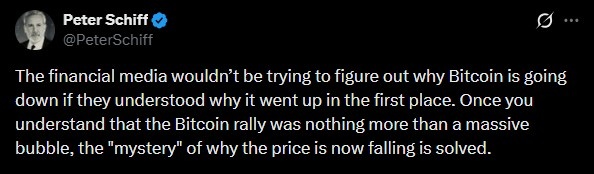
Source: X Official
Who Is Peter Schiff and Why His Views Matter
Peter Schiff is an American economist, investor, and financial commentator known for his long-standing criticism of digital currencies. He is also a fund manager and founder of an investment firm focused on global markets and precious metals.
He gained major attention after correctly warning about the 2008 financial crisis, which strengthened his reputation as a macro analyst. Over time, he became widely recognized as one of the strongest advocates for gold and a persistent critic of Bitcoin.
His commentary often appears in market discussions because he focuses on macro trends such as inflation, debt cycles, currency weakness, and monetary policy — all of which influence risk assets.
Schiff’s Core Argument: Trump Policy Crisis Could Hurt Bitcoin Demand
The recent Peter Schiff Statement also included a broader macro argument. He believes that during a major economic downturn, investors may shift toward traditional safe assets like gold instead of crypto, which could reduce Bitcoin demand.
He also clarified that his remarks linking Donald TRUMP to BTC risk were not about one individual directly destroying the asset. Instead, he was referring to government policy and macroeconomic conditions.
According to his view, the United States could face economic stress driven by:
Weak dollar
Rising national debt
Tariffs leading to higher borrowing costs
He argues that this environment may reduce investor risk appetite and redirect capital into gold rather than digital assets. He believes BTC does not function as a true safe-haven during severe crises.
Why Schiff Remains Negative on Bitcoin
Understanding his perspective is important when analyzing the Peter Schiff Statement. His criticism comes from a consistent belief framework:
Gold is real money
BTC lacks intrinsic value
Speculation drives price movements
A crisis could expose structural weakness
Because of this outlook, He tends to issue bearish forecasts regardless of short-term market rallies. His position is philosophical as well as economic.
How Practical His Warning Is and Potential Market Impact
Whether his prediction becomes reality depends on macro conditions. Historically, Bitcoin has behaved both as a risk asset and, at times, as a hedge narrative. Market reactions often depend on liquidity cycles rather than a single factor.
If his scenario proves correct, the impact could be significant across the broader crypto ecosystem. A deep decline could reduce liquidity, slow venture funding, weaken altcoin performance, and shift attention toward defensive assets. Institutional flows might pause while investors reassess risk exposure.
However, many analysts argue that adoption growth, ETF access, and infrastructure improvements create a different environment compared with past cycles.
Conclusion:
The latest Peter Schiff Statement highlights the ongoing debate about Bitcoin’s role during economic stress. While his bearish outlook reflects long-standing beliefs, actual outcomes depend on liquidity, policy direction, and adoption trends shaping the future digital asset landscape.
