InterLink Foundation Poised to Reshape Global Ecosystem Governance in 2026

Forget the old guard—InterLink just rewrote the rulebook.
Global governance isn't what it used to be. Centralized models creak under their own weight, while fragmented protocols fight for scraps. Enter the InterLink Foundation, launching a framework that doesn't just tweak the system—it aims to replace the foundation.
The Architecture of Autonomy
Their model cuts out the middleman. Think distributed proposal mechanisms, on-chain voting that actually scales, and treasury management that bypasses traditional gatekeepers. It's governance rebuilt from the ground up, using cryptographic guarantees instead of corporate bylaws.
Why This Hits Different
Timing is everything. As legacy institutions fumble with blockchain pilots, InterLink's launch targets the growing pain point of ecosystem coordination. It's a direct response to the governance fatigue setting in across major networks—a play for the next wave of adoption where community-led direction isn't a nice-to-have, it's the core product.
The foundation's bet is simple: the ecosystem that governs best, wins. And winning means attracting the developers, capital, and users currently trapped in slower, more politicized systems. It turns governance from a cost center into a competitive moat.
The Finance Skeptic's Take
Sure, the vision is slick. But let's be real—the crypto space is littered with 'foundations' that function more like tax-efficient marketing arms. The true test won't be the whitepaper, but what happens when real money and conflicting interests hit the voting dashboard. Will it handle a contentious fork when billions are on the line, or just become another theater for whale warfare?
InterLink promises a new era of collective steering. The market, perpetually skeptical of anything smelling like a committee, will decide if this is the real deal or just governance theater with a fresh coat of paint.
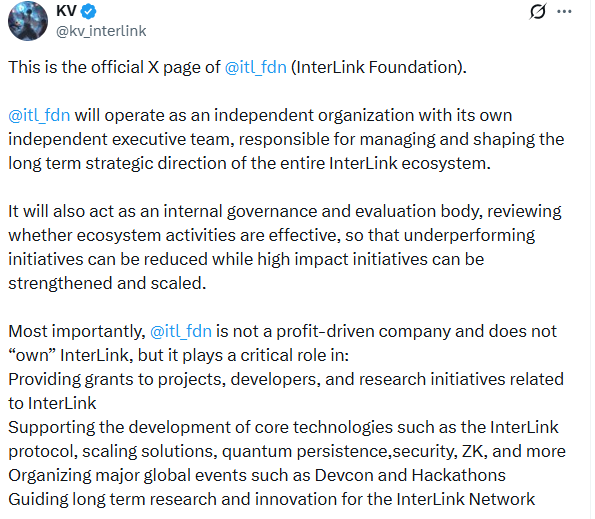
As a main part of the InterLink Foundation ecosystem, this group will check on all network activities. They will help boost high-impact projects and scale back those that do not perform well. This careful review helps keep the ecosystem strong and focused on what really matters to its users.
Strategic Growth Plans for the InterLink Foundation Ecosystem
The protocol's independent body ecosystem is now ready to support deep technical research and community growth. By moving to an independent model, it can focus on building a sustainable public good rather than just following short-term market trends.
Core Technical Goals and Global Events
The Foundation has several key duties to help the network succeed:
They provide funding to projects, developers, and researchers to build new tools.
They help develop Core tech like the InterLink protocol and scaling solutions.
Their research covers "quantum persistence" and ZK (Zero-Knowledge) tech to keep data safe.
The group organizes big events like Devcon and Hackathons to bring builders together.
They guide the future research and new ideas that keep the network moving forward.
Recent Growth and Human-Centric Design
In just nine months, the InterLink Network grew into a massive platform with reports indicate more than 5 million verified users. It currently supports 3 million daily active "Human Nodes" across 131 different countries. The protocol's independent body ecosystem uses "Proof of Personhood" (PoP) to make sure every user is a real human, not a bot. This trust system is the base for their 2026 expansion plans.
The ITLG Dual-Token Economy and Airdrop Mechanics
Central to the upcoming Q1 2026 launch is the sophisticated ITLG and ITL dual-token model. Unlike simple reward tokens, the InterLink economy utilizes a base rate halving mechanism to prevent supply dilution and reward long-term miners. The ITLG token serves as the genesis utility asset, with a total supply of 100 billion, while the ITL token acts as a reward LAYER for verified holders.
This "hold-to-earn" system is intended to convert short-term speculators into long-term infrastructure contributors. By requiring real-world identity verification via biometric face recognition, the network effectively eliminates bot-driven manipulation, ensuring that the 80% allocation of ITLG goes directly to genuine human nodes.
Expert Analysis: A Shift to Fair Governance
The launch of an independent foundation shows that InterLink is ready for the big stage. By separating the executive team from a profit-only mindset, The protocol's independent body ecosystem follows a path similar to other major crypto foundations.
As the network grows toward its goal of one billion users, the Foundation’s role in managing "Quantum Persistence" and ZK privacy will be key. Industry experts expect that this independent body will help the ITL token become a major treasury asset for global companies in 2026. The focus on real human identity may solve the bot problem that has hurt Web3 for years.
Cryptocurrency investments, especially in new ecosystems and presales, involve high market volatility and technical risk. The protocol's independent body ecosystem information is for journalistic purposes and does not constitute financial advice. Always perform your own research before committing capital to digital assets.
