ZeroHash Turbocharges Monad with USDC Integration - Crypto Payments Just Got Real

Another brick in the wall of traditional finance just crumbled. ZeroHash—the infrastructure giant powering crypto behind the scenes—just plugged USDC directly into the Monad blockchain. This isn't just another tech upgrade; it's a direct shot across the bow of legacy payment rails.
The Plumbing Gets an Upgrade
Forget slow settlements and intermediary fees. By embedding the world's leading dollar-pegged stablecoin into Monad's high-performance environment, ZeroHash effectively built a highway for instant, low-cost dollar transactions on-chain. Exchanges and fintech apps using their platform can now offer USDC payments and trading pairs without touching the clunky old system.
Why This Cuts Deep
It bypasses the need for traditional banking partners for dollar movement. Need to settle a cross-border trade in seconds, not days? Done. Want to pay a supplier without a 3% card fee? Sorted. This move turns abstract blockchain speed into tangible economic advantage—something Wall Street's legacy tech stacks can't replicate without a decade-long, billion-dollar overhaul.
The cynical take? The very banks that once dismissed crypto are now racing to build their own digital dollar projects, watching as infrastructure like this quietly eats their lunch. ZeroHash didn't just add a token; they switched on the ignition for a new payments engine. The race isn't about who has the most branches anymore—it's about who controls the fastest pipes.
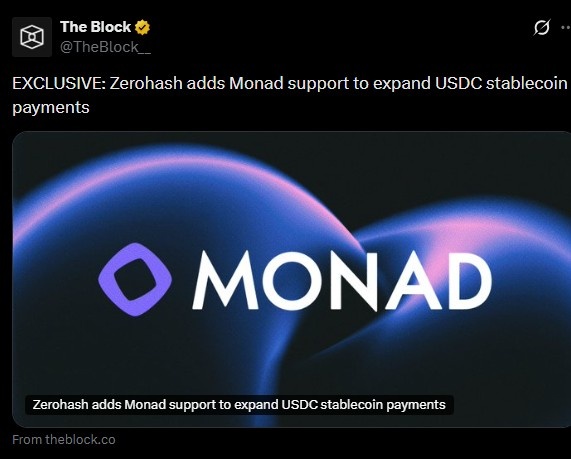
Official Update Signals Industry Momentum
ZeroHash has integrated USDC with Monad to support faster settlement.
The step focuses on improving access to stable digital transactions for enterprises.
This development reflects how infrastructure firms are pushing adoption forward as demand for reliable transaction rails continues to grow across global markets.
Understanding ZeroHash and Monad
ZeroHash plays a behind-the-scenes role in the financial ecosystem. It enables banks, fintech companies, brokerages, and digital platforms to move funds through blockchain technology without requiring each organization to build its own system. By offering ready-to-use tools, the firm makes transfers, settlements, and asset movement simpler.
Monad, on the other hand, is a Layer-1 network similar in purpose to ethereum or Solana but engineered for high throughput and lower costs. It supports smart contracts while focusing on faster execution, allowing developers to create scalable applications without sacrificing performance.
Together, their collaboration strengthens the foundation for stablecoin payment, USDC payment, and broader blockchain payments infrastructure, areas that analysts believe could define the next phase of financial innovation.
What the Integration Means for Businesses
Clients can launch stablecoin-based transaction flows without running nodes or obtaining separate regulatory approvals.
The design supports real-time funding, cross-border transfers, B2B settlement, and on-chain commerce.
ZeroHash’s partners, including prediction markets platform Kalshi, HR management provider Gusto, and trading app Public, can now develop payment experiences more efficiently. Removing technical and compliance hurdles allows companies to focus on product delivery rather than backend complexity.
From a market perspective, this type of setup may accelerate Crypto payments adoption by lowering entry barriers for institutions exploring digital settlement methods.
Leadership Views on Speed and Scalability
Raj Parekh, who leads stablecoins and payments at the Monad Foundation, described the network as both quick and reliable. He indicated that its architecture could help expand everyday usage of stable assets by offering near-instant transaction completion — a factor often seen as critical for mainstream acceptance.
Mark Daly, chief business officer at ZeroHash, noted that Ethereum still represents the largest portion of stablecoin activity on the firm’s platform. However, he highlighted rising engagement across alternative Layer-1 and Layer-2 environments as these assets gain traction in payment and settlement scenarios.
Daly also pointed out that Monad’s technical strengths may enable transactions to occur faster and at lower cost when handled at scale. Looking ahead, the company intends to introduce support for additional stable assets on the network once they become available, signaling continued investment in Crypto payments infrastructure.
Conclusion:
ZeroHash’s latest move highlights the steady evolution of Crypto payments as infrastructure becomes more advanced. By connecting USDC with Monad, the company is positioning institutions to access quicker, scalable settlement systems, reinforcing the growing importance of stable digital assets in global finance.
