SEC and CFTC Crypto Harmonization: Landmark Joint Event Set for January 27

Regulators finally share a table—and crypto markets hold their breath.
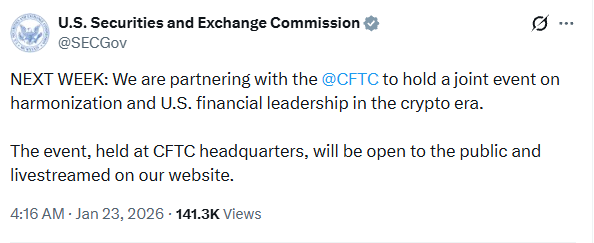
The long-awaited joint event between the U.S. Securities and Exchange Commission (SEC) and the Commodity Futures Trading Commission (CFTC) is locked in for January 27. This isn't another hearing; it's a coordinated push for regulatory clarity that could reshape the playing field.
The Harmony Play
For years, the SEC and CFTC have danced around digital assets—sometimes in step, often on each other's toes. The 'security vs. commodity' debate created a compliance maze that stifled innovation and fueled legal battles. This joint session signals a potential détente, a move toward a unified framework that the entire industry has been begging for.
Why January 27 Matters
The date itself is a statement. It's not tucked away in some bureaucratic calendar; it's a headline. Setting a public, collaborative event suggests the groundwork is already laid. The market is watching for concrete signals: Will there be a memorandum of understanding? A joint policy statement? The mere prospect of harmonized rules cuts through the uncertainty that has been crypto's biggest headwind.
Beyond the Beltway
This U.S. move doesn't happen in a vacuum. Global regulators from the UK's FCA to Singapore's MAS are racing to establish their own frameworks. A clear, coherent U.S. stance could finally provide the template others follow—or force them to play catch-up. For institutional capital sitting on the sidelines, this could be the all-clear signal they've been waiting for.
The Bottom Line
A unified regulatory front doesn't mean a free pass—it means known rules of the road. It exchanges wild-west ambiguity for structured growth. The January 27 event could mark the day the U.S. decided to build the on-ramp instead of just laying down spike strips. Just don't expect the agencies to agree on who pays for the coffee—some inter-agency habits die hard.
This rare "united front" directly aligns with President Donald Trump’s executive mandate to transform the United States into the undisputed crypto capital of the world. Led by SEC Chairman Paul S. Atkins and CFTC Chairman Michael S. Selig, the event marks a departure from the "regulation by enforcement" era that previously drove innovation offshore.
Breaking Down the SEC-CFTC Harmonization Event
The event, hosted at the CFTC headquarters in Washington, D.C., will be livestreamed globally. For market participants, the stakes couldn't be higher. Chairman Atkins and Chairman Selig are expected to address the "jurisdictional silos" that have forced companies like Coinbase and Ripple to navigate a legal maze for nearly a decade.
The discussion will be moderated by renowned crypto journalist Eleanor Terrett. According to internal agency briefs, the focus will be on creating a unified taxonomy an "innovation exemption" that allows startups to enter the market without the crushing weight of legacy securities laws.
The CLARITY Act: Why Timing is Everything
This joint announcement arrives at a critical juncture for the CLARITY Act (Digital Asset Market Clarity Act). While the House passed the bill with bipartisan support in 2025, the Senate has faced recent delays.
The Banking Committee Delay: Work has temporarily shifted toward housing policy, causing some industry anxiety.
The Agriculture Committee Push: Senate Republicans released a revised draft on Wednesday, aiming to finalise the SEC vs. CFTC boundaries.
Market Sentiment: Polymarket data shows a slight dip in trader confidence regarding the bill being signed in early 2026, making this joint agency event a vital signal of "de-facto" progress while Congress stalls.
Future Implications: Spot Markets, DeFi, and Stablecoins
Unlike previous roundtables, this event is expected to touch on the "realities of 24/7 trading." By harmonizing rules for DeFi, tokenized real-world assets (RWAs), and perpetual contracts, the agencies hope to lower compliance costs for institutional players. If the SEC and CFTC can successfully "marry" their oversight models, it WOULD provide the final leg of clarity needed for Wall Street banks to fully integrate digital assets into their brokerage accounts.
Expert Opinion: The Death of Regulatory Arbitrage
The "Project Crypto" initiative under Chairman Atkins is clearly about more than just cooperation; it’s about survival. In a global economy where Europe’s MiCA and Hong Kong’s stablecoin licenses are already operational, the U.S. cannot afford another year of internal bickering. By presenting a "united blueprint," Atkins and Selig are effectively bypassing legislative gridlock to provide immediate "Project Crypto" exemptions. This is "Algorithmic Governance" in action where the code of the law finally catches up to the code of the blockchain
