India’s Crypto Fraud Explodes: 773% Surge Marks 2026’s Cybercrime Peak

India's digital asset landscape faces a brutal reckoning as crypto-linked fraud skyrockets to unprecedented levels.
The Perfect Storm
Adoption surges meet regulatory gray zones—creating a playground for sophisticated scams. Fraudsters exploit fragmented oversight, targeting new investors flooding into the market.
Anatomy of a Heist
Phishing schemes drain wallets. Fake exchanges vanish with deposits. Rug pulls collapse 'projects' overnight. Each method leverages the same weakness: the frantic, often naive, rush for quick returns.
The 773% Wake-Up Call
That staggering spike isn't just a statistic—it's a direct correlation to mainstream attention without mainstream security literacy. As capital flows in, so do the predators.
The Regulatory Tightrope
Authorities scramble to respond. Heavy-handed bans risk stifling innovation, but a lax approach invites more carnage. The challenge: building guardrails without caging the entire ecosystem.
It's the oldest story in finance, just with a new, decentralized wrapper—where greed meets code, and code doesn't have a conscience.
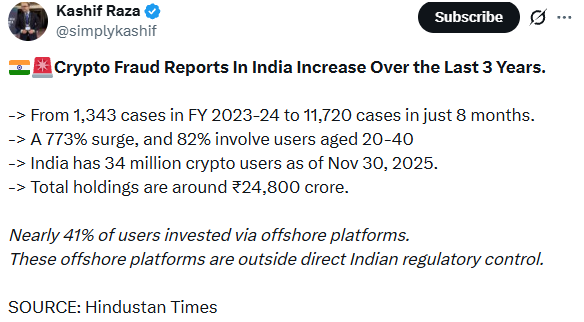
The numbers are genuinely scary. Just a couple of years ago, in 2024, there were about 1,300 reported cases of suspicious crypto activity. Fast forward to today, and that number has exploded to over 11,700 cases in just the first eight months of this fiscal year. That’s a 773% jump.
While there are 34 million Indians holding roughly ₹24,800 crore in digital assets, the scammers aren't going after the big whales they’re targeting regular people. In fact, 82% of all victims are young Indians between the ages of 20 and 40.
The ₹368-Crore "Freelance" Trap
If you think you're too smart to get scammed, look at what happened in Bengaluru’s tech hub, Bellandur. According to The Hindu, a 30-year-old developer (let’s call him "Kiran") was just looking for some extra freelance cash. Instead, he accidentally opened the door to a ₹368-crore heist.
It was a brilliant "long con". A fake recruiter named "Sarah Ferguson" contacted him on a professional networking site. For an entire year, they gave him real work and actually paid him ₹15 lakh to build total trust. Kiran had no reason to doubt it.
Then came the "sting". In July 2025, they sent him a file for a routine update. It looked like a dummy file, but the moment he opened it on his work laptop, it was game over. Because Kiran had admin access to his company’s servers, the hackers walked right into the treasury. Within a few hours, they siphoned off ₹368 crore in crypto and vanished.
The Cambodia Connection: Where the Money Goes
This isn't just a few local hackers. The government has traced a huge web of these scams back to Cambodia. International syndicates are using Cambodian phone numbers to run massive operations using Tether (USDT) which currently makes up 76% of all crypto fraud in India.
The money is often laundered through services like Huione Pay. These aren't just offices; they are essentially "scam factories" in Southeast Asia, often using forced labor to trick Indians into fake investment schemes.
Geographic Hotspots of Crypto Suspicious Activity
According to Hindustan Times Data
State | Percentage of Fraud Reports (STRs) |
Rajasthan | 18% |
Uttar Pradesh | 11% |
Maharashtra | 7% |
West Bengal | 7% |
Madhya Pradesh | 6% |
The Reality Check
The government is trying to fight back blocking websites and fining companies millions but the scale of the problem is massive. Since 41% of Indian investors use offshore platforms, they are basically invisible to local authorities until it's too late.
The Bottom Line:
Whether it’s a random job offer on Telegram or a "guaranteed" crypto tip, if it feels too good to be true, it’s probably a trap. In 2026, the scammers are professionals. If they can trick a Bengaluru techie into giving them the keys to a ₹368-crore vault, they can trick anyone.
