Hong Kong Crypto Firms Warn CARF Tax Rules Could Backfire — Here’s How

Hong Kong's crypto industry fires a warning shot: the global tax dragnet might just snag its own feet.
CARF's Compliance Conundrum
The Crypto-Asset Reporting Framework (CARF) promises transparency. It demands exchanges share user data across borders to stop tax evasion. The goal is clear: shine a light on the shadowy corners of digital finance. But Hong Kong's firms argue the plan has a critical flaw.
They see a system built for traditional finance, clumsily applied to a borderless, pseudonymous ecosystem. The compliance burden could crush smaller innovators, they warn. The very businesses driving the sector's growth might get regulated out of existence before they even start.
The Innovation Exodus
The real risk isn't just paperwork—it's capital flight. Stringent, ill-fitting rules could trigger a mass migration of talent and liquidity to more lenient jurisdictions. Singapore, Dubai, and even emerging European hubs are waiting in the wings. Hong Kong's hard-won status as a crypto gateway could evaporate overnight.
It’s the classic regulatory paradox: clamp down too hard, and the activity you want to monitor simply moves somewhere you can't see it. A global framework only works if everyone plays ball; if key nodes opt out, the entire network frays.
The result? A backfire of epic proportions. Instead of a transparent, compliant industry, regulators might get a hollowed-out shell and a thriving black market next door—proving once again that heavy-handed finance rules often do little more than shift problems to a new zip code.
Hong Kong Weighs CARF as Industry Seeks Smoother Implementation
In a detailed submission sent this week to the Financial Services and the Treasury Bureau, the Hong Kong Securities & Futures Professionals Association urged authorities to refine how the rules are rolled out.
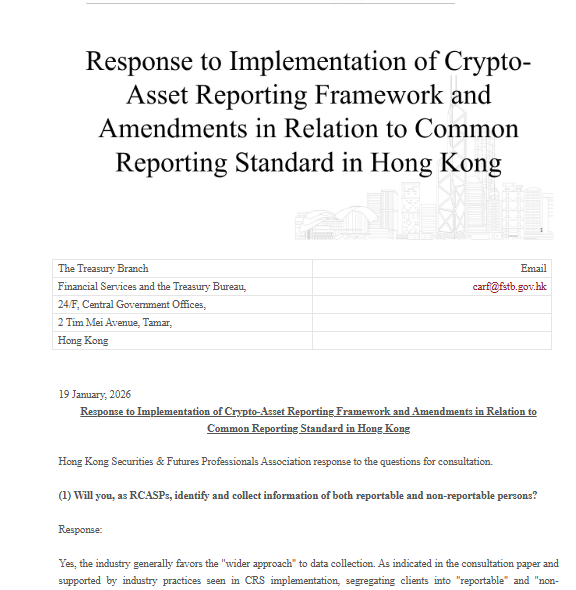
While the group said it broadly supports the goal of tax transparency, several elements of the proposed regime could expose local crypto firms to operational strain, legal uncertainty, and disproportionate penalties.
The association represents professionals working across securities, futures, and virtual asset markets and framed its comments as an effort to ensure Hong Kong remains competitive as a financial hub while meeting international obligations.
CARF is designed to close gaps left by existing tax reporting systems by capturing crypto-specific activity that falls outside traditional financial accounts.
Under CARF, crypto-asset service providers WOULD be required to collect and report detailed information on users and transactions, which would then be shared automatically with other participating jurisdictions.
 Hong Kong is set to implement the Crypto Asset Reporting Framework by 2026, enhancing tax transparency and tackling cross-border tax evasion in the crypto space!#Crypto #Taxhttps://t.co/MU2Cg6ac0D
Hong Kong is among 76 markets that have committed to the framework and is part of the first group of 27 jurisdictions expected to begin exchanging data by 2028.
The government plans to complete legislative amendments in 2026, following a public consultation that began late last year.
Progress Welcomed, but Data Rules Raise Red Flags
Industry participants say the direction of travel is clear, but the details matter.
One major concern is data collection, as the association said most firms favor a “wider approach,” collecting information on both reportable and non-reportable clients upfront.
However, it warned that without explicit legal protection, firms could face conflicts with Hong Kong’s personal data privacy rules for holding information on clients who are not yet reportable.
Record-keeping requirements are another pressure point. While the industry accepts a six-year retention period in line with existing tax rules, it raised alarms about proposals that could hold directors or senior officers personally responsible for maintaining records after a company is dissolved.
It argued that former officers may lack the legal authority or infrastructure to securely store sensitive client data once an entity no longer exists.
Firms Push Back on CARF Fines and Tight Reporting Deadlines
Penalties under CARF and the amended CRS also drew scrutiny.
While the industry supports the introduction of administrative penalties as an alternative to criminal prosecution, it warned that fines calculated on a “per account” basis could spiral into massive liabilities for firms hit by technical or software errors affecting thousands of users.
The association called for reasonable caps for unintentional breaches and a graduated approach that distinguishes between administrative mistakes and deliberate non-compliance.
Operationally, firms welcomed plans for electronic filing but said reliance on manual XML uploads could introduce avoidable risks.
Large institutions, in particular, are pushing for direct API connections to allow automated reporting.
They also warned that the proposed five-month filing deadline after year-end could be tight in the early years and suggested grace periods as systems are tested and refined.
