Teachers Unions Sound Alarm: Crypto Bill Puts Retirement Security at Risk

Teachers unions are raising red flags over new legislation that could open the floodgates for cryptocurrency investments in retirement portfolios. The bill, quietly gaining traction, would allow 401(k) plans to allocate funds into digital assets—a move critics call a dangerous gamble with educators' nest eggs.
The Core Conflict: Innovation vs. Protection
Proponents argue the bill modernizes retirement options, letting individuals tap into crypto's growth potential. Opponents fire back—they see volatile, unregulated assets threatening decades of pension stability. Unions point to crypto's infamous boom-bust cycles, questioning whether retirement accounts should double as speculative trading platforms.
Regulatory Gray Zones Amplify Concerns
The legislation bypasses traditional safeguards. Unlike stocks or bonds, cryptocurrencies lack standardized disclosure requirements or federal insurance protections. A sudden market crash wouldn't trigger the same safety nets that shield conventional retirement funds. One union representative called it "letting Wall Street's wildest experiment into the teachers' lounge."
A Cynical Take on Financial 'Progress'
Here's the finance jab: since when did securing a stable retirement require betting on internet tokens that swing 20% before lunch? The push feels less about empowering teachers and more about creating a captive, institutional-sized liquidity pool for an asset class hungry for legitimacy.
The bill forces a fundamental question: is expanding 'choice' worth the risk when the stakes are lifelong financial security? Teachers' unions are betting the answer is no—and digging in for a fight that could define retirement investing for the digital age.

The American Federation of Teachers (AFT) and the AFL-CIO have both warned lawmakers that the proposed legislation could expose worker pensions to dangerous levels of risk.
The unions represent millions of educators, healthcare workers, and public service employees across the United States. Their opposition centers on the Responsible Financial Innovation Act, which is currently making its way through Congress.
Union Leaders Warn of “Profound Risks”
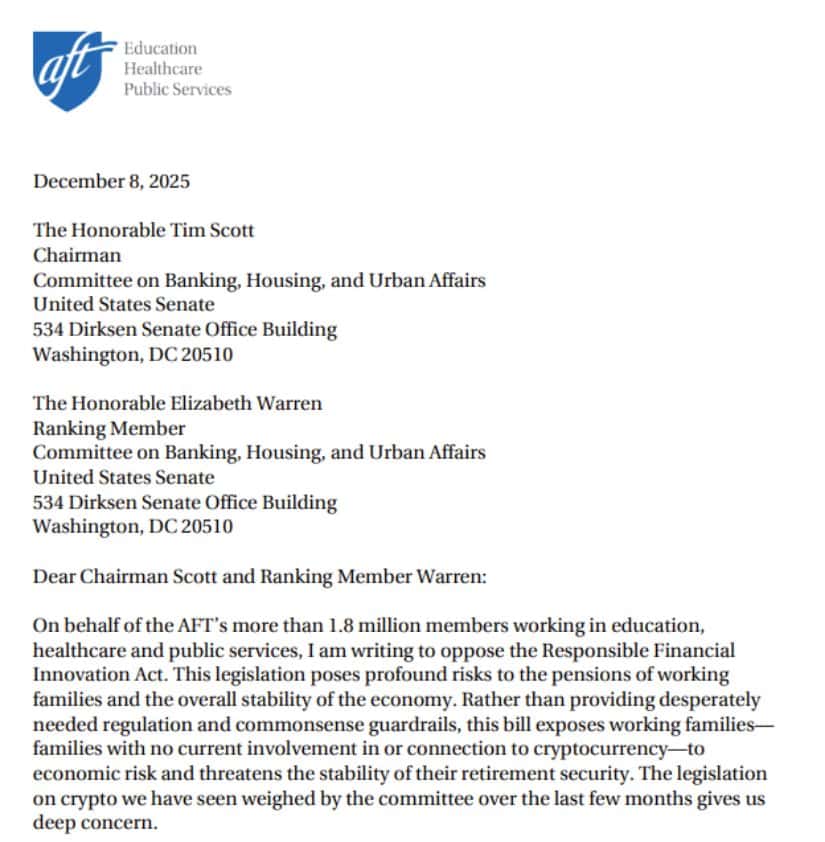
AFT President Randi Weingarten sent a strongly worded letter to Senate Banking Committee leaders in early December 2025. She warned that the bill poses “profound risks to the pensions of working families and the overall stability of the economy.”
The union argues that the legislation would expose workers who have no connection to cryptocurrency to financial dangers. These workers could see their retirement savings threatened by weakened safeguards that currently protect pension funds from fraud and volatile assets.
“Rather than just being silent on crypto, this bill strips the few safeguards that exist for crypto and erodes many protections for traditional securities,” Weingarten wrote in the letter to Senate leaders.
Source: CNBC
The AFT represents 1.8 million members, including teachers, school staff, nurses, and other public sector workers. Many of these employees depend on pension plans for their retirement security.
The Tokenization Threat
One of the biggest concerns raised by unions involves a practice called tokenization. The proposed bill WOULD allow regular companies to put their stock on blockchain technology. This could let them avoid many rules that currently protect investors.
According to union leaders, this creates a dangerous loophole. Companies could create digital versions of their stock that trade outside normal regulatory oversight. These tokenized securities might then end up in pension funds and 401(k) plans without proper protections.
“This loophole and the erosion of traditional securities law will have disastrous consequences: Pensions and 401(k) plans will end up having unsafe assets even if they were invested in traditional securities,” Weingarten explained.
The AFL-CIO also opposed the legislation in October 2025. As the nation’s largest labor union federation, the AFL-CIO warned that the bill would create “shadow public stock” markets outside Securities and Exchange Commission oversight.
Current Pension Fund Crypto Exposure
Public pension funds currently have very limited exposure to cryptocurrency. These investments make up only about 0.1% of total pension assets, according to recent data. However, this small percentage still represents significant dollar amounts given the massive size of pension funds.
The National Association of State Retirement Administrators reports that public pension assets, including teacher funds, totaled over $6.5 trillion in the second quarter of 2025.
Some state pension funds have begun experimenting with crypto investments. Michigan’s pension fund tripled its Bitcoin investment to $11 million in 2025. Wisconsin initially bought over $150 million in Bitcoin exchange-traded funds but later sold its holdings.
Over 20 states introduced legislation in 2024 and 2025 that would allow pension funds to invest in digital assets. These bills typically cap crypto investments at 5% to 10% of total portfolio value.
Trump Administration’s Crypto Push
The debate over crypto in retirement funds has gained attention under the current administration. Reports indicate that TRUMP has directed the Labor Department to reevaluate restrictions around alternative assets in defined-contribution plans, including digital assets.
This policy direction could affect the massive U.S. retirement system. Americans currently hold $8.9 trillion in 401(k) plans across more than 715,000 workplace programs.
The proposed changes would allow plan administrators to offer digital assets like Bitcoin and ethereum alongside traditional stock and bond mutual funds. However, critics worry that everyday investors don’t fully understand the risks of these volatile assets.
Legislative Timeline and Opposition
The Responsible Financial Innovation Act is currently being negotiated in the Senate Banking Committee. Senator Cynthia Lummis announced in December 2025 that she hopes to advance the bill to a markup hearing before the holiday recess.
The legislation builds on a similar bill that passed the House of Representatives in July 2025. However, progress has been slow due to disagreements over how to regulate decentralized finance and other technical issues.
Union opposition has grown as the bill moves closer to a potential vote. The AFL-CIO warned that banks engaging in crypto activities under the proposed framework could be “even riskier than some of the dangerous financial activities conducted before the 2008 financial crisis.”
Government watchdogs have also raised concerns. A December 2024 report from the Government Accountability Office found that bitcoin was four times more volatile than the S&P 500 stock index, even though it was the most stable cryptocurrency available to retirement plans.
The Department of Labor continues to urge “extreme care” when considering crypto investments due to their high risk levels.
Bottom Line: A Battle Over Retirement Security
The fight over cryptocurrency in retirement plans reflects a broader debate about innovation versus safety in financial markets. Unions argue that public employee pensions should prioritize security over potential gains from risky investments.
“State pension funds are not venture capital,” said Brady Williams, legal counsel for the advocacy group Better Markets. “These are long-term, risk-averse portfolios meant to provide a secure, stable retirement for teachers, firefighters, nurses, and countless other public servants.”
As Congress continues to debate the legislation, millions of public workers are watching to see whether their retirement security will be affected by the growing push to mainstream cryptocurrency investments.
