Solana Poised to Become World’s Most Decentralized Blockchain, Fund CEO Declares

Move over Ethereum—Solana's gunning for the decentralization crown. The high-speed blockchain just got a massive vote of confidence from a top fund CEO who claims it's on track to become the most distributed network in crypto.
The Scaling Revolution
Solana's been eating Ethereum's lunch on transaction speed for years, but now it's targeting decentralization—the holy grail of blockchain purists. The network's validator count keeps exploding while transaction costs stay laughably low compared to legacy chains.
Wall Street Meets Crypto
When fund managers start throwing weight behind decentralization narratives, you know we've entered a new phase of institutional adoption. They're not just betting on price anymore—they're betting on network integrity. Though let's be real—they'll still cash out at the first sign of trouble.
The Final Frontier
True decentralization isn't just about node count—it's about geographic distribution, client diversity, and resistance to censorship. Solana's making strides on all fronts while maintaining blistering performance. If they pull this off, we might finally see a blockchain that's both fast and truly decentralized—something the crypto space has been chasing since the beginning.
Solana Destined For Decentralization Leadership?
Bons’s core claim rests on an explicitly economic model of security and governance. If useful blockspace generates fees and those fees fund validator economics, the network can support a broader, healthier operator set. In his telling, solana is already on this trajectory, while Ethereum’s rollup-centric approach externalizes activity—and the fees that come with it—away from the base layer. “Fees are what will ultimately pay for the majority of security, scarcity & decentralization,” he asserts, positioning Solana’s aggressive L1 scaling as the path that sustains those flows on-chain rather than exporting them.
From there, Bons turns to the scoreboard he thinks matters. He juxtaposes the two networks’ Nakamoto Coefficients, claiming “ETH’s Nakamoto Coefficient is 2! SOL’s Nakamoto Coefficient is 19!”—a comparison designed to dramatize where, in his view, Ethereum’s staking market structure has drifted. He attributes the gap to Ethereum’s “decision not to implement native delegation,” which he says allowed one liquid-staking provider to “dominate staking instead.”
In governance terms, he draws the starkest possible contrast: “ETH has centralized governance! SOL has decentralized governance!” The rhetoric is intentionally provocative, but it is consistent with his broader thesis that decentralization is not purely a hardware or validator-count contest; it is an emergent property of fee-funded security, stake dispersion and stakeholder power.
A centerpiece of Bons’s argument is what he calls the “security budget.” He models it as a function of market capitalization, fee revenue and inflation, adjusted by staking participation and the attack threshold. By his math, Ethereum’s security budget stands at roughly $50.5 billion while Solana’s is about $25.3 billion, leading to his headline conclusion that “SOL price only needs to double to surpass ETH’s security budget.” The point is less the exact number than the direction: he believes Solana’s higher staking participation and L1-retained fees make it the more efficient security engine per dollar of market cap—hence his contention that Solana can overtake Ethereum’s security footing even at a smaller valuation.
That economic engine, in Bons’s view, is inseparable from Solana’s scaling strategy. He argues that the “ideal blockchain design” must balance node requirements with utility, because at sufficient scale utility produces the fee flows that, in turn, finance broader validator participation and stronger censorship resistance. Designs that fetishize ultra-low node requirements, he says, misread the problem: “The ‘ETH perspective’ represents an overly simplistic understanding of decentralization, where they think low node requirements = decentralization.” By contrast, he frames Solana’s path as the “middle way”—accepting higher node requirements to capture the utility-driven fees that then reinforce security and decentralization.
Solana Vs. Ethereum
Bons also devotes substantial attention to what he sees as Ethereum’s structural disadvantages. Because Ethereum “is not scaling its L1 meaningfully at all,” he contends, the network lets Layer-2s “take the majority of fees,” weakening the base layer’s security budget and ceding decentralization headroom in the long run. That design choice, he suggests, also shapes governance: by rejecting on-chain stakeholder governance at L1, Ethereum centralizes effective decision-making socially, whereas Solana—imperfect as it is—has “established” an on-chain governance social contract that can evolve alongside validator economics. “Is SOL perfect? Absolutely not,” he concedes, “however, it is still significantly better than ETH in the long run in every single way, including decentralization & utility!”
To underscore the primacy of scale in this framework, Bons reprises a refrain that has run through his research for years: “A blockchain that does not scale is a failure.” The line captures both his investment lens and the causal loop at the heart of his argument: throughput → usage → fees → validator P&L → stake dispersion → censorship resistance. If that loop compounds on L1, he says, Solana’s decentralization will outstrip Ethereum’s.
Bons’s quantitative comparisons extend beyond abstract models. He asserts that headline Ethereum validator counts are often misunderstood, because some advocates conflate 32-ETH validator keys with the number of “physical machines involved in block production.” He prefers to compare operator-level footprints and “real” validator infrastructure; under that lens he cites figures of “ETH has 8.8k validators” and “SOL has 1.1k validators,” noting that Ethereum’s advantage on this metric coexists with a market capitalization that is roughly five times larger. His takeaway is that raw validator counts, stripped of operator aggregation and economics, can be a misleading proxy for decentralization.
The thread culminates in a forward-looking claim: as Solana’s fee-funded security and governance mature, “SOL will eventually overtake ETH in all decentralization metrics.” He presents this as a consequence of divergent roadmaps rather than a culture war. With L1 scaling and fee capture, Solana can “flip” the composition of its security budget away from inflation and toward revenue, while Ethereum’s L2-heavy design leaves the base LAYER relatively underfunded by fees. In his words, “when the security budget finally flips, all non-scalable chains will have no legs left to stand on.”
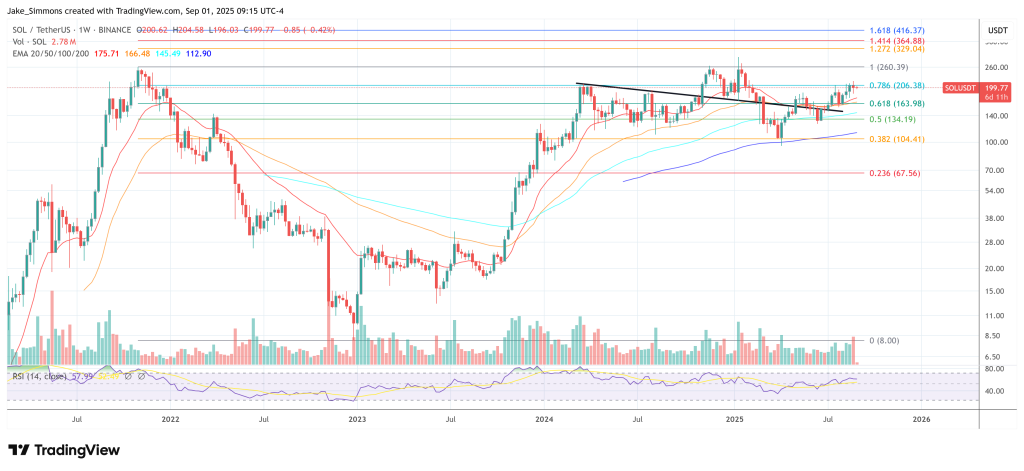
At press time, SOL traded at $199.